One evening Friday and I sat on the hill and looked at the sea. It was a very clear day, and the sky was a deep blue. “Master,” said Friday, “look!” He pointed to the west. Far away there was a dark line on the water. “That is my country,” he said, and his eyes were bright with tears. “Friday’s people live there. Friday go home?”
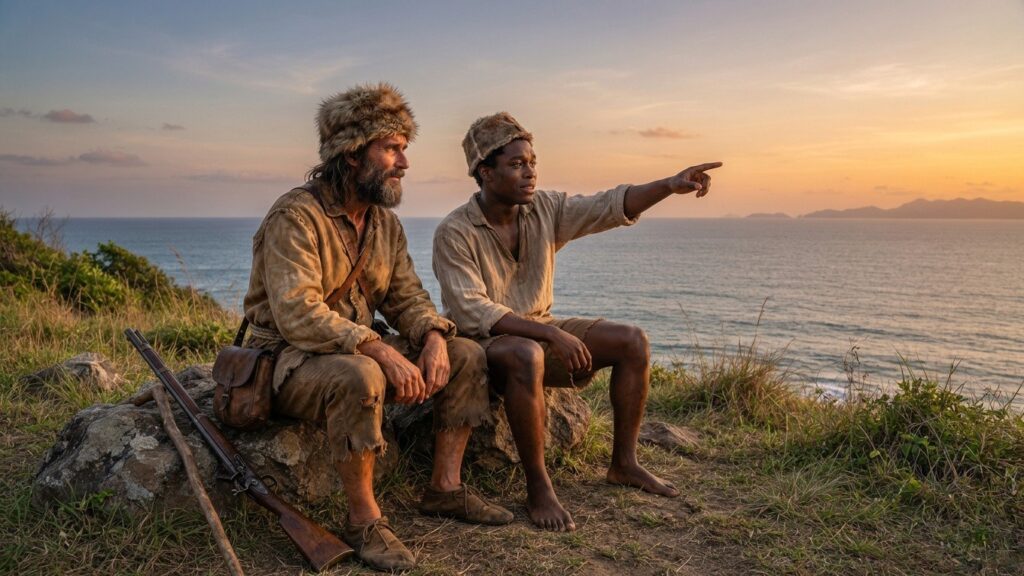
My heart went cold. “Do you want to leave me?” I asked. Friday looked at me and shook his head. “No, Master. Friday no leave Master. But Friday’s people… they not know you. They not know God. Friday want to tell them.” I understood. He loved his people, and he wanted to share the good things that he had learned.
I felt ashamed of my fear. I put my hand on his shoulder. The next day I wanted to test him, so I showed him the small canoe and said, “Friday, if you want to go home, you can go. I will not stop you.” He looked at me with big, sad eyes, and tears ran down his face. “Why you send Friday away?” he asked. “Friday no go without Master.” I understood that he was not only my servant. He was my friend, and he would stay with me.
After that we talked about the mainland on many evenings. Friday told me about his family, about a wide river, a hot sun and a green forest. And one evening he said something that made my heart jump. “Master,” he said, “there are white men in my country. Seventeen men, in a village with my people. They came in a big ship, and the ship was broken on the rocks. They live with us, and we are friends.” They were Europeans, of course! Spanish or Portuguese, perhaps.
That night I could not sleep. I asked Friday a hundred questions. How many days by canoe? Which way? Were the white men kind? What language did they speak? He answered slowly, with his hands and his few English words. I did not understand everything, but my heart was beating like a drum. For twenty-five years the sea had been a wall around me. Now, for the first time, I saw a door in it.
For years I had dreamed of leaving the island. Now I had a new hope. If white men lived on the mainland, perhaps I could meet them. Perhaps they had a ship, or perhaps we could build one together, and sail to a country where I could find my way home. “Friday,” I said, “we must build a boat. A big, strong boat, strong enough for the sea.”
I remembered my great canoe, lying uselessly on the hill, and I told myself that I was now older and wiser. “This time,” I told Friday, “we will do it properly. We will build the boat close to the water, so we can push it into the sea.” Friday laughed. “Yes, Master. Friday help.”
We made a plan in the sand. Friday took a stick and drew the island, the sea and the coast on the other side. He drew his river, his village and the place where the white men lived. I looked at the lines in the sand for a long time. The world, which had been so small for so many years, was suddenly big again. “Here,” said Friday, pointing, “we go. Here, my people. Here, white men.”
We looked for a good tree near the beach. Friday was clever with his hands. He showed me how to burn the inside of the trunk, and how to cut it with a stone and with my axe. It was hard work, but it was not boring, because we were together. We worked every day from the morning until the afternoon, and every evening we talked and laughed. After some weeks the boat was ready. It was long and strong, and it was lying on the sand, only a few steps from the water.
While we worked, Friday sang. He sang songs in his own language, with a slow, strong rhythm, and the axe came down on the beat of the song. I did not understand the words, but I understood the happiness. After some days I began to sing with him, and my voice was terrible, and he laughed so much that he had to stop work. It was the first time in my life that I had worked and sung with a friend.
We put round pieces of wood under it, and we pushed. Slowly, it began to move. Then it touched the water and floated. We both shouted with joy. I made a mast and a sail, and Friday helped me to test them. “Now we have a boat,” I said. “And this time it will carry us across the sea.”
That evening we sat on the sand next to the boat and shared a loaf of bread. The sun went down over the sea, and the water was soft and red. Friday looked at the sea for a long time, and I looked at it, too, and noticed something strange. I was not afraid of it any more. For twenty years I had hated the sea, and now I looked at it like a road.
Words from this chapter
- tears – noun the drops of water that come from your eyes
- mainland – noun the large piece of land near an island
- Europeans – noun people from Europe
- properly – adverb in the right way
- uselessly – adverb without being of any use
- clever – adjective quick to learn and understand
- burn – verb to destroy something with fire
- mast – noun the tall pole that holds a sail
- clear – adjective easy to see through; easy to understand
- deep – adjective going a long way down
- master – noun the man in charge; the owner
- pointed – verb showed with a finger
- bright – adjective full of light; shining
- heart – noun the part of your body that moves blood
- share – verb to give part of what you have
- ashamed – adjective feeling bad about something you did
- fear – noun the feeling of being afraid
- shoulder – noun the top of your arm
- canoe – noun a long, narrow boat moved with paddles
- servant – noun a person who works for another person
- forest – noun a large area with many trees
- spanish – adjective from Spain
- language – noun the words people speak, like English
- beating – verb (a heart) moving fast
- drum – noun a round music instrument you hit
- wiser – adjective knowing more about life
- rhythm – noun a regular beat in music
- happiness – noun the feeling of being happy
- shared – verb gave part of what they had
- hated – verb did not like at all
Check your understanding
What did Friday say about his people?
What was Robinson's new hope?
How did the new boat differ from the first canoe?
Reading is great. Speaking is better.
Talk about the story with a real teacher. Your first 25-minute lesson is free.
Book a free trial lessonFind your English level