Now I had grain, but I had a new problem. How can you make bread without tools? I had no mill to make flour, and I had no oven to bake it. I also needed pots to keep my grain and my water. Until now I used the things from the ship, but they were not enough. “I must learn to make everything myself,” I said. “I will begin with pots.”
I thought about all the work behind one loaf of bread. Somebody must plough the field and sow the seed. Somebody must wait for the rain and cut the plants. Somebody must take the grain out of the ears, make flour, make the dough and bake it. In England I never thought about it. A baker did everything, and I only paid a few coins. Now I understood. A piece of bread is a small miracle of many hands, and on the island I only had two.
I knew that pots were made of clay, so I looked for it. After a few days I found some good red clay in the hills. I carried it home in a basket, and I started to work. I made a pot with my hands, and I put it in the sun to dry. But when it was dry, it was so weak that it broke into pieces when I touched it! I made another one, and another. They all broke. Sometimes the sun was too hot, and the clay cracked. Sometimes the pot was too heavy and it fell down. I tried again and again for many weeks. I was angry, and I was ready to give up.
My first pots were very ugly. One was like a bag, one was like an old hat, and one looked like a sleeping animal. I put them in a row, and I laughed. Poll looked at them and said nothing, and I think that was the kindest thing he could say. But I did not stop. Each new pot was a little better than the last one, and every morning I looked at them with hope.
Then I had a lucky idea. One evening I made a big fire, and I put some of the pots next to it, and the next morning I found something strange in the ashes. The pots did not break! They were hard and red, like a roof tile. “That is the secret,” I said. “Clay needs fire.” After that, I built a hot fire around my pots, and I kept it burning for hours. At last I had pots that could hold water and grain. I also made a few plates and a large jar. They were not beautiful, but they were mine, and I loved them.
When I opened the fire the next morning, I took the first pot in my hands. It was still warm. I hit it softly with my knuckle, and it made a clear sound, like a small bell. I filled it with water and waited. Not one drop came out! I jumped up and danced around the fire like a boy. The dog barked, Poll shouted, and for one wonderful moment the island was full of music.
Next I needed to make flour. I cut the trunk of a hard tree, and I made a hole in it. I used a heavy stick to push the grain in the hole. It was slow, tiring work, but it made fine flour. For a sieve, I used some old cloth from the sailors’ clothes. It was not perfect, but it was good enough.
In the evening my arms hurt so much that I could not lift my cup. My back was sore, and there was white dust in my hair and my beard. But in my jar there was a small pile of fine flour, and every day it became a little bigger. I looked at it with pride. A rich man in England counts his money. I counted my flour, and I thought that I was richer than he was.
At last I was ready to bake. I did not have an oven, so I thought of a plan. I made a fire on a flat stone, and when the stone was very hot, I took the fire away. I put my bread on the hot stone and covered it with a clay pot. Then I put some burning wood around the pot to keep it hot.
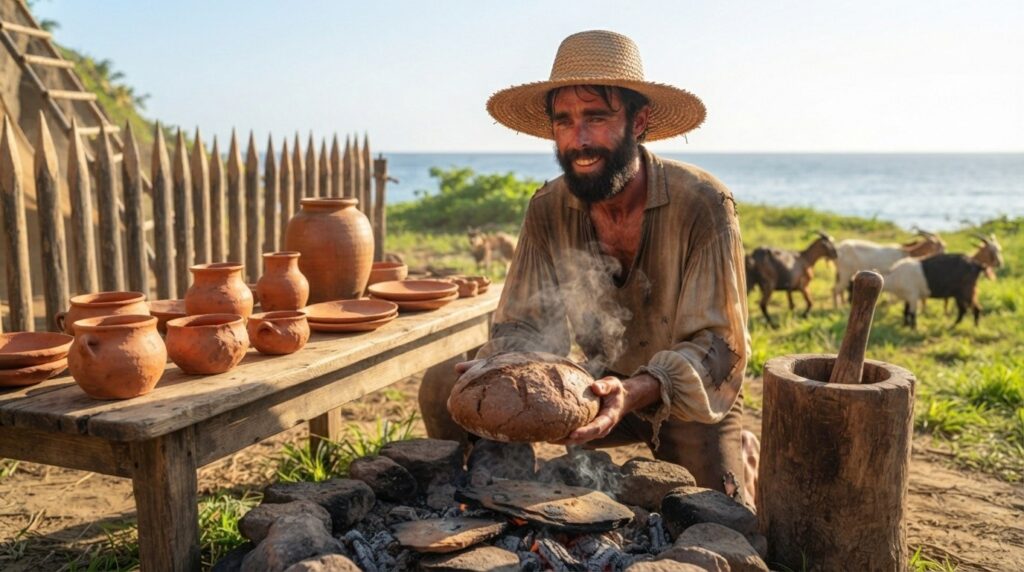
My first loaves were very bad. The first was black like coal on the outside and raw inside. The second was hard like a stone, and when I gave a piece to the dog, he sniffed it and walked away. I was angry, but I learned something. The fire must not be too hot, and I must watch the stone carefully. On the fifth day I made a loaf that was brown and soft. “That is better,” I said. “That is much better.”
When I took the pot away, I saw a small, golden loaf. I smelled it, and my mouth was full of water. I ate it slowly, with a little cheese. It was the best bread in the world, and I was happy for a long time. I had no baker to thank, only myself.
Words from this chapter
- mill – noun a machine that makes grain into flour
- flour – noun the white powder that bread is made from
- clay – noun soft wet earth that becomes hard when it is dry or hot
- cracked – verb broke with a line on the surface
- ashes – noun the grey powder that is left after a fire
- tile – noun a flat piece of baked clay used on roofs
- sieve – noun a tool for separating fine powder from bigger pieces
- loaf – noun bread that is baked in one piece
- grain – noun the seeds of plants like wheat and rice
- tools – noun things you use to do work, like a hammer
- oven – noun a hot box for baking bread
- bake – verb to cook bread or cake in an oven
- pots – noun round containers for cooking or keeping food
- ship – noun a large boat
- enough – determiner as much as you need
- behind – preposition at the back of
- plough – noun a tool for turning the earth
- field – noun an open area of land for animals or plants
- sow – verb to put seeds in the ground
- dough – noun flour and water before you bake it
- coins – noun small round pieces of metal money
- miracle – noun a wonderful thing that God does
- pot – noun a round container for cooking or keeping food
- secret – adjective something that other people do not know
- burning – adjective on fire
- hold – verb to have something in your hands
- jar – noun a glass or clay pot with a lid
- drop – noun a very small amount of liquid
- danced – verb moved to music
- barked – verb made the loud sound a dog makes
- hole – noun an empty space in something
- perfect – adjective with no mistakes
- sore – adjective painful
- beard – noun the hair on a man's face
- pile – noun many things one on top of another
- covered – verb put something over another thing
- sniffed – verb smelled with short breaths
- golden – adjective the colour of gold
Check your understanding
What happened to the first clay pots?
What was the secret of making strong pots?
What did Robinson use to bake his bread?
Reading is great. Speaking is better.
Talk about the story with a real teacher. Your first 25-minute lesson is free.
Book a free trial lessonFind your English level