As soon as I felt strong again, I wanted to see more of the island. So far I knew only the beach, the hill and my home. “Perhaps there is something good on the other side,” I thought. One fine morning I took my gun, a bag of food and my dog, and I set off to explore.
Before I left, I closed my fence carefully and looked back at my tent. I put a hat on my head, a knife in my belt and a long stick in my hand. On the way I cut a small mark in the bark of the trees with my knife. “These marks will show me the way home,” I told the dog. I was a little afraid of getting lost, but I was also excited. It was a long time since I had felt like a traveller.
I followed the stream away from the sea. At first the land was dry, with only a few small bushes, but after a few hours the scene changed completely. I came down into a long valley, and I could hardly believe my eyes. It was green and full of flowers, with tall trees, soft grass and hundreds of singing birds, and in the middle a clear little river ran over the stones. It was the most beautiful place I had ever seen.
“This is a paradise,” I said, and the dog ran ahead of me, wild with joy. I walked slowly and looked at everything. There were tobacco plants and sugar cane. There were wild melons as big as my head, and in the trees I found grapes, sweet and ripe, hanging in long bunches. I ate until I could not eat any more. Then I discovered lemons and limes, too, and I filled my bag with fruit. For the first time since the shipwreck, I felt rich.
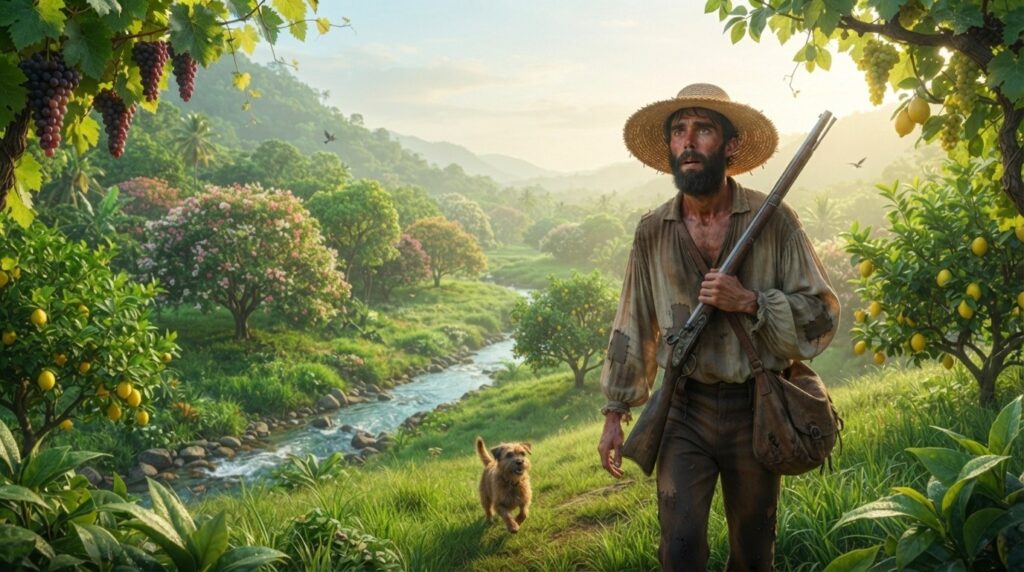
In the evening I lay on the soft grass and looked at the sky. The leaves moved gently, and the river made a quiet song. “All this is mine,” I thought. “I am the king of this place.” There was nobody to say no, and nobody could take it away from me. But then I looked at the empty valley and smiled sadly. A king with no people is only a lonely man with a big garden.
I wanted to keep the grapes for the rainy season, so I hung them in the sun to dry. In a few days they became raisins, and I carried them home. They were delicious, and they gave me strength during the long winter.
I liked the valley so much that I decided to build a second house there. “I will live near the sea,” I said, “where I can watch for ships, but I will come to the valley in the hot season.” In a few days I had built a small house of sticks under a group of trees, with a strong double fence around it. I called it my country house. I slept there often, and in the morning I woke up to the sound of birds. I felt almost happy.
The country house was small, but I loved it. In the evenings I sat on the grass in front of it and ate fruit, with the dog lying at my feet. The valley was full of sounds: birds, insects, the river running over the stones. At night the stars were so bright that I could see my own hands. I thought, “If I did not feel so alone, this could be a very good life.”
On one of my walks I caught a young parrot. I took him home, and I patiently taught him to speak. After some months he could say my name, “Robin, Robin Crusoe!”, in a funny little voice. He sat on my shoulder, and he often woke me in the morning. I called him Poll. After so long a time of silence, it was wonderful to hear a voice that spoke to me.
I had found Poll in a nest in a tree, a small, ugly bird with soft grey feathers. I carried him home in my hat and gave him fruit and water. Every day I sat with him and repeated his name: “Poll. Poll. Poll.” For weeks he said nothing, and I laughed at myself, a grown man talking to a bird. But one morning he opened his beak and said, “Poll!” I was so happy that I jumped up and shouted, and he was frightened and said it again.
Another day I walked across to the other side of the island, where a long flat beach lay in the sun. There I saw some large sea turtles, and I killed one and cooked the meat. It was delicious. I did not see any people or ships. “Perhaps one will come soon,” I told myself, and I went back to my valley.
I stayed on the far beach for two nights. I made a small fire and watched the stars come out over the sea. The waves were slow and soft, and the sand was still warm from the sun. I thought of the ships that I had sailed on and looked at the empty horizon. “Somewhere there are ships,” I said. “Somewhere there are people who talk and laugh.” I lay awake for a long time, listening to the sea.
Words from this chapter
- scene – noun what you see in a place
- wild with joy – phrase extremely happy
- paradise – noun a perfect and beautiful place
- sugar cane – noun a tall plant that sugar is made from
- delicious – adjective tasting very good
- patiently – adverb in a calm way, without hurrying
- turtles – noun animals with a hard shell that live in the sea
- shoulder – noun the part of your body between your neck and your arm
- explore – verb to travel around a place to learn about it
- fence – noun a wall made of wood or sticks
- tent – noun a home made of cloth
- belt – noun a strip of leather you wear around your waist
- lost – verb could not find; not able to find the way
- excited – adjective very happy and full of energy
- traveller – noun a person who travels
- followed – verb went after someone
- bushes – noun small, thick plants like trees
- completely – adverb totally
- valley – noun low land between hills
- believe – verb to think that something is true
- hundreds – noun many hundreds; a very large number
- ahead – adverb in front; forward
- joy – noun great happiness
- melons – noun big round fruits with sweet juice
- bunches – noun groups of fruit or flowers growing together
- discovered – verb found something for the first time
- shipwreck – noun when a ship is destroyed at sea
- strength – noun being strong
- parrot – noun a colourful bird that can learn to talk
- horizon – noun the line where the sky and the sea meet
Check your understanding
How did Robinson feel when he saw the valley?
Why did Robinson build a second house?
What did Robinson teach the parrot to say?
Reading is great. Speaking is better.
Talk about the story with a real teacher. Your first 25-minute lesson is free.
Book a free trial lessonFind your English level