After some months, I stopped being sad about the big canoe, and I made a new plan. This time I built a small boat, and I built it close to the water. I was careful, and I thought about every part of the job. It took me about two years, but when it was finished, I was able to push it into the sea. I made a mast and a small sail from the old sails of the ship, and I felt very proud. It was not a big boat, but it was enough for me.
The little canoe floated at once. I sat in it in the quiet bay and moved my oar slowly. The water was clear, and I could see small fish under me. I laughed like a child. On the beach Poll watched me from a tree and shouted, “Robin Crusoe!” I made a few short trips in the bay, and every day I felt more sure. A man who is proud of his boat will sometimes forget to be afraid of the sea.
I wanted to see all of my island, and I was tired of walking. “I will sail around it,” I said. It was a good idea, but I knew that the sea could be dangerous. On the east side of the island there was a line of rocks that went far out into the water, and I was afraid of them. But I wanted to see everything.
Before I left, I told the dog to stay at home. He looked at me with sad eyes and lay down on the sand with his head between his paws. I packed my bag again and again, and I checked the sail, the oar and the rope. I looked at the sky. It was blue, with a few white clouds. “A good day for a small trip,” I said. I was not afraid. That was my mistake.
One morning, I put some bread, some water and my gun into the boat and sailed away. At first it was easy. The sea was calm, the sun was warm, and I felt like a free man. I followed the coast and watched the hills and beaches move slowly past. After some hours I reached the east side and saw the rocks in front of me, long, black and dangerous, with the waves breaking over them in white foam.
When I came near the rocks, I saw something strange. On one side the water was quiet and green. On the other side it moved fast, like a river, and white spray jumped into the air like trees. The noise was very loud. I did not understand what it meant. I was only a farmer in a little boat, and I knew very little about the sea and how strong it could be.
“I will go around them,” I said. But as I came near, my boat suddenly began to move very fast. A strong current had caught it and was carrying me away from the land. I tried to turn the boat. I pulled on my oar with all my strength, but it was no good. Every minute the island became smaller.
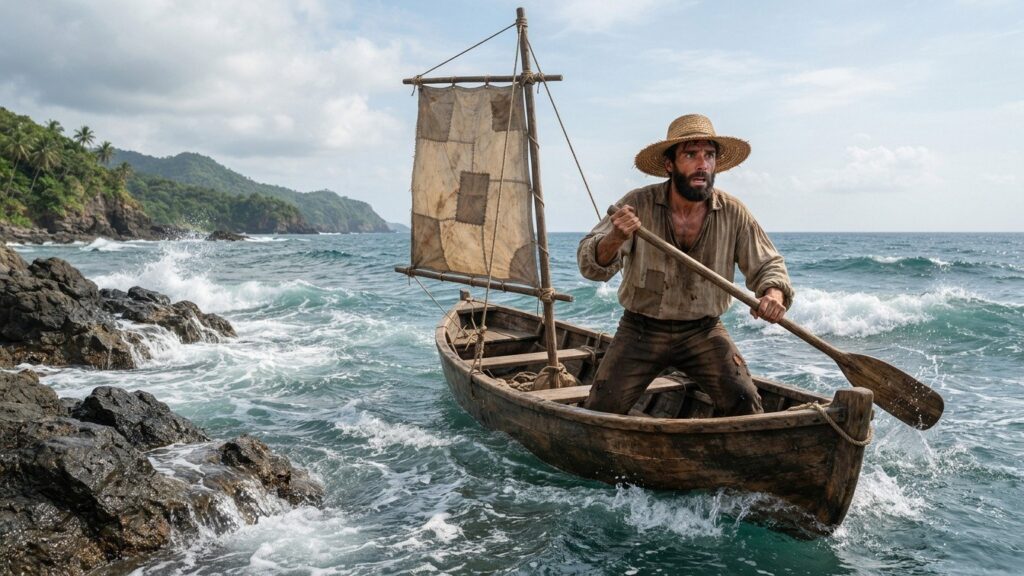
I was cold with fear. I stood up in the boat and shouted, but only the wind answered me. I looked back at the island. I could still see my hill, the green valley and the small white beach, but they looked like a picture. Every minute they became smaller. I sat down again and pulled the oar until my arms burned. But the sea was stronger than I was, and it did not even notice me.
“This is the end,” I thought. “I will die at sea, and no one will ever know.” I thought of my home, my dog, my parrot and my cats. In my old life, I had called this island a prison. Now it was the place that I wanted more than anything, and I could not reach it.
I made a promise to God and to myself. “If I can return,” I said, “I will never complain about this island again.” It was strange. For years I had called it my prison. Now I saw that it was also my home, and the thought of losing it was worse than the thought of staying in it for ever.
For hours I fought against the sea. Then something happened: the wind changed and began to blow from the north. It pushed my boat back towards the land. I held the sail with both hands, and I prayed. At last the current became weaker, and I could steer. I sailed to a small beach, jumped out and fell on the sand.
When the boat touched the sand, I fell out of it on to my knees and put my face on the ground. The sand was wet and cold, and it tasted of salt. I was shaking, and I could not stop. “Thank you,” I said, again and again. “Thank you, thank you.” I looked up at the hills and the trees, and I loved every one of them, even the thorn bushes.
I was so tired that I slept there for hours. Later, I walked to my country house and slept again. In the morning a small voice woke me: “Robin Crusoe! Robin Crusoe! Where have you been?” It was Poll! I laughed until I cried. I was home, and I was alive.
Words from this chapter
- foam – noun white bubbles on water
- current – noun water in the sea that moves in one direction
- mast – noun the tall pole that holds a sail
- oar – noun a long flat stick for moving a boat
- steer – verb to make a boat go in the direction you want
- strength – noun physical power
- prison – noun a place where people are kept against their will
- reach – verb to get to a place
- canoe – noun a long, narrow boat moved with paddles
- plan – noun an idea of what you will do
- push – verb to move something away from you
- sails – noun big cloths on a boat that catch the wind
- proud – adjective happy about what you did
- floated – verb stayed on top of the water
- bay – noun a part of the sea with land around it
- forget – verb to not remember
- dangerous – adjective not safe
- paws – noun the feet of an animal
- packed – verb put things in a box or bag
- mistake – noun something that is wrong
- reached – verb arrived at
- spray – noun small drops of water in the air
- suddenly – adverb quickly and without warning
- pulled – verb moved something towards you
- fear – noun the feeling of being afraid
- parrot – noun a colourful bird that can learn to talk
- promise – verb to say you will surely do something
- complain – verb to say that you are not happy about something
- blow – verb (wind) to move the air
- weaker – adjective less strong
Check your understanding
Why was Robinson afraid of the east coast?
What happened when Robinson came near the rocks?
How did Robinson get home?
Reading is great. Speaking is better.
Talk about the story with a real teacher. Your first 25-minute lesson is free.
Book a free trial lessonFind your English level