In the twenty-third year, I felt that I needed to know more. “I must see the west side of the island,” I said. “I never go there. Perhaps I can find out who made the footprint.” It was a long walk, and I was nervous, so I took my gun, my sword and a large bag of food. I left very early, before the sun became hot, and I left the dog at home so that he would not make any noise. Then I walked quietly through the trees.
The way was long. I walked up and down over hills, through thick trees and along a dry river bed. The sea was on my left, blue and quiet. At noon I sat in the shade and ate some bread and cheese. A bird sang in a tree, and for a moment I forgot my fear. I thought, “This is a beautiful day for a walk.” I did not know that the day would be one of the worst of my life.
After a few hours I came to the end of the island and stopped to look at the beach. At first I saw nothing unusual. Then I noticed something white on the sand, and I walked closer. They were bones: many arms, legs and a few skulls. Near them, I saw a big black ring on the ground, the place where somebody had lit a fire. A few half-burnt pieces of wood were still lying there.
I did not walk on to the beach. I stayed back at the edge of the trees and looked. The bones were white in the sun, and the black ring on the sand was very large. There was no sound except the waves. The wind moved a few dry sticks, and they made a small noise. My knees were weak and my mouth was dry. I held on to a tree with one hand, because I thought that I might fall.
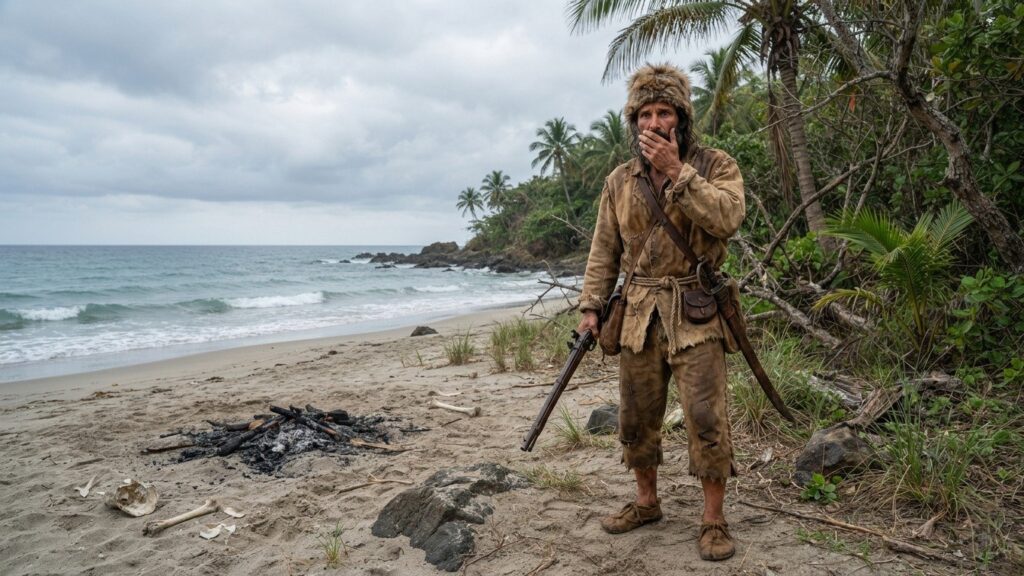
I did not need anyone to explain what had happened. People had come to this beach in boats. They had brought prisoners with them, and they had held a terrible feast. I stood there for a long time with my stomach turning, and then I ran away from the place, and I was sick on the grass. After that, I knelt down and thanked God that I had not been born in such a country.
I sat on a rock far from the beach and thought about my own country. In England too there were cruel things. I remembered wars, prisons and punishments that I had seen. Men did terrible things to other men in every country of the world, and they always found a reason. Cruel customs change their shape from place to place, but they live everywhere. This thought did not make me happy, but it made me less proud.
But as the hours passed, my thoughts became calmer. I told myself, “They do not know that it is wrong. Nobody has taught them. They have not hurt me, and they do not even know me. It is not my job to punish them. God can judge them, but I cannot.” I was still afraid, and I was still angry, but I tried to be fair. For many years I did not go back to that place.
Before I left, I looked at the shore once more. There was a small, quiet bay where a canoe could easily arrive. I learned it by heart: the rocks, the trees and the shape of the sand. Then I turned my back on the sea and walked into the trees. I did not want to look at that place again, but I knew that I would never forget it.The sun was already going down when I came to a hill that I knew, and only then did I feel safe.
I walked home by a different path and kept my eyes open. When I arrived, the dog ran to meet me and jumped around me with joy. I gave him a big piece of cheese, and I sat down by the fire and looked at my old cat. “Now I understand,” I said. “The footprint was not made by a ghost. It was made by one of the visitors. They come here from time to time, but they do not stay. This is only a place for their terrible feasts.” That thought made me feel a little better.
I looked at my fortress, my walls and my trees, and I thought that the biggest wall was not made of wood. It was inside me. I could build ten walls and a hundred fences, but fear still found a way in. Only courage and trust could close that door. “Be calm, Robinson,” I told myself. “Be careful, but do not be afraid every minute.” It was not easy, but I tried.
But that night I did not sleep well. I had a bad dream about the beach, and I woke up many times. I kept my gun next to my bed, and I listened to every sound. I made a decision: from that day on I would be more careful than ever, and I would always know exactly where my weapons were.
Words from this chapter
- nervous – adjective worried and a little afraid
- skulls – noun the bones of the head
- prisoners – noun people who are kept and cannot leave
- feast – noun a very big meal for many people
- stomach – noun the part of the body where food goes
- punish – verb to make someone suffer for doing something wrong
- fair – adjective right and reasonable
- judge – verb to decide if someone is good or bad
- footprint – noun the mark a foot makes on sand or earth
- sword – noun a long, sharp metal weapon
- noise – noun a sound, often loud
- unusual – adjective not normal; strange
- noticed – verb saw
- bones – noun the hard white parts inside a body
- burnt – adjective destroyed by fire
- lying – verb being in a flat position
- edge – noun the end or side of something
- explain – verb to make something clear
- knelt – verb went down on the knees
- shape – noun the form of something
- thoughts – noun ideas in your mind
- calmer – adjective more quiet and peaceful
- shore – noun the land at the edge of the sea
- canoe – noun a long, narrow boat moved with paddles
- easily – adverb without problems
- ghost – noun the spirit of a dead person
- fortress – noun a strong building that keeps people safe
- courage – noun being brave
- decision – noun a choice you make
- weapons – noun things used to fight, like guns and swords
Check your understanding
Why did Robinson leave the dog at home?
What did Robinson find on the beach?
What did Robinson try to remember?
Reading is great. Speaking is better.
Talk about the story with a real teacher. Your first 25-minute lesson is free.
Book a free trial lessonFind your English level