On the nineteenth of December 1686, I left the island. I had lived there for twenty-eight years, two months and nineteen days. I stood on the deck of the ship and looked at the green hills for a long time. They became smaller and smaller, and at last they were only a thin line on the water. I thought about my first night on the beach, my fear, my tent and my first loaf of bread. I thought about the footprint and about Friday. I was crying, and I did not know whether I was happy or sad. Friday stood next to me and held my hand. “Master,” he said, “we go home.”
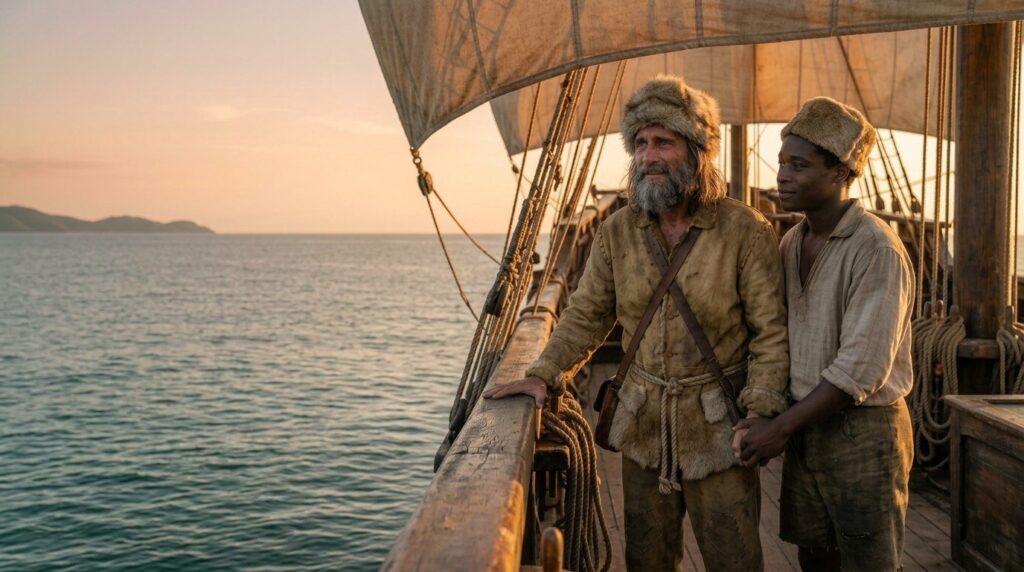
The first days on the ship were strange. The deck moved under my feet, and the sailors shouted all day long, and I was not used to so many voices. At night I went up on deck and looked at the stars. They were the same stars that I had watched from my hill, but now they were travelling with me. I thought, “For twenty-eight years I looked at the sea from the land. Now I am on the sea, and the land is far behind me.”
Before we left, I had given the five men on the island a letter. “If the Spaniards come back,” I had told them, “be kind to them. Share your food and live in peace.” Many years later I heard that the Spaniards had arrived, and that all the men had learned to live together. The island had become a small village, with goats, fields and a good house.
Friday loved the ship. He touched the ropes and the sails and asked a hundred questions. “Master, how the big boat go with no paddle?” I laughed and explained about the wind. He listened with great care and then said, “Your people very clever.” I answered, “Some are clever, Friday, and some are not.” In the evenings he sat with the sailors, and they taught him new English words and a few songs.
The journey to England was long. We sailed for many months, and in June 1687 I saw the white cliffs of my country. I had been away for thirty-five years. My heart was full. The ship came into the port, and I walked on English ground for the first time since I was nineteen years old.
England was loud and busy. In the port there were carts, horses, shops and hundreds of people, all walking fast, and nobody looked at my face. I stood in the street with my goat-skin hat in my hand and felt like a child. A man laughed at my old clothes, and a woman gave me a coin. I looked at it for a long time. It was the first money in my hand for twenty-eight years, and it was only a small piece of metal. On the island it had been useless, but here it bought bread.
I went to York to find my family, but there was sad news. My father and mother had died many years before. Everybody had thought that I was dead, too, and nobody had written my name in any papers. I found only one sister, with two children, and they did not know me. I was an old man, with grey hair and strange clothes, and they were afraid of me. But when I told them my story, my sister cried and held me in her arms. It was a very good moment, and a very sad one.
At my sister's house I could not sleep in a bed. It was too soft, and the room was too quiet and too warm. Every night I got up, walked to the window and looked at the dark street, listening for the sea. My sister's children watched me with big eyes. After some weeks the youngest girl sat on my knee and said, “Uncle, tell us about the goats.” I told her, and she laughed and laughed. That was the first time in England that I felt at home.
Then I travelled to Lisbon, because I wanted to find the old Portuguese captain who had saved me at sea. He was now very old, but he was alive, and he welcomed me like a son. He had wonderful news for me. While I was on the island, my partner had looked after my farm in Brazil, and it had grown big and rich. He had kept all the money for me for all those years. Now I was a very rich man!
I used the money well. I gave some to my sister, some to the captain and his family, and some to the poor. I asked about Xury, my brave little friend, but nobody knew where he was. I hoped that he was free and happy.
In England, Friday saw many things for the first time: snow, a church, a clock, a big city, and streets full of faces. He was not afraid. He looked at everything with a quiet smile, and one evening he told me, “Master, the world is very big, but you are always with me.” I held his hand and could not answer. I only thought, “Of all the things that the island gave me, he was the best.”
Friday stayed with me, and he was my best friend until the end of his life. We spent many evenings in front of my fire, talking about the island. I had a good life, a wife and children. But I will never forget the lesson of my island. My father had said, “The best life is the middle life.” Now I knew that he was right, and I knew something more: a person can be happy anywhere, if he has work, hope and a friend.
Words from this chapter
- deck – noun the floor of a ship
- cliffs – noun high walls of rock next to the sea
- journey – noun a long trip
- ground – noun the surface of the earth
- papers – noun official documents
- partner – noun a person who owns a business with you
- poor – adjective having very little money
- lesson – noun something that you learn from an experience
- fear – noun the feeling of being afraid
- tent – noun a home made of cloth
- loaf – noun a whole bread
- footprint – noun the mark a foot makes on sand or earth
- master – noun the man in charge; the owner
- strange – adjective unusual, not normal
- shouted – verb spoke very loudly
- behind – preposition at the back of
- share – verb to give part of what you have
- peace – noun a time with no war; a quiet feeling
- arrived – verb came to a place
- goats – noun farm animals with horns
- fields – noun open areas of land for animals or plants
- touched – verb put the hand on something
- ropes – noun thick, strong strings
- sails – noun big cloths on a boat that catch the wind
- paddle – noun a short oar for a canoe
- metal – noun iron, gold, silver etc.
- useless – adjective of no use
- everybody – pronoun all people
- welcomed – verb said hello to someone in a friendly way
- brave – adjective not afraid of danger
Check your understanding
What did Robinson tell the five men to do about the Spaniards?
Why did Robinson's family not know him?
What did Robinson learn from his island?
Reading is great. Speaking is better.
Talk about the story with a real teacher. Your first 25-minute lesson is free.
Book a free trial lessonFind your English level