On the first of September 1659, exactly eight years after I had run away from my father’s house, we sailed from Brazil in a ship with fourteen men on board. She was not a large ship, but she carried a good cargo, and I felt full of hope. For twelve days the weather was good and the sea was quiet. Then, without warning, a terrible storm came from the south. For days the wind pushed our ship across the sea, and the sailors had no idea where we were. The sky was so dark that we could not see the sun or the stars, and nobody expected to live. The sailors tied everything down, and they took turns at the pumps day and night. I tried to help, but I was so tired and frightened that my hands shook. Some of the men prayed aloud, and others sat in silence with their faces in their hands.
Before we sailed, I made my plans carefully. I asked a good partner to look after my farm while I was away. I also wrote a letter to the old Portuguese captain in Lisbon, my friend, and I told him what to do if I did not come back. On the last evening I walked around my fields in the red light of the sun. The tobacco was tall and green, and the house looked small and warm. I was not afraid. “It is only a short trip,” I told myself. “In a few months I will be here again.”
Early one morning, a sailor shouted, “Land!” Before we could do anything, the ship hit a sandbank and stopped. The huge waves broke over the back of the ship, and we all knew that she would soon fall to pieces. We lowered the small boat into the water and climbed in, eleven men in all. We tried to row towards the land, but the sea was far too strong, and we did not even know what kind of land it was. Then a giant wave came from behind us and turned the boat over.
On the fifth night of the storm the ship began to leak. Water came in through the floor, and the sailors worked at the pumps without any rest. Their hands were red and their faces were grey. I tried to help, but my arms were weak, and I was often sick. I lay in the dark and listened to the wood of the ship. It cried and cried like a living thing. I thought, “Why am I here again? I made a promise in my first storm, and I did not keep it. This is my punishment.” I did not sleep. I only waited.
I was a good swimmer, but I could not breathe, and the water pulled me down. I thought that my life was finished. I remembered my father, my mother and the promise that I had broken in the first storm. “Now it is the end,” I thought, “and I deserve it.” Then another wave lifted me and threw me towards the land. I stood up and ran as fast as I could. A third wave came behind me, but this time I managed to hold on to a rock until the sea went back. Then I climbed up the beach. I was alive!
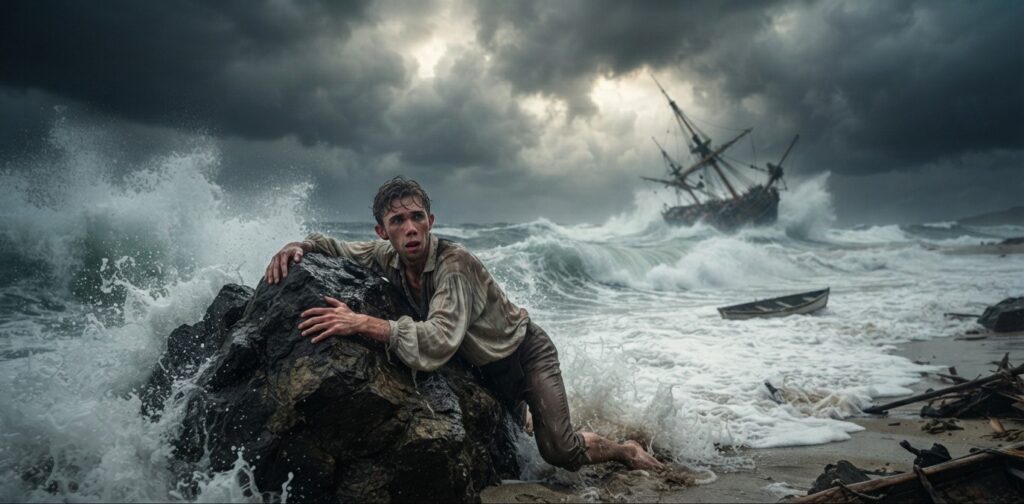
I fell on my knees and thanked God. Then I looked around. Where were the others? I saw nobody, only a hat, a cap and two shoes lying on the sand. All my friends had drowned. I was completely alone, wet through, tired and hungry. I had no food, no water and no dry clothes. In my pockets I found only a knife, a pipe and a little tobacco.
I ran up and down the beach like a madman. I shouted, I waved my arms and I jumped. I laughed and I cried at the same time. I thanked God again and again for my life. “I am alive!” I shouted to the sky. “I am alive!” A bird flew up from the rocks, and the sea went on with its noise, and nobody heard me. At last I sat down on the sand, and my legs were shaking so much that I could not stand.
When night came, I was afraid of wild animals, so I climbed into a thick tree and found a safe place in its branches. I was soon fast asleep, too tired even to be afraid. I did not know it yet, but I was on an island, and I was going to stay there for a very long time.
I walked along the beach until the light began to fade. I called the names of my friends, one after another. “Tom! Will! Captain!” Only the sea answered me, and the wind. I was thirsty, and my mouth was as dry as paper. I had no water and no food, and I did not know if there was any on this land. I chewed a little of my tobacco, because I had heard that it helps a hungry man. It was bitter, and it did not help much.
Words from this chapter
- sandbank – noun a bank of sand under the water, near the land
- lowered – verb moved something down
- row – verb to move a boat with long flat sticks
- breathe – verb to take air into your body
- managed – verb was able to do something difficult
- drowned – verb died in the water
- pockets – noun the small bags in your clothes
- thick – adjective with many branches and leaves
- exactly – adverb completely correct
- sailed – verb travelled on a ship
- board – noun a long, flat piece of wood
- cargo – noun the things that a ship carries
- warning – noun something that tells you about danger
- pushed – verb moved something away from you
- across – preposition from one side to the other
- expected – verb thought that something would happen
- tied – verb held with a rope
- pumps – noun machines that move water out of a ship
- frightened – adjective afraid
- prayed – verb spoke to God
- aloud – adverb in a voice that people can hear
- silence – noun no sound at all
- partner – noun a person you work with
- fields – noun open areas of land for animals or plants
- shouted – verb spoke very loudly
- fall – verb to go down to the ground
- punishment – noun what happens to someone because they did wrong
- deserve – verb to have earned something because of what you did
- madman – noun a man who is mentally ill or acts crazily
- fade – verb to slowly become less bright or strong
Check your understanding
What did a sailor shout early one morning?
How did Robinson reach the land?
What did he find in his pockets?
Reading is great. Speaking is better.
Talk about the story with a real teacher. Your first 25-minute lesson is free.
Book a free trial lessonFind your English level