On a clear morning I climbed to the highest hill on the far side of the island, and when I looked out over the sea, I saw something that made my heart leap. On the horizon lay a faint blue line, unmistakably land. “It must be the coast of America,” I said. “There are people there, and perhaps Spanish settlements.” For the first time in years I had a genuine reason to hope, and the hope took possession of me. That night I lay awake in my tent, listening to the wind, and made a hundred plans in my head, each one more adventurous than the last.
For many days I returned to the top of the hill and looked at that blue line. Sometimes I was afraid that it was only a cloud. But in the evening, when the sun went down, it was still there. Clouds change and drift away; land stays. I sat on a rock and thought, “It is real. It is there. And somebody lives on it.” My heart was so full that I could not eat my supper that night.
From that day, I could think of nothing but a boat. I had no boat, and I could not swim such a distance, so I resolved to build a canoe. I searched the forest for the largest tree I could find and chose an enormous cedar, nearly as thick as a house. It took twenty days to bring it down with my axe, and many more to strip the branches and shape the trunk. Then began the long labour of hollowing it out, with axe and fire and endless patience. After five months of effort, the canoe was ready. It was long and beautifully balanced, and it could have carried twenty men. “I am a genius,” I told the parrot, and I walked round it a dozen times, admiring my own work.
I made a careful plan. How far away was the land? Perhaps forty or fifty miles. A good canoe could cross that in a day or two if the sea was calm. I would need food, water and my gun, as well as a mast and a sail. I wrote the list in my journal and read it every evening, and each line made the dream a little more real. In my mind I was already on the other side.
Then, with a dreadful sensation in my stomach, I asked myself where the sea was. I looked, and I understood. In my enthusiasm I had built the canoe in the middle of the forest, a hundred metres from the water and on the slope of a hill. It was far too heavy to move. “How stupid I was!” I cried. “I never thought about the end of the job.”
I worked in the hot sun every day, burning out the inside of the trunk with fire and then cutting away the charred wood with my axe. Sometimes I burned my fingers and hopped around shouting. In the evenings I lay in my tent and imagined the day of my arrival: people running down to the beach, and myself saying “Good morning!” in a loud voice. I practised the words in my head, because I had no idea whether anyone would understand English.
I tried everything. I made levers from long poles, and I laid round logs under the keel so that the canoe could roll. Nothing worked. Then I thought of digging a canal from the sea up to the canoe, and I measured and calculated. The job would take ten or twelve years. I did not know whether to laugh or to weep, so I did both.
I sat down on the grass and stared at the canoe for a long time. It looked like a dead whale lying on the hill. The dog came and sat beside me and gazed at it too, and I think he was just as surprised as I was. I imagined the whole island laughing at me: the birds, the goats, the trees. “Look at the clever man,” they said, “who built a ship on a mountain.” And the worst of it was that they were right.
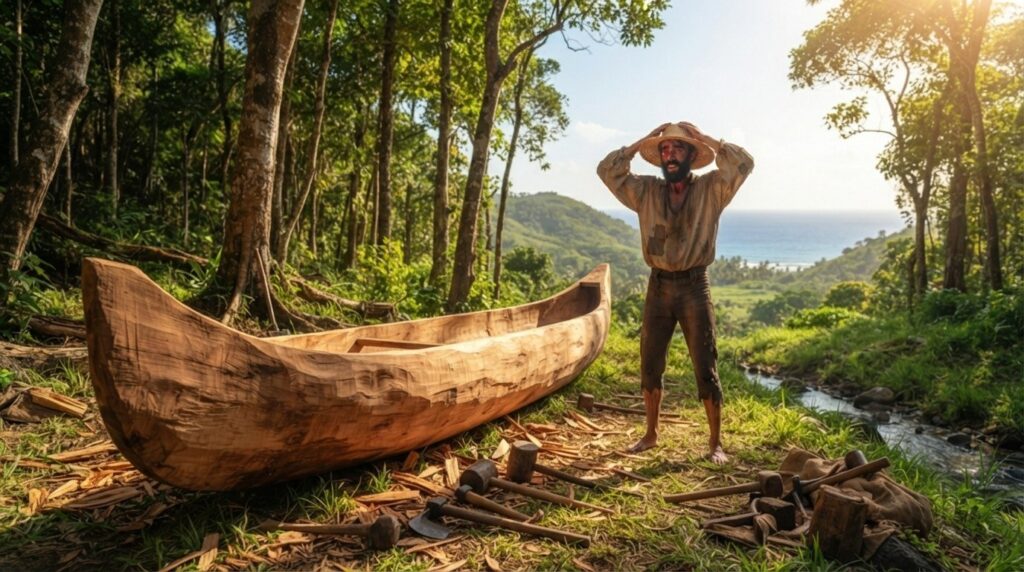
Rage came later. I kicked the canoe, which hurt my foot and did nothing to the canoe. I shouted at the sky, at the sea and at myself. Then, being tired, I sat down on the trunk and began to laugh, because the sight of a grown man yelling at a tree was so absurd that even Poll, who was perched on my shoulder, fell silent in astonishment.
In the end I abandoned the beautiful canoe, and it lay on the hill for the rest of my time on the island. Yet the lesson stayed with me for ever: before beginning a great undertaking, one must think through the whole plan from its start to its finish. And the labour had not been entirely wasted. I had become a skilled carpenter, and I had proved to myself that one man, with enough patience, can accomplish almost anything, as long as he remembers to ask where the water is. When I returned to my fence that evening, Poll was waiting on his perch, and he greeted me by name, which made the day's failure feel much lighter.
Words from this chapter
- faint – adjective not strong or clear
- unmistakably – adverb in a way that cannot be confused with anything else
- settlements – noun small towns built by new arrivals
- possession – noun the state of owning or controlling something
- enthusiasm – noun a strong feeling of excitement and interest
- keel – noun the long piece at the bottom of a boat
- undertaking – noun a big and difficult job
- accomplish – verb to succeed in doing something
- leap – verb to jump high or far
- genuine – adjective real; true
- adventurous – adjective liking new and exciting experiences
- resolved – verb decided firmly
- enormous – adjective extremely big
- labour – noun hard physical work
- endless – adjective never ending
- balanced – verb kept steady without falling
- sensation – noun a feeling
- charred – adjective burnt black
- levers – noun long bars that help you move heavy things
- measured – verb found the size of something
- calculated – verb worked out with numbers
- gazed – verb looked for a long time
- rage – noun very strong anger
- yelling – verb shouting loudly
- absurd – adjective silly and unreasonable
- perched – verb sat on the edge of something
- astonishment – noun great surprise
- abandoned – verb left forever, with no plan to return
- skilled – adjective having skill
- greeted – verb said hello to
Check your understanding
What did Robinson see on the horizon?
Why was the canoe useless?
What practical lesson did Robinson learn?
Reading is great. Speaking is better.
Talk about the story with a real teacher. Your first 25-minute lesson is free.
Book a free trial lessonFind your English level