London, as it turned out, had one more piece of luck in store for me. Through a chance acquaintance I met the captain of a merchant ship who had grown prosperous trading along the coast of Guinea. He took a liking to me, perhaps because I listened to his stories with such obvious hunger, and he offered to take me with him on his next voyage. I would pay nothing for the passage, he said, and I could carry a small cargo of my own.
I invested the modest sum I had in cheap English goods, such as toys, scissors and knives, and the captain, who was scrupulously honest, taught me navigation, a little arithmetic and a good deal about the tricks of the trade. In the evenings, when the heat of the day had faded, we sat on deck while he explained the stars to me, one by one, and told me of the harbours where a foreigner could and could not be trusted. When we returned, my small cargo had brought me a real profit. For the first time in my life I felt that I had earned something, and my appetite for the sea was stronger than ever.
The voyage was hard, and I was often ill with fever in the fierce heat, but I loved every day of it. Everything was new: the red rivers, the brilliant birds, the noisy markets where people laughed and bargained, and were happy to buy my toys and knives. In the evenings I sat in the shade and counted my gold again and again, like a miser. I was twenty years old, and for the first time I felt that I was truly a man.
Unfortunately, my teacher died soon afterwards, and I decided to make a second voyage on my own account, borrowing money to buy a larger cargo. I wrote to nobody at home. In my vanity, I preferred to wait until I could return in triumph, and so my parents spent those years not knowing whether their youngest son was alive or dead.
I knew that my father must be worried. A letter takes only a few minutes to write, but each time I picked up the paper I told myself, “Not yet. When I am rich, I will go home, and my father will be proud of me.” And so I put the paper away again. Pride, I have learned, is a strange master: it never allows a man to say that he is sorry.
It was a fatal decision. One misty morning, off the coast of Morocco, a swift, low ship with many oars came racing out of the haze. The captain realised at once what she was. “Pirates from Salé!” he shouted. We fought with everything we had, but we were outnumbered and outgunned, and after several hours of brutal fighting the ship was taken. The pirates carried us off to their port, and there I was separated from the others and given to the pirate captain as his personal slave.
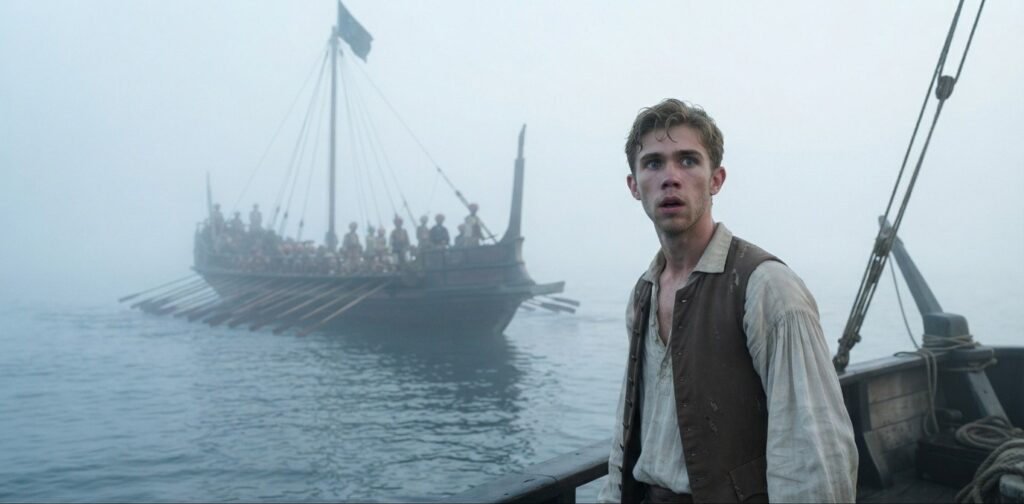
When the pirates' ship came out of the mist, everyone ran on to the deck. The captain studied her through his glass, and his face turned grey. We altered course and put up every sail we owned, but hour after hour she came nearer, and I could see men with long knives crowded at her bow. My heart was beating like a drum. I looked at the empty sea around us and thought, with a terrible clarity, that there was nowhere to run.
I will not pretend that I took it well. Only months earlier I had been a young man with a hundred roads to choose from, and now I was a servant, digging the garden of a man who owned me like a tool. I slept on a hard floor, I ate what was left over, and a watchful guard followed me wherever I went, so that I could not even think of running away. Day after day I thought of my father’s words about the middle way of life, and I understood, too late and with a bitterness that is hard to describe, how right he had been.
In Salé, a white town on the hot coast, I was marched through narrow streets between high walls, and people stopped to stare as we passed. I was tired and thirsty, and I understood not a word of what was said around me. A few days earlier I had been a young merchant with a full purse. Now I was a young man in dirty clothes, and anyone could look at me and say, “This one is mine.” I had never really thought about what it means to own another human being. In that garden I learned it, and I resolved that I would never treat any person so. I have never forgotten that thought.
Yet bitterness was no use to me. Slowly, a hard, quiet resolution began to grow inside me. I watched the harbour, I learned the habits of the men around me, and I told nobody what I was thinking. Wherever the road led, I would not die in that garden.
Words from this chapter
- acquaintance – noun a person you know a little
- prosperous – adjective rich and successful
- cargo – noun goods carried by a ship
- scrupulously – adverb very carefully and honestly
- vanity – noun too much pride in yourself
- outnumbered – verb fewer in number than the enemy
- brutal – adjective very violent and cruel
- resolution – noun a firm decision to do something
- voyage – noun a long journey by sea
- invested – verb put money into something to make a profit
- modest – adjective not large; not proud
- navigation – noun finding the way on the sea
- trade – noun buying and selling
- profit – noun money you earn from business
- appetite – noun the wish to eat
- fierce – adjective wild, strong and frightening
- brilliant – adjective very bright; very clever
- bargained – verb discussed a price to get a better deal
- preferred – verb liked better
- triumph – noun a great success
- fatal – adjective causing death
- misty – adjective with a thin cloud in the air
- swift – adjective fast
- haze – noun air that is not clear because of heat or dust
- altered – verb changed
- clarity – noun being clear and easy to understand
- pretend – verb to act as if something is true
- watchful – adjective watching carefully
- bitterness – noun angry, unhappy feelings about something unfair
- resolved – verb decided firmly
Check your understanding
What did Robinson's first voyage give him?
Why did Robinson's parents not know where he was?
What decision grew inside Robinson as a slave?
Reading is great. Speaking is better.
Talk about the story with a real teacher. Your first 25-minute lesson is free.
Book a free trial lessonFind your English level