One morning, in the second year of my exile, I climbed out of the fence and noticed something strange near the foot of the rock. A dozen slender green shoots were standing in a small group, as straight as soldiers. I stared at them for a long time. They reminded me of something from England, but my memory refused to supply their name.
I was astonished. The ground there was dry and stony, and the sun was merciless. It seemed an unlikely place for anything to grow. “It is a miracle,” I thought, and I fell on my knees. Since my illness I had become a devout man, and I took the shoots for a sign that Providence had put them there for my benefit. I thanked heaven with tears running down my face.
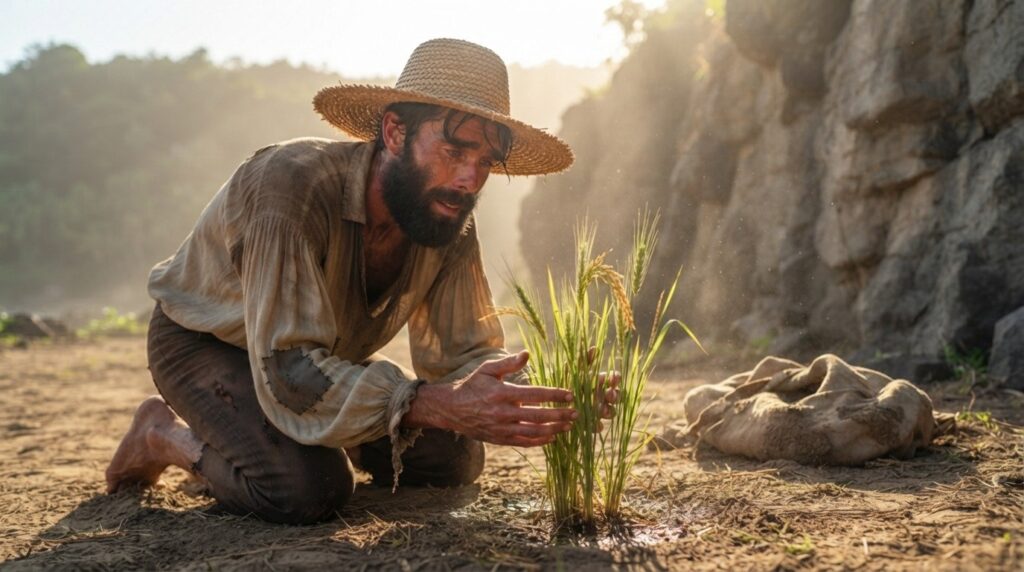
I walked slowly around the plants and touched the leaves with my fingers. They were real. I looked up at the sky and asked, “Who put you here?” Nobody answered, but I resolved to protect them. I cut some thorn bushes and made a small fence around the plants, because goats and birds could easily eat them. Every morning I came to look at them, and every morning I was a little happier.
Some weeks later the plants had grown taller, and I could see ears at the top of each stalk. Then, all at once, I understood. It was barley, and beside it, rice! At the same moment I remembered an old bag that I had found on the ship. It had once held food for the chickens, and when I no longer needed it, I had shaken the husks out beside the rock, without a second thought. Then the rains had come, and the forgotten grains had woken in the wet earth.
I laughed until my stomach hurt. How many things had I thrown away without thinking? I looked at my old boxes with new eyes. “What else have I forgotten?” I asked myself. I opened the empty bag again, and in a corner I found three more grains, small and dry. I laid them in my hand like treasure. In my father's office people had counted money. Now I was counting grains, and I loved it better.
“It is not a miracle at all,” I said, laughing, “only a lucky accident.” Yet my gratitude was not much smaller for that. Whether the gift came from heaven, from luck or from the sea itself, it was a gift, and I resolved to treat it with respect. When the plants were ripe, I gathered the ears and stored them in a dry place, and I did not eat a single grain. Every one of them was seed for the next season.
I put the ears of grain in a small box and placed the box in the driest corner of my cave. Every day I looked at it. There were not many grains, only a handful, but they were more precious than gold. “I must be patient,” I said. “One grain can become fifty, and fifty can become a thousand.” It was the first time in my life that I truly understood that something small can become something great, if one is willing to wait.
Farming turned out to be a patient and humbling craft. I had no plough and no spade, so I made a spade from a very hard tree. It was heavy and clumsy, and it broke more than once, but it did the job. My first sowing was a failure, because I chose the wrong month and the soil was too dry. At the second attempt, the birds ate half of the seed. I stood guard with my gun and my dog, shot several thieves and hung their bodies on poles in the field as a warning to the rest, which proved remarkably effective.
I wrote in my journal: “Too dry. Too many birds.” Every failure taught me something. I learned that the earth does not hurry, and that a farmer must be patient and brave. I had always been a man who wanted everything at once, a man who ran away from home because he could not wait. Now I waited for the rain and I waited for the seed, and I learned the slow music of the seasons.
There were times when I lost my temper. Once I found that the birds had eaten half of the seeds, and I threw my wooden spade across the field. It broke, of course, and I had to spend two days making another. I sat down in the dust and laughed at myself. Anger, I decided, was an expensive luxury on an island, because every broken tool cost me a week of my life.
It took four seasons before I had a decent harvest. At last, for the first time since the wreck, I had grain to eat as well as to sow. I could make bread. “Now I am a farmer,” I told the dog, and Poll shouted from his perch, “Robin Crusoe!”
I held the first full basket of grain in my arms. It was heavy and smelled sweet. I thought about the years since the wreck: the fear, the fever, the loneliness, the work. Here, in this basket, was the answer to all my hard days. I sat down on the ground with the basket on my knees and cried a little. They were happy tears, and Poll looked at me from his perch and said, very softly, “Poor Robin.”
Words from this chapter
- slender – adjective thin in an attractive way
- devout – adjective very religious
- Providence – noun God's care for people
- stalk – noun the main stem of a plant
- husks – noun the dry outer parts of grains
- gratitude – noun the feeling of being thankful
- humbling – adjective making you feel less important
- clumsy – adjective not graceful, and difficult to use
- exile – noun being forced to live away from your home
- dozen – noun twelve
- soldiers – noun people who fight in an army
- refused – verb said no
- astonished – adjective very surprised
- stony – adjective full of stones; cold and unfriendly
- merciless – adjective without pity
- resolved – verb decided firmly
- respect – noun a feeling that someone is good and important
- gathered – verb collected; came together
- stored – verb kept for later
- willing – adjective happy to do something
- craft – noun a boat; a skill of making things by hand
- soil – noun the earth in which plants grow
- attempt – noun a try
- thieves – noun people who steal
- proved – verb showed that something is true
- remarkably – adverb surprisingly
- temper – noun a tendency to become angry
- luxury – noun something expensive and pleasant you do not need
- decent – adjective good and acceptable
- perch – noun a stick or place where a bird sits
Check your understanding
What did Robinson first think the green shoots were?
What really happened to the grains?
What did Robinson do with the first plants?
Reading is great. Speaking is better.
Talk about the story with a real teacher. Your first 25-minute lesson is free.
Book a free trial lessonFind your English level