Now I had grain, but I still had a lot of problems. How could I make bread with no tools? I had no mill to grind the grain into flour, and I had no oven to bake it in. I also needed pots to store my grain and carry water, and the few things that I had saved from the ship were not enough. “I must learn to make everything myself,” I said. “And I will start with pots.”
I thought about all the work behind a single loaf of bread. Somebody had to plough the field and sow the seed, wait for the rain and cut the plants. Somebody had to take the grain out of the ears, make flour, mix the dough and bake it. In England I had never thought about any of this. A baker did everything, and I paid a few coins. Now I understood. A piece of bread is a small miracle of many hands, and on the island I only had two.
I knew that pots were made of clay, so I went looking for it. After a few days I found some good red clay in the hills, and I carried it home in a basket. I shaped a pot with my hands and put it in the sun to dry. But when it was dry, it was so weak that it fell to pieces when I touched it. I made another and another, and they all broke. Sometimes the sun was too hot and the clay cracked. Sometimes the pot was too heavy and it collapsed under its own weight. I tried again and again for weeks, and I was close to giving up.
My first pots were very ugly. One was shaped like a bag, one like an old hat, and one looked like a sleeping animal. I put them in a row and laughed. Poll looked at them and said nothing, and I think that was the kindest thing he could have said. But I did not stop. Each new pot was a little better than the last one, and every morning I looked at them with hope.
Then, by chance, I made a discovery. One evening I lit a big fire, and I put some of the pots near it to keep them warm. The next morning, I found them in the ashes, and they had not broken. They were hard and red, like pieces of a tiled roof. “That is the secret,” I said. “Clay needs fire!” From that day, I built a hot fire around my pots and kept it burning for many hours. In the end I had real pots that could hold water and grain. I also made some plates and a big jar. They were not beautiful, but they were mine, and I was very proud of them.
When I opened the fire the next morning, I took the first pot in my hands. It was still warm. I hit it softly with my knuckle, and it rang with a clear sound, like a small bell. I filled it with water and waited. Not one drop came out! I jumped up and danced around the fire like a boy. The dog barked, Poll shouted, and for one wonderful moment the island was full of music.
Next I needed flour. I cut the trunk of a hard tree and made a deep hole in the top, and with a heavy wooden stick I crushed the grain in it. It was slow, tiring work, but it made fine flour. For a sieve, I used a piece of old cloth from the sailors’ clothes. It was not perfect, but it was good enough.
In the evening my arms hurt so much that I could not lift my cup. My back was sore, and there was white dust in my hair and my beard. But in my jar there was a small pile of fine flour, and every day it grew a little bigger. I looked at it with pride. A rich man in England counts his money. I counted my flour, and I thought that I was richer than he was.
At last, I was ready to bake. I had no oven, so I made a fire on a flat stone, and when the stone was very hot, I took the fire away. I put my dough on the stone and covered it with a clay pot. Then I piled burning wood around the pot to keep it hot.
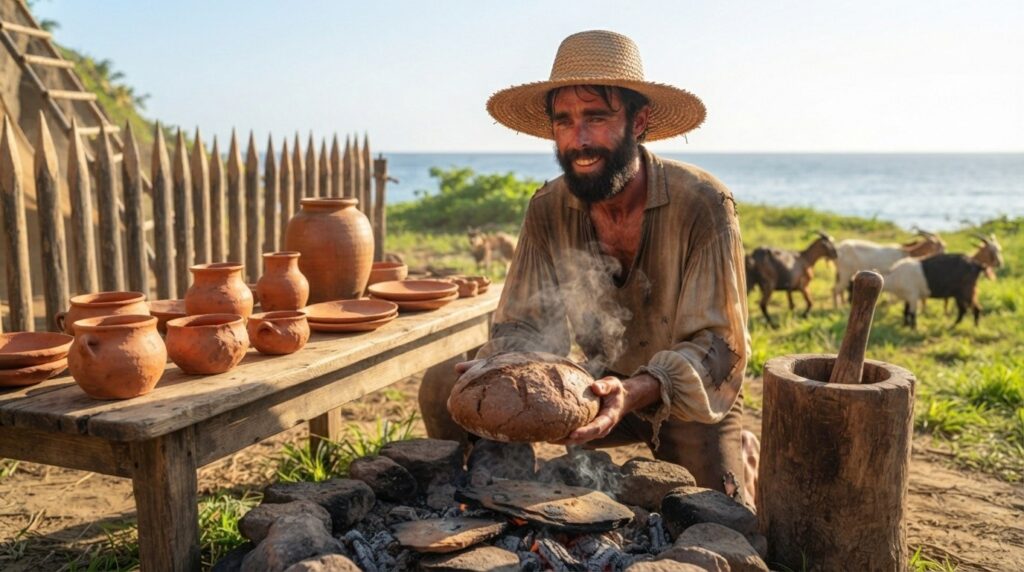
My first loaves were very bad. The first was black like coal on the outside and raw inside. The second was as hard as a stone, and when I offered a piece to the dog, he sniffed it and walked away. I was angry, but I learned something. The fire must not be too hot, and I must watch the stone carefully. On the fifth day I made a loaf that was brown and soft. “That is better,” I said. “That is much better.”
When I lifted the pot, there was a small golden loaf. The smell was so good that my mouth filled with water. I ate it slowly, with a little cheese, and it was the best bread I had ever eaten. There was no baker to thank, only myself.
Words from this chapter
- grind – verb to crush something into powder
- store – verb to keep something for later
- collapsed – verb fell down suddenly
- discovery – noun something that you find or learn for the first time
- tiled – adjective covered with flat pieces of baked clay
- crushed – verb pressed hard until broken into small pieces
- dough – noun a mixture of flour and water before it becomes bread
- sieve – noun a tool for separating fine powder from bigger pieces
- grain – noun the seeds of plants like wheat and rice
- flour – noun the white powder that bread is made from
- oven – noun a hot box for baking bread
- bake – verb to cook bread or cake in an oven
- saved – verb helped someone out of danger
- single – adjective only one
- loaf – noun a whole bread
- plough – noun a tool for turning the earth
- field – noun an open area of land for animals or plants
- sow – verb to put seeds in the ground
- seed – noun a small thing that grows into a plant
- miracle – noun a wonderful thing that seems to come from God
- clay – noun soft earth used to make pots
- pot – noun a round container for cooking or keeping food
- touched – verb put the hand on something
- cracked – verb broke with a line but did not fall into pieces
- weight – noun how heavy something is
- ashes – noun the grey powder left after a fire
- piled – verb put things one on top of another
- loaves – noun whole breads (plural of loaf)
- offered – verb said you would give or do something
- sniffed – verb smelled with short breaths
Check your understanding
Why did Robinson's first pots break?
What did Robinson discover about clay?
How did Robinson bake bread without an oven?
Reading is great. Speaking is better.
Talk about the story with a real teacher. Your first 25-minute lesson is free.
Book a free trial lessonFind your English level