The years went by. I kept my calendar on the post, and each year I cut a long line for the first day of January. Ten years passed, then twelve, then fifteen. My hair turned grey and my beard grew long. All my clothes were made from goat skins, and I must have looked like a wild man. But I was happy in my own way.
The island changed over the years, and so did I. The small trees I had planted near my fence grew tall and thick. My paths in the grass became hard and clear, because I walked on them every day. I knew every stone and every bush, where the goats liked to sleep, where the best fruit grew and which birds came in which month. The island was no longer a strange place for me. It was a book that I read again and again, and I loved it.
My days were all alike, and I did not mind. I woke at first light, read a few pages from the Bible and thanked God for the new day. Then I went out to my fields and my goats. I milked them, checked my plants and repaired my fences. At noon the sun was too hot, so I rested in the shade and ate bread, cheese and fruit. In the afternoon I worked again: I baked bread, made baskets or pots, or walked to my valley. In the evening I lit a lamp and wrote in my journal. I never went to bed without thinking of my family in England.
On Sundays I did not work. I put on my best goat-skin hat, washed in the stream and read the Bible aloud under a tree. Then I sang an old song from church in England. My voice was not beautiful, but the birds listened. When I finished, Poll said, “Amen!” in his funny voice, and I laughed so loudly that the goats ran away. Sunday was the day when I felt most like a man in a country with neighbours.
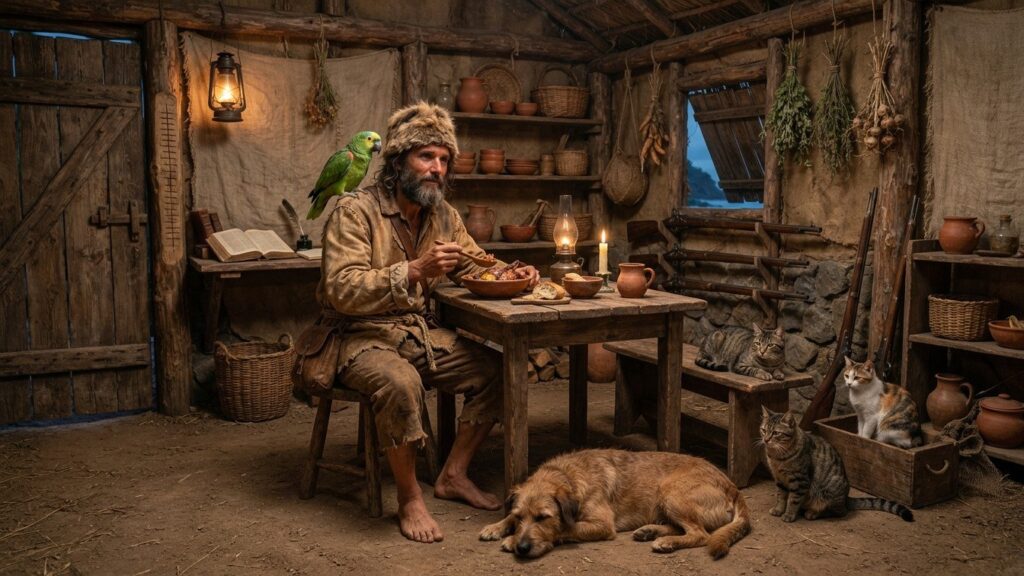
My animals were my family now. My old dog was still with me. He slept most of the day, but he always stayed close to my feet. The two cats from the ship had had many kittens, and I had to make a rule: only a few were allowed to live inside my fence, and the others had to live in the fields. And of course there was Poll, who had learned many words and talked to me every day. When I sat down to dinner, I used to look around at my little family, with Poll on my shoulder, the dog at my feet and a cat on each side. “I am like a king at the table,” I thought, “and these are my loyal subjects.”
At dinner Poll often talked to me. “Robin Crusoe,” he said. “Poor Robin. Where have you been?” I answered him, and so we had a little conversation, and I felt that I had a friend. When the cats saw me with a piece of cheese, they came and sat in a circle around me with big round eyes. Nobody could say that I was alone. I only had nobody who could tell me something new.
One day I took out my old list of good and evil things, and I saw that I could now add many more things to the good side. I was alive and healthy, and I had a house, a farm and companions. I paid no tax, and nobody gave me orders. I understood something that I had not understood before. I had once believed that I was a prisoner in a terrible place, but many people in the big world were far more unhappy than I was. They had money and possessions, but they were not free in their minds.
I thought about the people in the big world. In England rich men worked from morning until night and still wanted more. They worried about money, about war, about other people's opinions, and they slept badly. I did not need money here, I had no enemies, and I slept like a child. “My father was right,” I said. “The best life is the middle life. But he did not tell me that you can find it on a lonely island.”
I thanked God for my life, and I tried to be content. On the evening of each anniversary of my arrival, I sat outside and looked at the stars, and I said a short prayer for the friends who had died in the storm.
Sometimes in the evening I climbed to the top of the hill and looked at the sea. There were no ships. There never were. A strange thing happened to me then: I was no longer sure that I wanted one to come. I loved my home, my animals and my quiet life. But when I thought about my family and about a church full of people, I felt a sharp pain in my heart. I was a man between two worlds.
But my peace did not last. Something was about to happen that would change my life again, and it would be the beginning of the greatest fear that I ever knew.
Words from this chapter
- alike – adjective the same, similar
- repaired – verb made something work again
- checked – verb looked at something to be sure it is all right
- loyal – adjective always faithful to a friend or a ruler
- subjects – noun the people who live under a king
- possessions – noun the things that you own
- content – adjective quietly happy
- tax – noun money that people must pay to the government
- calendar – noun a list of the days of the year
- beard – noun the hair on a man's face
- skins – noun the outsides of animals, used to make clothes
- planted – verb put seeds or trees in the ground
- fence – noun a wall made of wood or sticks
- bush – noun a small, thick plant like a tree
- goats – noun farm animals with horns
- thanked – verb said thank you
- baked – verb cooked in an oven
- journal – noun a book where you write about your days
- kittens – noun young cats
- shoulder – noun the top of your arm
- circle – noun a round shape
- round – adjective like a circle
- evil – adjective very bad; wicked
- healthy – adjective well, not ill
- companions – noun people who spend time or travel with you
- believed – verb thought that something was true
- prisoner – noun a person who is not free
- badly – adverb in a bad way
- anniversary – noun the same date as an important day in the past
- arrival – noun the moment when you arrive
Check your understanding
What did Robinson do at noon?
How did Robinson feel when he sat down to dinner?
What did Robinson understand about unhappiness?
Reading is great. Speaking is better.
Talk about the story with a real teacher. Your first 25-minute lesson is free.
Book a free trial lessonFind your English level