The years went by with a regularity that I came to find soothing. I kept my calendar on the post, and each New Year’s Day I cut a longer notch than the others. Ten years passed, then twelve, then fifteen. My hair turned grey, my beard grew long, and my clothes, all made of goat skins, would have frightened a small child. Yet, in my own peculiar way, I was happy.
The island changed over the years, and so did I. The small trees I had planted beside my fence grew tall and thick, and the paths I walked every day were pressed hard and clear into the grass. I knew every stone and every bush, where the goats liked to sleep, where the best fruit ripened, and which birds arrived in which month. The island was no longer a foreign country. It was a book that I read again and again, and I loved it.
My days followed a pattern, and I was glad of it. I rose at first light, read a few pages from my Bible and gave thanks for the new day. I then went out to my fields and my goats, milking, weeding and repairing fences. At noon, when the heat was too great, I rested in the shade and ate bread, cheese and fruit. In the afternoon I returned to my work: baking, basket-making, potting or walking to my valley. At night I lit a small lamp and wrote in my journal, and I never lay down without thinking of my family in England.
On Sundays I did not work. I put on my best goat-skin hat, washed in the stream and read the Bible aloud under a tree, and then I sang an old hymn from church in England. My voice was not beautiful, but the birds seemed to listen. When I finished, Poll would announce “Amen!” in his comic voice, and I laughed so loudly that the goats ran away. Sunday was the day when I felt most like a man in a country with neighbours.
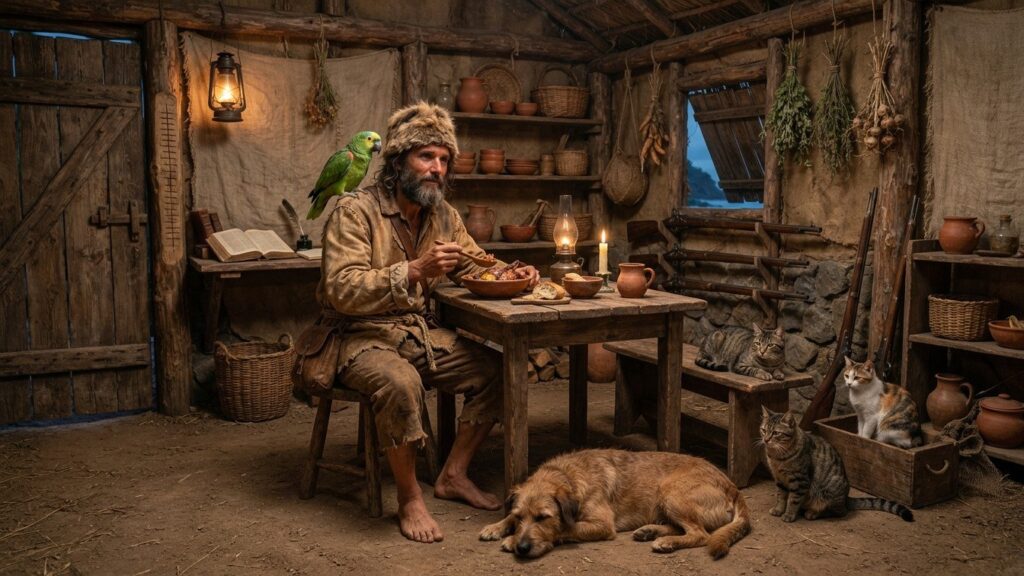
My animals were my family now. My old dog, who had been with me since the wreck, spent most of his days asleep, but he never failed to stay within reach of my feet. The cats from the ship had multiplied, and I was obliged to impose a rule: a few could live within my fence, and the rest had to find their own living in the fields. And then there was Poll, who had learned so many words that conversation with him was almost natural. When I sat down to dinner, with Poll on my shoulder, the dog at my feet and a cat on each side, I would look at them solemnly and think: “I am a king at his table, and these are my loyal subjects.”
At dinner Poll often talked to me. “Robin Crusoe,” he said. “Poor Robin. Where have you been?” I answered him, and so we held a little conversation, and I felt that I had a friend. When the cats saw me with a piece of cheese, they gathered in a circle around me with wide round eyes. Nobody could say that I was alone. I only lacked someone who could tell me something new.
One evening I took out my old list of good and evil, and I discovered that the right-hand column had grown remarkably long. I was alive and healthy. I had a home, a farm and companions. I paid no taxes, and nobody gave me orders. Gradually, I realised something that I had never understood in England. I had once believed that I was a prisoner in a dreadful place, but, in the wide world, there were thousands who were far less free than I. They owned property and held positions, yet they were slaves to their own appetites. I had been stripped of everything, and I had learned what I truly needed.
I thought about the people in the great world. In England, rich men worked from morning until night and still wanted more. They worried about money, about war, about other people's opinions, and they slept badly. I needed no money here, I had no enemies, and I slept like a child. “My father was right,” I said. “The best life is the middle way. But he did not tell me that it can be found on a lonely island.”
I thanked God for my life, and I tried to be content with it.
Sometimes in the evening I climbed to the top of the hill and looked at the sea. There were no ships. There never were. A strange thing happened to me then: I was no longer certain that I wished for one. I loved my home, my animals and my quiet life. But when I thought of my family, and of a church full of people, I felt a sharp pain in my heart. I was a man standing between two worlds.
But contentment is a fragile thing, and mine was about to be tested. Something was approaching that would shatter my peace and begin the longest and most frightening chapter of my years on the island.
Words from this chapter
- soothing – adjective calming and relaxing
- peculiar – adjective strange or unusual
- weeding – verb removing unwanted plants
- multiplied – verb became much greater in number
- impose – verb to make people accept a rule
- solemnly – adverb in a very serious way
- appetites – noun strong desires for things like food or money
- fragile – adjective easy to break
- calendar – noun a list of the days of the year
- skins – noun the outsides of animals, used to make clothes
- fence – noun a wall made of wood or sticks
- goats – noun farm animals with horns
- ripened – verb became ready to eat
- foreign – adjective from another country
- rose – verb went up (past of rise)
- heat – noun the quality of being hot
- journal – noun a book where you write about your days
- hymn – noun a religious song
- obliged – adjective forced; grateful
- gathered – verb collected; came together
- lacked – verb did not have
- remarkably – adverb surprisingly
- companions – noun people who spend time or travel with you
- gradually – adverb slowly, little by little
- dreadful – adjective very bad; terrible
- owned – verb had something as your property
- property – noun things that someone owns
- stripped – verb took off clothes or covering
- truly – adverb really; sincerely
- contentment – noun a quiet feeling of being happy and satisfied
Check your understanding
Why did Robinson's routine seem soothing?
What did Robinson learn about people in the wide world?
What did the final paragraph warn about?
Reading is great. Speaking is better.
Talk about the story with a real teacher. Your first 25-minute lesson is free.
Book a free trial lessonFind your English level