It was about noon one day, and I was walking down to my boat. The sun was bright, the sea was calm, and I was thinking about my dinner, with no care in the world. Then, quite suddenly, I stopped as if I had struck a wall. There, in the sand in front of me, was the print of a man’s bare foot.
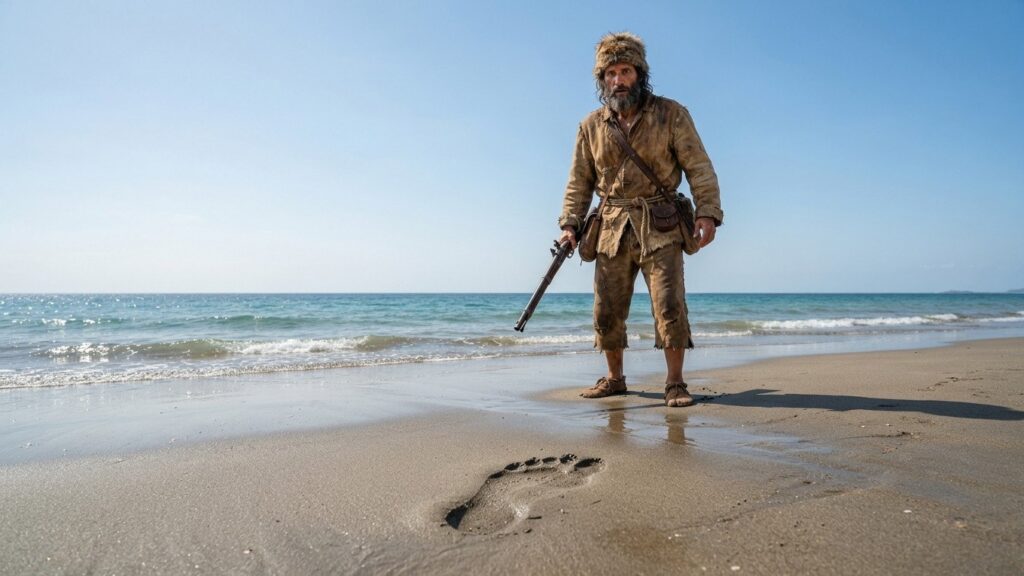
I stood motionless, like a statue, with my heart pounding and my head spinning. I looked round me, and I listened. There was nobody and there was no sound. I climbed a small rise and scanned the shore in every direction, but I saw only sea and sky. I went back to the footprint. It was real: a clear impression, with the toes, the heel and the arch.
I walked slowly around the footprint in a wide circle, examining the sand like a detective. I searched for a second print, and a third, and a fourth. There were none. There was only one print, only one foot. That made it even stranger. A man who walks has two feet. Where was the other? Where had he come from, and where had he gone? The sea lay quiet, and it gave me no answer.
My thoughts raced in confusion. Was it a ghost? Was it the devil? Or was it a living person, from the mainland? That was the worst of it: I did not know, and my imagination, with nothing to hold it back, supplied the answers. I ran home without once looking behind me. Every few steps I imagined a man in the trees, and every bush was an enemy. When I reached my fence, I scrambled in and pulled up the ladder after me, shaking like a leaf in the wind.
Inside my fence I sat on the floor with my back against the wall. My hands were shaking so much that I could not stop them. I checked my gun, my knife and the powder, one after the other, three times. Then I looked through the small holes in the wall and watched the trees. Every time the wind moved a branch, my heart jumped. The dog lay beside me with his ears raised. He was afraid, too, because he could feel my fear.
I did not sleep at all that night. For fifteen years I had been alone, and in a single moment, everything had changed. “Perhaps the visitor is still here,” I whispered. “Perhaps he is watching me at this very moment.” I held my gun all night. In the morning I could not bring myself to go out, and I stayed in my cave for three days and nights, eating very little and thinking of nothing but that footprint.
In the dark I thought about all the stories I knew. Sailors in England used to tell tales of wild men living on the coasts of the world, who were cruel to strangers. I did not know whether the stories were true, but at night every story is true. I lay with my eyes open and saw faces on the walls of my cave.
On the fourth day, hunger and shame together made me braver. I went down to the beach and examined the footprint again. I put my own foot next to it, and I saw that it was considerably larger. Therefore it was not mine, and some stranger had really been there. And he had probably not been alone. “Perhaps people from the mainland visit this island,” I said to myself, “and I have never met them, because I live on the other side.” The thought made my blood run cold.
I sat on the sand and thought about God. Fifteen years earlier He had put the corn on the dry ground and sent me the parrot and the goats. Was this footprint also His doing? I did not know. I only knew that I was afraid and ashamed of my fear. “Why am I afraid of a man,” I asked, “when I am not afraid of lions and storms?” But I had no answer.
For fifteen years, I had lived without fear, and I had been, in my own way, happy. Now I looked at my fields, my fences and my animals, and I could see them only as things that I might lose. I had thought that I was the master of the island. Now I understood that I was only its guest, and that my peaceful life was finished. That evening I went back to the shore and searched for further traces, but the tide had washed the sand clean, and I found nothing more.
That night I took my pen and wrote in my journal: “Today I saw a footprint. I do not know whose it is. I am afraid, and I do not know why I am more afraid of one print than of a hundred storms.” I looked at the words for a long time. Then I added one more line: “Perhaps God knows.” I closed the book and listened to the night, and for the first time in many years I checked my fence twice before I went to sleep.
Words from this chapter
- pounding – verb beating very strongly and fast
- motionless – adjective not moving at all
- scanned – verb looked quickly at something from side to side
- impression – noun a mark made by pressing on a surface
- arch – noun the curved part under the foot
- shaking – verb trembling
- considerably – adverb by a large amount
- guest – noun a person who visits a place and is not the owner
- quite – adverb fairly; very
- struck – verb hit (past of strike)
- statue – noun a figure of a person made of stone or metal
- raced – verb ran very fast
- confusion – noun not understanding what is happening
- ghost – noun the spirit of a dead person
- devil – noun the enemy of God in stories
- mainland – noun the big land, not the island
- imagination – noun the ability to make pictures in your mind
- fence – noun a wall made of wood or sticks
- scrambled – verb climbed or moved quickly and awkwardly
- ladder – noun steps you can move, for climbing
- powder – noun gunpowder, which makes a gun fire
- single – adjective only one
- whispered – verb spoke very quietly
- cave – noun a big hole in a rock or a hill
- tales – noun stories
- shame – noun the bad feeling after doing something wrong
- examined – verb looked at very carefully
- probably – adverb almost certainly
- ashamed – adjective feeling bad about something you did
- traces – noun small signs that something was there
Check your understanding
What did Robinson do when he first saw the footprint?
Why did Robinson think the visitor was not alone?
What did Robinson realise at the end?
Reading is great. Speaking is better.
Talk about the story with a real teacher. Your first 25-minute lesson is free.
Book a free trial lessonFind your English level