After the day of the footprint, nothing was the same. I lived in a state of permanent alarm. Every morning I scanned the sea with anxious eyes, and every evening I scanned it again. I stopped visiting my boat. I stopped walking on the beach. I no longer fired my gun, for the sound might tell strangers that I was there, and I even avoided lighting fires in daylight, since smoke can be seen from a great distance. In my own kingdom, I had become a hunted animal.
At night I woke many times, climbed the ladder and looked at the sea in the moonlight, counting the waves, because I imagined that I saw boats. I saw sails in the clouds and men in the shadows of the rocks. In the daytime I walked only in the early morning or the evening, when the light was weak. My little kingdom grew smaller every week, and my fear grew larger.
I surveyed my home critically, as an enemy might have done, and I found it far too exposed. My tent and fence were visible from the sea, and so were my animals in the fields. I decided to transform the place. Behind the old fence I built a second wall, setting strong stakes in a half circle some two metres away from the first and filling the space between with more stakes and packed earth. In it I made seven small openings, and in each I fixed a loaded gun, so that from inside I could fire at any attacker without leaving shelter. I called it my fortress.
It took me many weeks to build the second wall. The sticks were heavy, the work was hot and dusty, and my hands were covered with small cuts. When it was finished, I walked around outside and examined it with the eyes of an enemy. I saw a pile of sticks against the side of a hill, and nothing more: no door, no window, no smoke. I stood there and smiled for the first time since the footprint. “Good,” I said. “Very good.”
I also planted a forest. I took young branches from a fast-growing tree and pushed them into the ground in front of my wall, and within two years the trees had grown so thick that nobody could have guessed that a house lay behind them. The only way in was by a hidden path, and, as before, I climbed over with a ladder.
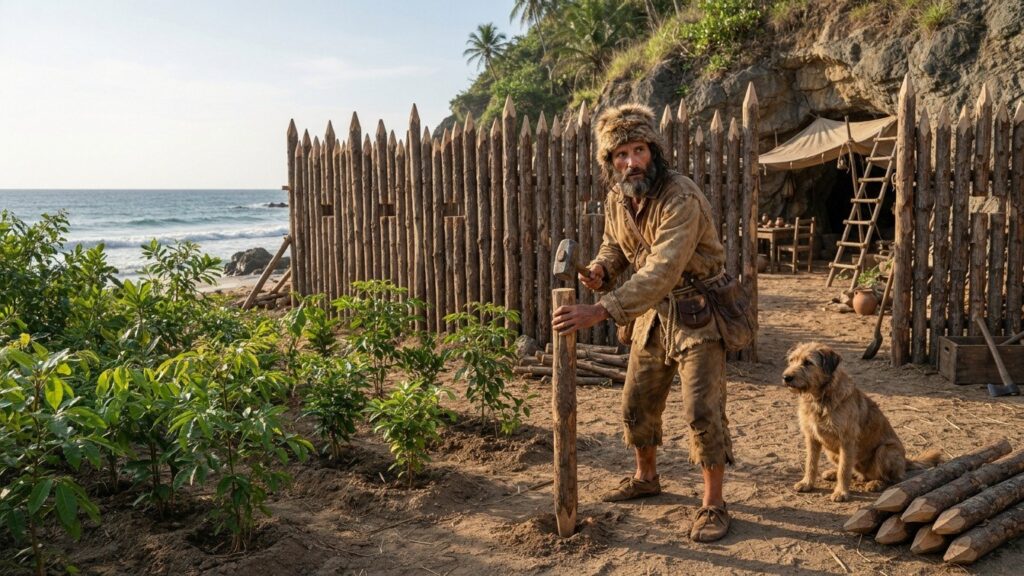
I watered the little trees every evening, and they grew astonishingly fast. Birds built nests in them, and the wind made a soft noise in the leaves. After two years the forest was so dense that I sometimes lost my own path. I felt rather silly: I was a man who had hidden his house so well that he could not find it! But I was also proud, because the forest was a gift that I had made with my own hands.
My goats presented another problem, since they were easy to spot in the open. I searched the woods for two secret places. I found a small, sheltered meadow, far from the beach and surrounded by trees, and I fenced it and moved part of the herd there. I did the same in another valley. If a visitor stumbled upon one group, he would be unlikely to find the other.
I visited my secret fields by a different route every time, so that I never wore a clear path in the grass, walking on stones and dry ground and glancing behind me every few minutes. I felt like a thief on my own island. “How sad it is,” I thought, “that I must hide my goats, my house and myself, and that I am the only man here.” But the fear did not go away, and the work gave my hands something to do.
For two years, I lived in this way, working quietly with my eyes always open. I met nobody, and I saw no further footprints. Little by little my terror lessened, but it never entirely left me. Every few days I still climbed the hill with my telescope and studied the horizon for a long time, and every white wave looked, at first glance, like a sail.
Night after night, as I lay in the dark, one question returned. If they came again, what should I do? At first my answer was simple: I wanted to shoot every one of them. But then another voice inside me spoke. They had not harmed me; they did not even know that I existed. Did I have the right to take their lives? I could not answer with any certainty, but I decided that I would never attack unless I was attacked first.
That night I prayed for wisdom. “Lord,” I said, “show me what is right. I do not wish to be a murderer, and I do not wish to be a coward.” I listened for an answer, but there was only the wind. Even so, when I got up from my knees my heart was a little quieter. I understood that wise people do not hurry to do a terrible thing.
Words from this chapter
- alarm – noun sudden fear that something bad will happen
- anxious – adjective worried and nervous
- exposed – adjective not protected from being seen or attacked
- transform – verb to change completely
- stumbled upon – verb found by chance
- sheltered – adjective protected from wind or danger
- terror – noun very great fear
- certainty – noun the feeling of being completely sure
- permanent – adjective lasting forever
- scanned – verb looked quickly over an area
- avoided – verb kept away from
- daylight – noun the light of the day
- daytime – noun the time when it is light
- critically – adverb carefully, looking for faults
- visible – adjective can be seen
- stakes – noun sharp wooden posts
- attacker – noun a person who attacks
- shelter – noun a place that protects from weather or danger
- fortress – noun a strong building that keeps people safe
- examined – verb looked at very carefully
- guessed – verb gave an answer without being sure
- dense – adjective thick; with things close together
- meadow – noun a field of grass and flowers
- herd – noun a group of animals
- stumbled – verb almost fell while walking
- route – noun the way from one place to another
- thief – noun a person who steals
- footprints – noun marks made by feet on the ground
- entirely – adverb completely
- glance – noun a quick look
Check your understanding
How did Robinson feel after the footprint?
What did Robinson do to hide his home?
What troubled his conscience?
Reading is great. Speaking is better.
Talk about the story with a real teacher. Your first 25-minute lesson is free.
Book a free trial lessonFind your English level