After my narrow escape, I resolved to stay close to home. I left my little canoe in a quiet creek, and I never again ventured beyond sight of the coast. This did not trouble me as much as I had expected. There was plenty of work on shore, and with every year that passed I became a more capable farmer and craftsman.
My greatest anxiety was my food supply. My powder was dwindling year by year, and I could not shoot goats for ever. “What shall I do when it is gone?” I asked myself. The answer was obvious: I must breed goats of my own.
I counted my powder. There was enough for perhaps twenty shots, no more. I looked at my guns and set them down gently, like old friends. “Soon you will be silent for ever,” I told them. It was a sad thought. For many years the guns had given me meat, safety and courage, and I knew that one day I should have to learn to live without them.
First I had to catch some. I dug pits in the ground and covered them with branches and leaves. Some weeks later I found an old goat in one of them, and, in another, two kids. They were terrified and refused to eat. I tied them with a cord and carried them home, and little by little they came to trust me, until they were following me around the fence like puppies. Within a few months, I had a small herd.
I took one of the small young goats in my arms. It was warm, and its heart was beating fast. I gave it a little milk from a cup, and slowly it stopped trembling. After a while it licked my fingers with its rough little tongue. I laughed. It was the first friend I had made on the island, apart from Poll and the dog. When I carried it home, it looked up at me with big yellow eyes, and I thought, “Perhaps we shall become a family.”
I built a large enclosure round a field of good grass, to keep the animals safe and fed. The labour was heavy, but it was also a great satisfaction. When I had ten goats, I began to milk them. The milk was warm and rich, and I soon learned to make butter and cheese. After some years I owned more than forty goats, and I could eat meat and drink milk whenever I chose. I was a farmer, a baker and a dairyman in one person, and I was prouder of that than I had been of anything in years.
The first time I made butter, I shook the milk in a bag for an hour until my arms ached. Then I saw small yellow pieces in the bag, and I shouted for joy. I also made cheese and pressed it between two flat stones. That evening I enjoyed a feast of fresh bread, butter, cheese, raisins and roast goat. I sat at my table and thought, “The best kings in Europe do not eat better than I do.”
My clothes were by now in a deplorable condition. I was still wearing the garments I had taken from the ship, and they were so torn that they scarcely held together. I made new clothes from goat skins: a coat, a pair of trousers and an enormous hat, all with the fur on the outside. I must have looked ridiculous, and any English tailor would have fainted at the sight, but the clothes were warm, and the hat shed rain like the roof of a house.
I did not know how to sew, and my first coat was a disaster. It was like a large bag with two holes for my arms. My trousers were too short, and my hat looked like a small black animal. When I put on my new clothes for the first time, the dog did not recognise me. He barked and ran away, and I laughed so much that I fell on the grass. After a few days he understood, and he came back and licked my hand.
Finally, I turned my attention to making an umbrella. I had seen them used against the sun in Brazil, and I remembered the principle. After many failures, I produced one that worked. I covered it with skins and fitted it so that I could open and close it as I pleased. In the heat of the day it gave me shade, and in the rainy season it kept me dry. “Every king should have an umbrella,” I told the dog, and I laughed at my own absurd appearance.
My first umbrella was a failure. The wind carried it away, and it fell to pieces on the ground. The second had a good shape, but when the rain came, it would not close. I tried again and again. At last I produced an umbrella that worked, and I walked around in the rain feeling proud, dry and slightly ridiculous. Poll sat on my shoulder, under the umbrella, and said, “Poor Robin Crusoe,” in a very sad voice.
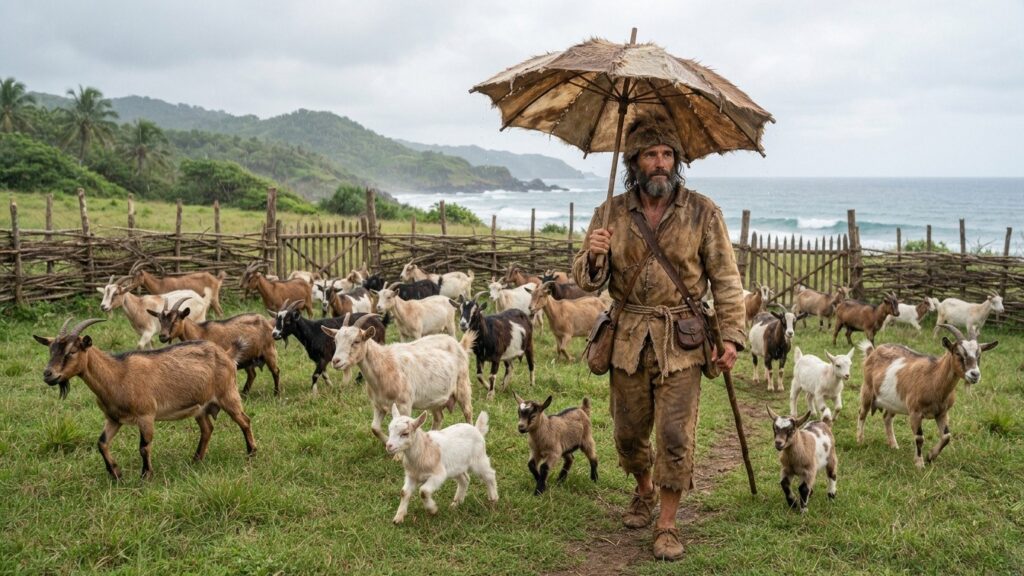
In the evenings I used to sit outside with my goats around me, watching the sun go down into the sea. I was not unhappy. I was Robinson Crusoe, monarch of all I surveyed, and I was beginning to suspect that a king without a kingdom might in some ways be happier than a king with one.
Words from this chapter
- ventured – verb went somewhere that might be dangerous
- capable – adjective able to do things well
- dwindling – verb becoming smaller and smaller
- enclosure – noun a piece of land with a fence round it
- dairyman – noun a person who works with milk, butter and cheese
- deplorable – adjective extremely bad
- ridiculous – adjective so silly that it makes people laugh
- monarch – noun a king or queen
- resolved – verb decided firmly
- canoe – noun a long, narrow boat moved with paddles
- creek – noun a small, narrow bay or river
- beyond – preposition on the other side of; further than
- sight – noun something you see
- craftsman – noun a person who is skilled at making things by hand
- anxiety – noun a strong feeling of worry
- obvious – adjective easy to see or understand
- terrified – adjective extremely afraid
- cord – noun a thin rope
- herd – noun a group of animals
- trembling – verb shaking because of fear or cold
- labour – noun hard physical work
- satisfaction – noun the pleasant feeling of having what you want
- ached – verb felt a dull, continuous pain
- garments – noun pieces of clothing
- scarcely – adverb almost not
- enormous – adjective extremely big
- tailor – noun a person who makes clothes
- fainted – verb suddenly fell down, unconscious
- shed – verb let tears fall; let something go
- absurd – adjective silly and unreasonable
Check your understanding
What did Robinson do about the problem of his powder running low?
How did Robinson make new clothes?
What did Robinson suspect at the end?
Reading is great. Speaking is better.
Talk about the story with a real teacher. Your first 25-minute lesson is free.
Book a free trial lessonFind your English level