One evening Friday and I sat on the hill, looking out to sea. The day was clear, the sky a deep, cloudless blue. “Master,” said Friday suddenly, “look!” He pointed west. On the far edge of the water lay a dark line. “That is my country,” he said, and his eyes shone with tears. “Friday’s people live there. Friday go home?”
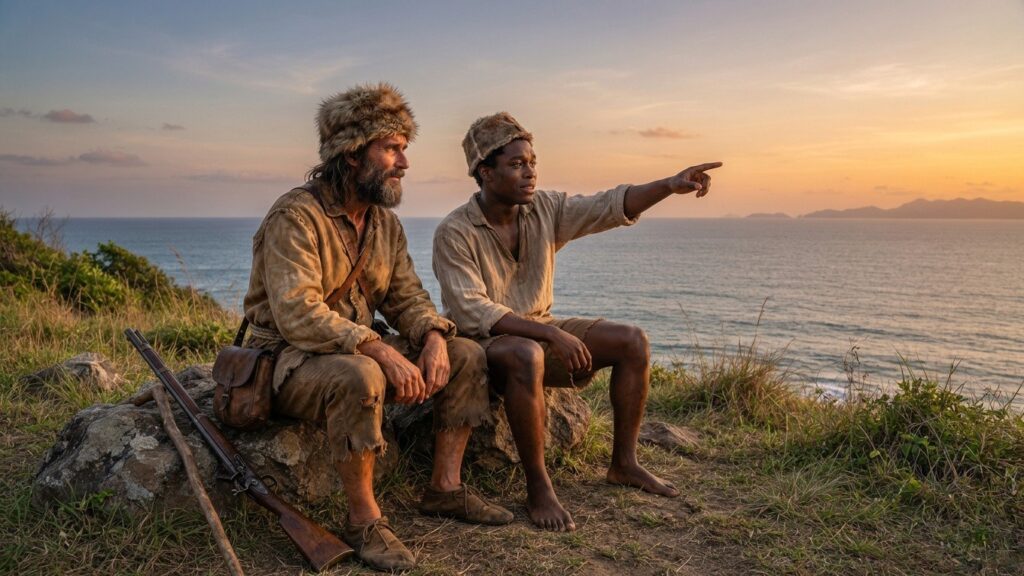
My heart went cold. “Do you want to leave me?” I asked. Friday shook his head. “No, Master. Friday no leave Master. But Friday’s people… they not know you. They not know God. Friday want to tell them.” I understood. He loved his people, and he wanted to share the good things that he had learned.
I felt ashamed of my fear. I put my hand on his shoulder. The next day I wanted to test him, so I showed him the small canoe and said, “Friday, if you wish to go home, you may go. I will not stop you.” He looked at me with big, sad eyes, and tears ran down his face. “Why you send Friday away?” he asked. “Friday no go without Master.” I understood that he was not only my servant. He was my friend, and he would stay with me.
In the following weeks we talked often about the mainland. Friday told me about his family, a wide river, a burning sun and a green forest. And one evening he said something that made my heart leap. “Master, there are white men in my country. Seventeen men. They came in a big ship, and the ship broke on the rocks. They live with us, and we are friends.” Europeans! Perhaps Spaniards or Portuguese, shipwrecked like me.
That night I could not sleep. I asked Friday a hundred questions. How many days by canoe? Which way? Were the white men kind? What language did they speak? He answered slowly, with his hands and his few English words. I did not understand everything, but my heart was beating like a drum. For twenty-five years the sea had been a wall around me. Now, for the first time, I saw a door in it.
For years my one dream had been to leave the island, and now a new hope opened before me. If white men lived on the mainland, I might meet them. They might have a boat, or we might build one together and sail to some country from which I could find my way home. “Friday,” I said, “we must build a boat. A strong, seaworthy boat.”
I remembered the great canoe, still lying uselessly on its hill, and I told myself that I was now older and wiser. “This time,” I said, “we will build the boat close to the water, so that we can launch it.” Friday laughed. “Yes, Master. Friday help.”
We made a plan in the sand. Friday took a stick and drew the island, the sea and the opposite coast. He drew his river, his village and the place where the white men lived. I looked at the lines for a long time. The world, which had been so small for so many years, was suddenly large again. “Here,” said Friday, pointing, “we go. Here, my people. Here, white men.”
We searched along the shore for a suitable tree. Friday was wonderfully skilful with his hands. He showed me how to burn out the inside of the trunk, and how to shape the outside with stone tools as well as my axe. It was hard work, but it was never dull, because we worked as a pair. We started every morning at dawn and talked and laughed in the evenings. After some weeks, the boat was ready. It was long and strong and lay on the sand only a few steps from the water.
While we worked, Friday sang. He sang songs in his own language, with a slow, strong rhythm, and the axe came down on the beat of the song. I did not understand the words, but I understood the happiness. After some days I began to sing with him, and my voice was terrible, and he laughed so much that he had to stop work. It was the first time in my life that I had worked and sung with a friend.
We laid round logs under it and pushed. Slowly the heavy boat began to move, and then, at last, it slid into the water and floated. We both shouted for joy. I made a mast and a sail, and Friday helped me to test them. “Now we have a boat,” I said, “and this time it will carry us across the sea.”
That evening we sat on the sand beside the boat and shared a loaf of bread. The sun sank into the sea, and the water was soft and red. Friday looked at the sea for a long time, and so did I, and I noticed something strange. I was not afraid of it any more. For twenty years I had hated the sea, and now I looked at it as a road.A man can change his enemy into a friend, I thought, if only he waits long enough and learns to see it differently.
Words from this chapter
- cloudless – adjective with no clouds in the sky
- shipwrecked – adjective left on land after a ship has been destroyed
- seaworthy – adjective strong enough to travel safely on the sea
- launch – verb to put a boat into the water
- suitable – adjective right for a particular purpose
- skilful – adjective very good at doing something
- dull – adjective boring
- pair – noun two people who work together
- shone – verb gave out light (past of shine)
- ashamed – adjective feeling bad about something you did
- canoe – noun a long, narrow boat moved with paddles
- servant – noun a person who works for another person
- mainland – noun the big land, not the island
- leap – verb to jump high or far
- uselessly – adverb without any use
- wiser – adjective knowing more about life
- opposite – adjective facing; on the other side
- dawn – noun the time when the sun rises
- laid – verb put down carefully
- mast – noun the tall pole on a ship that holds the sails
- sank – verb went down under the water
Check your understanding
Why did Friday want to visit his people?
What gave Robinson new hope?
Why was the new boat a success?
Reading is great. Speaking is better.
Talk about the story with a real teacher. Your first 25-minute lesson is free.
Book a free trial lessonFind your English level