We were almost ready to depart, but we had to wait for the rainy season to end, and meanwhile we began to prepare food for the voyage. One morning, very early, I was still asleep when I heard Friday outside. “Master! Master!” he shouted, in great excitement. “They come! They come! Three canoes!”
In those weeks we worked hard. We dried meat in the sun, made bread and filled our pots with fresh water. Friday carried everything to the boat, singing as he walked. I checked the mast and the sail again and again. Every night I looked at the stars and counted the days. “Soon,” I said to myself. “Soon, soon.” I did not know that events had another plan for us.
I leapt out of bed. In a minute I was armed, with my guns and my sword. “Friday,” I said, “we must not be afraid. Stay close to me and do exactly what I tell you.” I gave him a gun and a sword, and I took three guns myself. We slipped through the woods and arrived at a place near the beach.
As we walked, I told Friday my plan. “We will not kill because we want to,” I said. “We shall only save the prisoner.” I was troubled. I had promised myself never to attack unless I was attacked. But I thought, “They are about to kill a man who has done nothing to them. If I do nothing, I am not a good man.” I prayed to God to forgive me if I was wrong. Friday said nothing, but he looked at me with serious eyes and nodded.
There were about twenty-one of the visitors and three prisoners. A large fire was burning, and the men were dancing round it. I examined the prisoners. One of them was lying on the sand with his hands tied. He wore European clothes. “A white man!” I whispered. “They will kill him soon. We must help him.”
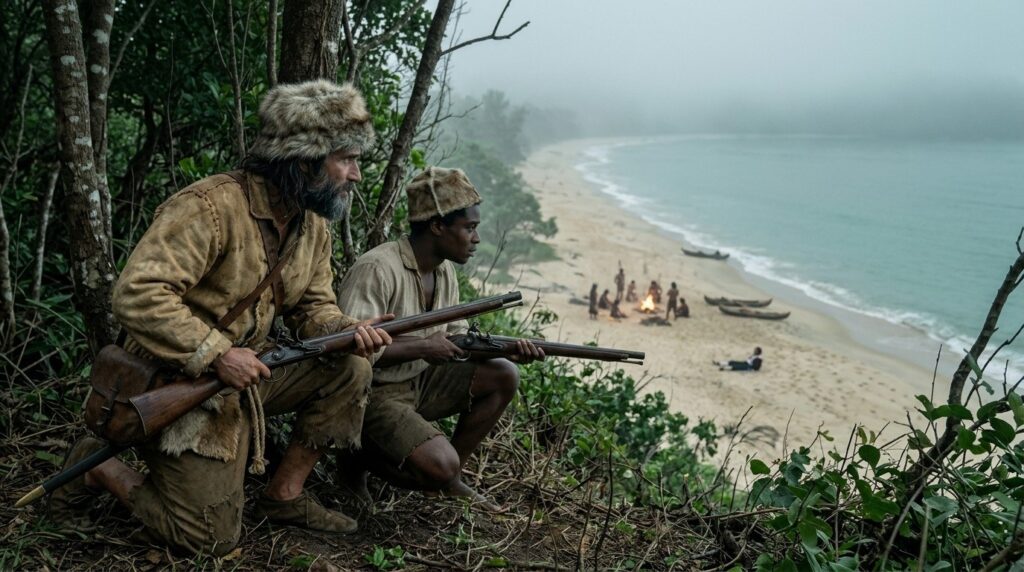
“Friday,” I said, “shoot when I shoot. Do you understand?” “Yes, Master,” he said. His hands were perfectly steady. I counted to three, and we fired together. Many of the visitors fell, and the others screamed and scattered in all directions. We ran out from the trees, shouting. Most of them leapt into their canoes and tried to escape, and only a few stayed to fight.
When the shooting stopped, I ran to the white man. He was lying on the sand, very weak but alive. I cut his ropes. He looked at me and said in Spanish, “Thank you! Thank you, my friend!” I did not understand all the words, but I understood his face. I gave him some rum from my bottle, and slowly he sat up.
He tried to stand, but his legs were too weak, so I gave him some bread and a little more rum. He took my hand and kissed it. He said many words in Spanish, quickly, and I did not understand all of them. But his eyes were full of tears, and I understood everything. I thought about how it feels to be a prisoner and to be saved when you had stopped hoping for it. I knew that feeling very well.
Then I heard a strange sound. It was Friday! He was running to the other prisoner. He threw himself on his knees beside him, laughing and weeping and shouting all at once. He kissed the old man’s hands and his face. He jumped up and down like a child. I could not understand it. Then I looked at the old man’s face, and I knew.
“Master!” Friday cried. “My father! It is my father!”
I shall never forget that moment. For years I had had no family and no friends, and now I saw a son and his father together. It was the most beautiful thing I had ever seen, and I felt tears in my own eyes. Friday sat with his father for a long time, holding his head and talking without stopping. I left them alone and went to look after the Spaniard.
That night Friday cooked for his father and fed him with his own hands. The old man looked at me and bowed his head. He said some words, and Friday told me, “He say, you are the best man in the world.” I felt ashamed, because I was only a tired man who had been too afraid for many years. “Tell him,” I said, “that his son is the best of men. He saved me, too.” Friday translated, and the old man smiled.
That evening, in my cave, the Spaniard told me his story with Friday’s help. He and sixteen of his companions were living among Friday’s people, in peace but without hope: they had no boat, no tools and no means of leaving. “If you can help us,” he said, “we shall be your friends for ever.” I looked at Friday and his father, and a plan began to take shape. The Spaniard and the old man would cross the sea and bring the other men here, and then, together, we would build a boat large enough for all of us.
That night I lay in bed and listened to the sounds of the house. Friday and his father were talking quietly, and the Spaniard was sleeping. For the first time in twenty-five years, my cave was full of people. I thought about the boat, the sea and the white men across the water. My mind was full of plans, and I could not sleep for a long time. It was the best kind of sleeplessness.
Words from this chapter
- depart – verb to leave
- armed – adjective carrying weapons
- examined – verb looked at carefully
- scattered – verb ran in many different directions
- steady – adjective not shaking
- weak – adjective not strong
- rum – noun a strong alcoholic drink
- weeping – verb crying
- meanwhile – adverb at the same time
- voyage – noun a long journey by sea
- mast – noun the tall pole on a ship that holds the sails
- leapt – verb jumped high or far
- sword – noun a long, sharp metal weapon
- nodded – verb moved the head down and up to say yes
- prisoners – noun people who are not free
- whispered – verb spoke very quietly
- ashamed – adjective feeling bad about something you did
- cave – noun a big hole in a rock or a hill
- companions – noun people who spend time or travel with you
- sleeplessness – noun not being able to sleep
Check your understanding
Why did Robinson need to wait before leaving?
What did Robinson and Friday do when they saw the prisoners?
What was Friday's surprise?
Reading is great. Speaking is better.
Talk about the story with a real teacher. Your first 25-minute lesson is free.
Book a free trial lessonFind your English level