The Spaniard and Friday’s father sailed away in a canoe loaded with provisions for many days. “We shall return in eight days,” the Spaniard promised, “and we shall bring the others.” I waved to them from the beach, and my heart was full of hope. Friday stood beside me. “Master, they come back soon,” he said. We began to count the days.
Every morning Friday looked at the west for a long time and said very little. I saw that he was worried about his father. “A canoe needs many days,” I told him, “and the wind is not always kind.” “Yes, Master,” he said, but his eyes did not smile. We repaired the boat and checked the mast, and we ate our supper without many words. In the evening we sat on the hill and watched the sun go down behind the mainland.
Eight days passed, and nobody came. Then ten, then twelve. Every morning I walked to the hill and searched the sea. I wondered whether the Spaniards had run into trouble, or whether they had simply forgotten us, and I felt my hope slowly begin to fade.
The sea stayed empty, and my old fear returned. After twenty-eight years, I thought, how can a few days seem so long? But hope is heavy, and every empty morning I had to carry it up the hill again. One evening I said to Friday, “Perhaps they are not coming.” He put his hand on my arm. “Master, Friday's father is strong. He no die. He come.” His voice was so sure that I felt a little better.
One morning, very early, Friday woke me by shaking my arm. “Master! Master!” he cried. “Boat! A boat is coming!” I ran to the hill with my telescope, and what I saw nearly stopped my heart. It was not a canoe. It was a ship’s boat with a sail, and it was English! There were eleven men in it, and three of them had their hands tied.
My legs were weak and my hands were cold. I counted the men again and again through the telescope: one, two, three, four, five, six, seven, eight, nine, ten, eleven. I looked at their faces. They were rough faces, tanned by the sun, and some of them looked angry. Friday studied my face and asked, “Master, why you cry?” I had not known that I was crying. “Because they are my people,” I said. “After so many years, they are my people.”
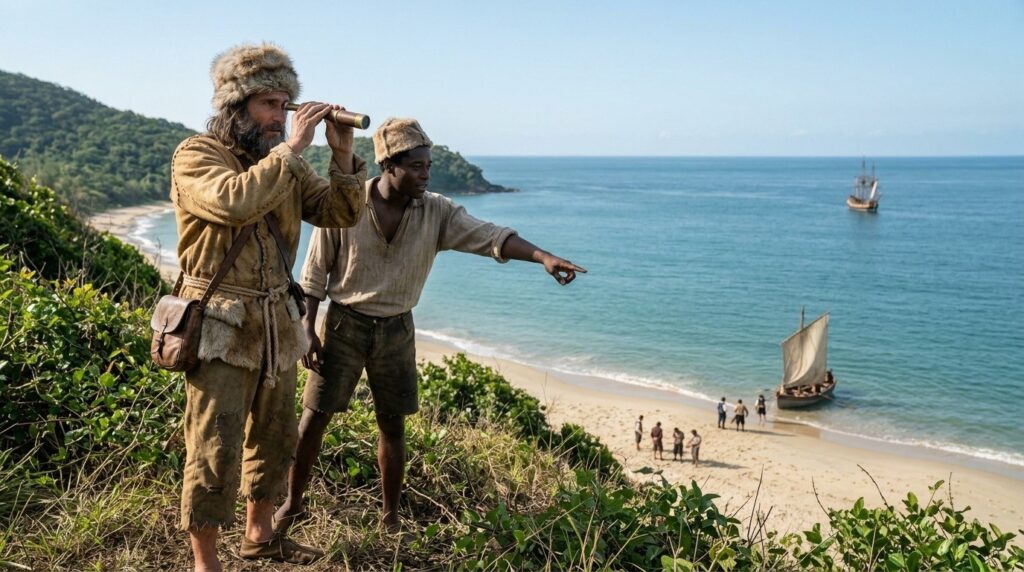
I could scarcely believe my eyes: English faces, English clothes, after twenty-eight years! I longed to run down and shout, but I forced myself to be cautious. “Friday, wait,” I said. “Something is wrong. Why are those three men bound?”
The boat touched the beach, and the men jumped out. Eight of them seized the prisoners and dragged them across the sand. They left them under a large tree, and then they wandered off into the woods without even a backward glance. Evidently they believed that nobody lived on the island.
From my hill I watched the men wander into the trees. Some sat in the shade, and some lay down on the grass and closed their eyes. They were careless, like men who think that nobody is near. Under the big tree the three prisoners sat with their heads down, and one of them covered his face with his hands. I felt a strange pity for him, because I knew very well how it feels to be alone at the end of the world.
I waited until evening. Then, with Friday behind me, I walked slowly towards the prisoners, and when I was close enough, I called out in English, “Gentlemen! Do not be afraid. I am a friend.” The three men started violently. They stared at me, at my goat-skin hat, my long beard and my guns. “Who are you?” one of them asked. “Are you a man or an angel?”
My words came out slowly and strangely, because I had not spoken English to an Englishman for twenty-eight years. The three men stared at me, and one of them began to laugh, and then he began to weep. I understood that, for them, I was a miracle: a wild man in goat skins had stepped out of the bushes and spoken to them in their own language. And in that moment I understood that, for me, they were a miracle, too.
“I am an Englishman,” I said, “and I have lived on this island for twenty-eight years. Perhaps I can help you.” The man burst into tears. He was the captain of a ship, and he told me a terrible story. His crew had mutinied in the night and taken command, led by the boatswain. “They meant to kill us,” the captain said, “but some of them lost their nerve. So they have brought us to this island, bound us, and intend to leave us here, where no one will ever find us.”
“Captain,” I said, “if I help you to recover your ship, what will you do for me?” He stared at me. “Anything,” he said. “I will carry you and your friend to England, and I will give you my life besides. Only help us!”
Words from this chapter
- provisions – noun supplies of food
- fade – verb to become weaker
- cautious – adjective careful to avoid danger
- seized – verb took hold of something suddenly and firmly
- evidently – adverb clearly
- mutinied – verb refused to obey the captain and took control of a ship
- boatswain – noun an officer on a ship who looks after the crew
- recover – verb to get something back
- canoe – noun a long, narrow boat moved with paddles
- mast – noun the tall pole on a ship that holds the sails
- mainland – noun the big land, not the island
- simply – adverb just; only
- forgotten – verb not remembered
- tanned – adjective (skin) made into leather
- scarcely – adverb almost not
- longed – verb wanted very much
- forced – verb made someone do something they did not want
- dragged – verb pulled along the ground with difficulty
- wandered – verb walked slowly with no special aim
- glance – noun a quick look
- wander – verb to walk slowly with no special aim
- pity – noun a feeling of sadness for someone who suffers
- gentlemen – noun polite word for men
- violently – adverb with great force
- weep – verb to cry
- miracle – noun a wonderful thing that seems to come from God
- burst – verb broke open suddenly
- command – noun an order; control over people
- nerve – noun courage
- besides – adverb also; in addition
Check your understanding
Why did Robinson's hope begin to fade?
What did the mutineers do with the prisoners?
What did the captain promise?
Reading is great. Speaking is better.
Talk about the story with a real teacher. Your first 25-minute lesson is free.
Book a free trial lessonFind your English level