That night I took the captain and the two other men to my home. They were tired and hungry, and they looked around my fence and my cave in surprise. I gave them bread, cheese and a cup of rum. “You are safe here,” I told them. “Now we must think about the ship.”
The captain looked at everything: the ladder, the high fence, the thick green forest and my cool cave. “I cannot believe it,” he said. “One man built all this, alone.” I laughed and showed him my pots, my goats and my fields. He touched the bread with his fingers, and he said, “This is a real home.” That night the three men slept on dry grass in my cave, and I heard them breathing. I listened to them for a long time, and I was very happy.
I told the captain my plan. There were eleven bad men. Three men stayed in the boat, but the others walked in the woods. “If we are careful, we can catch them one by one,” I said. “We have guns, and they do not know that we are here.” The captain was happy. “You are a clever man,” he said. “I will do what you say.”
That night I could not sleep. I checked my guns again and again. Friday cleaned his, and he put it near the door. I remembered the many nights when I lay awake in fear, alone. Tonight I was not alone. I had a friend and three more men, and I had a plan. I looked at the stars through the hole in the roof, and I thought, “Tomorrow everything will change.” It was a good feeling, and it was also a little frightening.
The next morning we waited near the boat. The boatswain and some of the men came back from the woods, and they were looking for the prisoners. They found nothing! The prisoners were not under the tree. Where were they? The men looked at each other, and they were very afraid. The captain stepped out from the trees with a gun in his hand. “Put down your weapons,” he said. Some of the men ran away, but the others stopped. We took their guns, and we tied their hands.
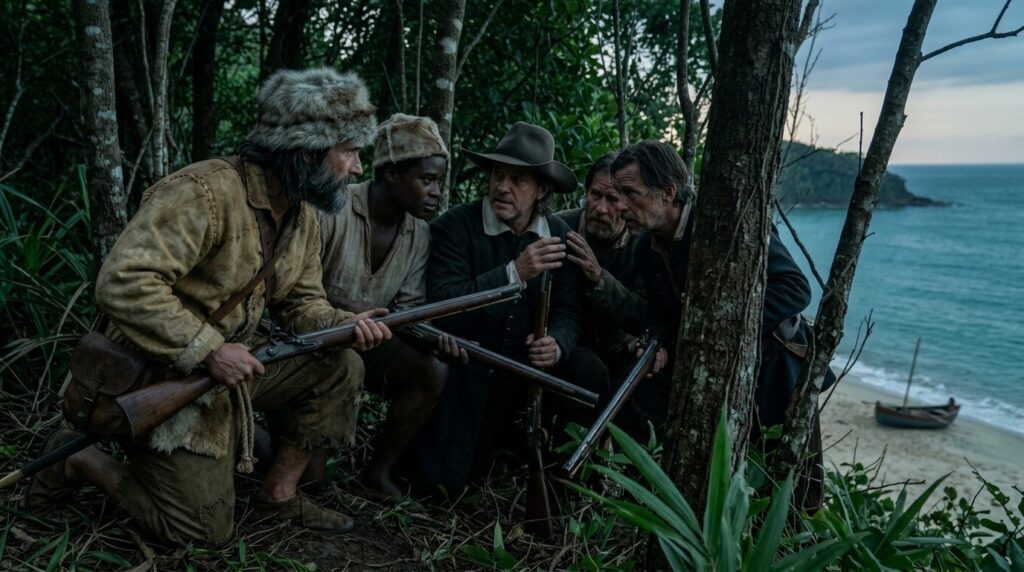
I looked at Friday. “Friday,” I said, “we need to be clever.” He shouted loudly in the woods, in different voices, and the men who were hiding thought that many people were there. I laughed, because it was very funny. At last, all of them were prisoners. The captain’s old sailors came to him, and they promised to be loyal again.
Now we needed the ship. It was waiting in the bay, with about ten men on board. In the evening, we took the small boat, and we rowed to the ship. We called out in the voices of the bad men. “Come, come, we have the prisoners!” The men on the ship did not know about our plan. They came down, one by one, and the captain’s sailors took them. The fighting was short. When the sun came up, the ship was ours.
At sunrise the captain stood on the deck of his ship, and he put his hand on the wheel. Then he bent down and kissed the wood. His sailors cheered, and some of them wiped their eyes. I walked on the deck slowly, like a ghost. The ship was huge. I touched the ropes, the sails and the wooden walls, and I smelled the tar and the salt. After twenty-eight years, I was on a real ship again, and I could not believe it.
The captain shook my hand. He said, with tears in his eyes, “Sir, you gave me back my ship, and my life.” He told his men to give me clothes, and I took off my skins for the first time in twenty-eight years. I felt strange, like a boy in his first suit.
Before we left the island, I took a long walk alone. I touched my fence and my post with the notches. I stood in the middle of my field, and I looked at my goats. I said goodbye to the little stream, to the cave, to the valley with the grapes. I thought about the man who came here, wet and afraid, with a knife and a pipe. That man was young. This man was old. But I was not sorry. I loved the place that was my prison, and my school, and my home.
On the ship, the captain gave me a mirror, and I looked at myself for the first time in twenty-eight years. I did not know the man in it. His beard was grey, his skin was dark, and his eyes were full of lines. The ship's barber cut my hair and my beard, and he made me look like an Englishman again. When he finished, I looked younger, but I still did not feel like the Robinson who left York.
The captain wanted to punish the bad men, but I asked him to be kind. “Let them live here,” I said. “They can learn to farm the island, as I did.” Five of them chose to stay. I gave them my tools and my seeds, and I told them how to live. Then I said goodbye to my little home. I took with me my goat-skin hat, my umbrella and my parrot, Poll. On the last day, we went on board, and the ship sailed away from the island that was my home.
Words from this chapter
- rum – noun a strong alcoholic drink
- fence – noun a wall made of sticks or wood
- weapons – noun things that you use to fight, like guns
- loyal – adjective always faithful to a friend
- bay – noun a part of the sea that goes into the land
- rowed – verb moved a boat with oars
- tears – noun the drops of water that come from your eyes
- tools – noun things that you use to do a job
- captain – noun the person in charge of a ship
- cave – noun a big hole in a rock or a hill
- surprise – noun something you did not expect
- cheese – noun a yellow or white food made from milk
- safe – adjective not in danger
- ship – noun a large boat
- ladder – noun steps you can move, for climbing
- thick – adjective wide; with things close together
- forest – noun a large area with many trees
- believe – verb to think that something is true
- built – verb past of build
- alone – adjective without other people
- laughed – verb made a happy sound
- pots – noun round containers for cooking or keeping food
- goats – noun farm animals with horns
- fields – noun open areas of land for animals or plants
- touched – verb put the hand on something
- slept – verb past of sleep
- awake – adjective not sleeping
- fighting – verb trying to hurt someone
- sunrise – noun when the sun comes up
- bent – verb moved your body down
- cheered – verb shouted because they were happy
- wiped – verb cleaned with a cloth
- huge – adjective very, very big
- tar – noun a black, sticky liquid
- notches – noun small cuts in wood
- mirror – noun glass in which you see yourself
- chose – verb past of choose
- umbrella – noun a thing you hold over your head against rain or sun
Check your understanding
How did Robinson and the captain catch the bad men?
What did Friday do in the woods?
What did Robinson ask the captain to do?
Reading is great. Speaking is better.
Talk about the story with a real teacher. Your first 25-minute lesson is free.
Book a free trial lessonFind your English level