In London I met another captain. He often sailed to Guinea, a hot country in Africa. “Come with me,” he said. “You can make money there.” I thought about my father. Then I thought about money, and I said yes.
I bought some cheap things in London: toys, knives and scissors. In Africa I sold them, and I came back to England with gold. It was a great trip. The captain was a good man and a good teacher. He showed me how to read a map and how to use the stars. But he was old, and he died soon after our trip.
I wanted to go to Africa again. This time I borrowed money and bought more things to sell. “I will be rich,” I thought. I did not write to my mother and father. I was too proud. “When I am rich, I will go home,” I said. “Then my father will be proud of me.”
We sailed south along the coast of Africa. One morning a fast ship came out of the fog. It had many men and many guns. “Pirates!” somebody shouted.
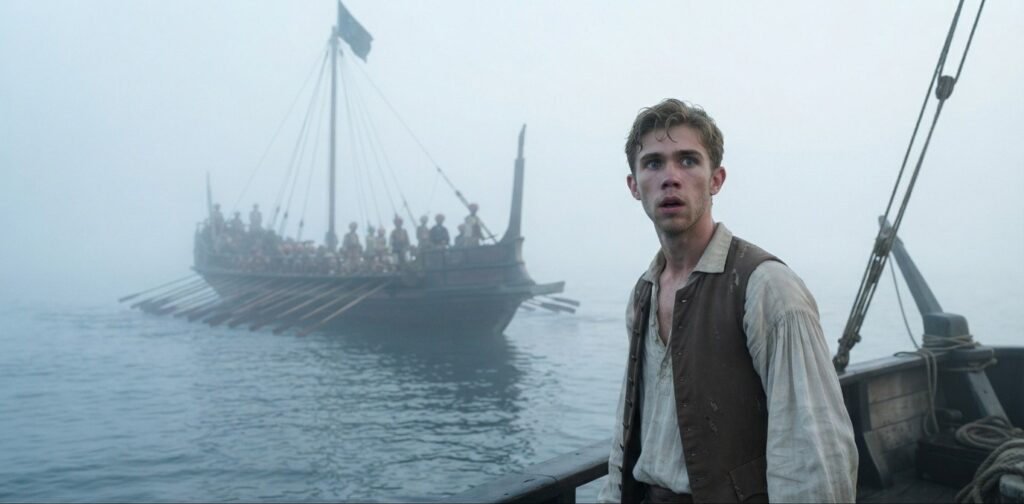
We tried to sail away, but the pirate ship was too fast. Then we fought. But the pirates had more men and bigger guns. After a few hours they took our ship. They took all of us to their town, Salé, in the north of Africa.
Salé was a white town with high walls and a busy market. People stopped in the street and looked at us. I was tired and thirsty. I did not understand their language.
The pirate captain looked at me. “This young man is mine,” he said. Now I was his prisoner and his slave. Every day I worked in his house and in his garden. I washed the floors, carried water and cut wood. A man watched me all the time, and I could not leave. The food was bad, and the work was hard. I had no friends in that place.
There was a high white wall around the garden. Between two houses I could see a small piece of the sea. I looked at it every day. Now I understood something important: nobody should be the slave of another person.
At night I sometimes cried. I remembered my father’s words. He was right, and I was wrong. I was not rich now. I was a slave.
I lived like this for two long years. But every evening I looked at the sea, and I said to myself, “One day I will escape.”
Words from this chapter
- prisoner – noun a person who cannot go free
- pirates – noun bad men who take ships and money on the sea
- cheap – adjective it does not cost a lot of money
- toys – noun things that children play with
- knives – noun more than one knife; you cut things with them
- sold – verb gave things for money (past of sell)
- gold – noun a yellow metal that costs a lot of money
- map – noun a picture of a country or the sea, from above
- stars – noun small lights in the sky at night
- borrowed – verb took money that you must give back later
- proud – adjective feeling that you are very good or important
- fog – noun a grey cloud near the ground or the sea
- fought – verb had a fight (past of fight)
- walls – noun the sides of a building or a town
- market – noun a place in the street where people buy and sell things
- thirsty – adjective you want to drink
- language – noun words that people speak, for example English
- slave – noun a person who must work for another person and is not free
- carried – verb took something in your hands from one place to another
- garden – noun a place with flowers and trees next to a house
- escape – verb to get away from a bad place
Check your understanding
What did Robinson sell in Africa?
Who took Robinson’s ship on the second trip?
What did Robinson do every day in Salé?
How long was Robinson a slave?
Reading is great. Speaking is better.
Talk about the story with a real teacher. Your first 25-minute lesson is free.
Book a free trial lessonFind your English level