One evening I sat in front of my tent and thought about time. What day was it? What month was it? I did not know. On the island there were no clocks and no calendars. “If I do not count the days, I will forget them,” I thought.
So I made a calendar. I found a big piece of wood and made a tall post. I put it in the ground near the beach. With my knife I wrote on it: “I came here on the 30th of September, 1659.” Every day I cut one line in the post. On Sundays I cut a longer line. On the first day of every month the line was even longer. In this way I always knew the date. Counting the days was very important for me.
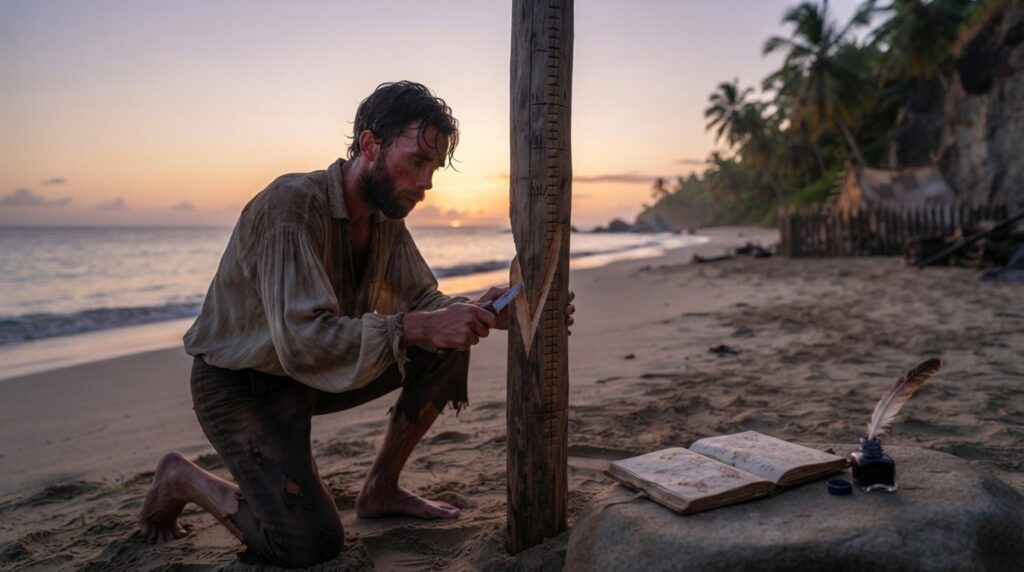
Every morning I walked to the post. I cut a new line, and I said the date: “Today is Tuesday, the second of October.” My voice was the only voice on the island. At first it sounded strange. But I liked this little job. It was like a “good morning” from a friend.
In the boxes from the ship I found pens, ink, paper and some books. “Now I can write a diary,” I said. Every night I wrote about my day: the weather, my work and my thoughts. Sometimes I wrote only a few words: “Rain. I made a shelf.” Sometimes I wrote for an hour about my family and my old life. When I wrote, I did not feel so alone.
In the first weeks I was very sad. I cried a lot. One night I could not sleep. So I took my pen and made a list. On one side I wrote the bad things. On the other side I wrote the good things.
Bad: I am alone on an island. I have no friends here. I cannot talk to anybody.
Good: But I am alive. My friends died in the sea, but I did not. I have food and water. I have guns and tools. There are no dangerous animals here.
I looked at the list for a long time, and I felt a little better. “There is always something good,” I said, “when you look for it.” After that night I did not cry so often.
I made a plan for every day. I woke up with the sun and washed in the river. I worked in the morning. At noon it was too hot, so I rested in the shade. In the afternoon I worked again. In the evening I wrote in my diary. When I was tired, I slept well.
The rain came in the autumn. For many days I stayed in my cave. But I was not bored. I had my calendar, my diary, my dog and my two cats.
Words from this chapter
- counting – verb saying numbers to know how many
- time – noun minutes, hours and days
- month – noun January, February and so on
- clocks – noun things on the wall that show the time
- calendar – noun a list of the days, weeks and months of the year
- post – noun a tall piece of wood in the ground
- knife – noun a tool for cutting
- line – noun a long, thin mark
- date – noun the number of the day and the month, for example 2 October
- voice – noun the sound you make when you speak
- pens – noun you write with them
- ink – noun the blue or black water in a pen
- diary – noun a book where you write about your day
- shelf – noun a flat board on a wall for books and things
- list – noun things written one under the other
- noon – noun twelve o’clock in the day
- rested – verb stopped working and sat or lay down
- afternoon – noun the time between noon and the evening
- autumn – noun the season before winter
- bored – adjective not interested; with nothing to do
Check your understanding
What did Robinson make to count the days?
When did Robinson come to the island?
What did Robinson write every night?
What did Robinson do at noon?
Reading is great. Speaking is better.
Talk about the story with a real teacher. Your first 25-minute lesson is free.
Book a free trial lessonFind your English level