One evening, as I sat outside the tent watching the light fade over the water, I realised that I was in danger of a different kind. I had no clock, no calendar and no neighbour to ask what day it was. If I allowed the days to blur into each other, I thought, I might gradually lose not only the date but also my sense of who I was, and I had seen enough of loneliness to know that it could do such things to a mind.
I made a calendar the following morning. I cut a thick post from a tree and set it upright on the beach where I had first come ashore. With my knife I carved the words, “I came on shore here on the 30th of September 1659.” Every day I cut a notch in the wood. Every seventh notch was longer, to mark a Sunday, and the first notch of each month was longer still. It was a crude instrument, but it gave me back the one thing that I had been losing: the right to know where I stood in time.
Every morning the first thing I did was to walk down to the post, cut a new notch and say the date aloud: “It is Tuesday, the second of October.” My voice was the only voice on the island, and at first it sounded strange even to me. But I came to love this small ceremony; it was like a good morning from an old friend. The post stood on the beach, grey and tall, and I told myself that any passing ship would see it from far away.
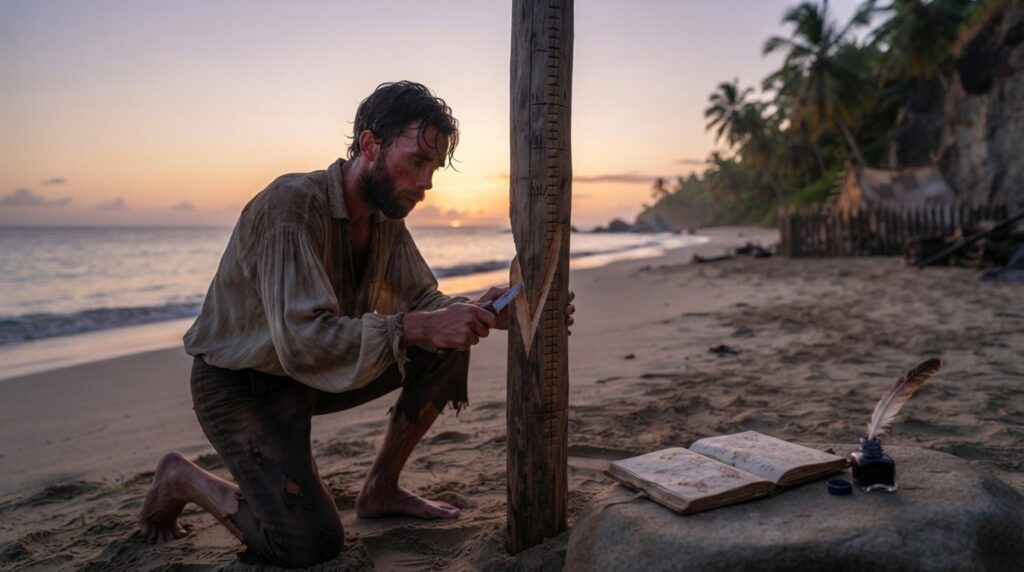
Among the things I had saved from the wreck I found pens, a bottle of ink, a few books and a stack of paper. I decided to keep a journal. Each night I wrote down what I had done, what the weather had been like and what I felt, and I discovered that the very act of choosing words made my situation easier to bear. A man who is writing to somebody, even to himself, is not entirely alone.
Some days I wrote only a few words. “1 October. Rain. Carried the last box.” “8 October. Saw a goat on the hill, but it ran away.” “15 October. Made a shelf. It is not straight, but it works.” On other days I wrote for an hour, about my father, my mother, the sea and the strange sounds of the night. The pages became a small book of my new life, and each of them said, in its own way: Robinson was here.
In the evenings I also read aloud from my few books, to the dog and the cats, who were not demanding critics. I discovered that a human voice, even my own, was a kind of food. The words did not matter as much as the sound, and sometimes I laughed at myself, a grown man reading poetry to a cat that was busy washing its face.
In those early weeks, however, there were still nights when despair overwhelmed me. On one of them, unable to sleep, I lit a lamp and did something that I now believe saved my sanity. I drew a line down the middle of a page and set out my situation as if I were an accountant, with evil on the left and good on the right.
On the left, I wrote that I was cast away on a desolate island, that I had no hope of rescue, that I had no company and few clothes. On the right, I wrote that I was alive when all my companions were dead, that I had food and fresh water, guns and tools, and that there were no savage beasts on the island that might devour me.
I read it over and over. Nothing on the left side had changed, but the right side had changed the meaning of the whole page. From that night on, I taught myself to begin each morning by looking at the right-hand column, and in the long rainy season that followed, when I was shut up in my tent for days on end, that habit kept me sane.
I made a plan for every day and kept to it. I woke with the first light and washed in the stream. I worked until noon, then rested in the shade while the sun was at its height, and in the afternoon I worked again. In the evening I wrote in my journal. A man who is busy has little time to be sad, and when I was tired at the end of the day, my thoughts grew quiet and I slept well.
In the rainy days I thought a great deal about England. I imagined my mother in the kitchen and my father at his desk with his letters, and sometimes I spoke to them in my head. “Father, you were right about the middle way of life,” I said. “I was a fool.” I was no longer angry with myself. I was sad, and I was also a little grateful. Perhaps I had needed to lose everything before I could understand it.
Words from this chapter
- blur – verb to become unclear and mixed together
- notch – noun a small cut in the surface of something
- crude – adjective simple and not very carefully made
- overwhelmed – verb completely defeated by a strong feeling
- sanity – noun the ability to think in a healthy and normal way
- accountant – noun a person who keeps lists of money
- desolate – adjective empty and very sad
- devour – verb to eat something quickly and hungrily
- tent – noun a home made of cloth
- fade – verb to slowly become less bright or strong
- calendar – noun a list of the days of the year
- gradually – adverb slowly, little by little
- loneliness – noun being sad because you are alone
- upright – adverb standing straight up
- ashore – adverb onto the land from the sea
- carved – verb cut wood or stone into a shape
- ceremony – noun a formal event for an important occasion
- wreck – noun a ship that is broken
- ink – noun coloured liquid for writing
- stack – noun a pile
- journal – noun a book where you write about your days
- discovered – verb found something for the first time
- entirely – adverb completely
- despair – noun the feeling of having no hope
- rescue – noun saving someone from danger
- savage – adjective wild and violent
- beasts – noun large or wild animals
- habit – noun something you do often, without thinking
- sane – adjective mentally healthy
- height – noun how high something is
Check your understanding
Why did Robinson feel in danger of losing his mind?
What did Robinson's journal give him?
What changed how Robinson saw his situation?
Reading is great. Speaking is better.
Talk about the story with a real teacher. Your first 25-minute lesson is free.
Book a free trial lessonFind your English level