Life on the island remained hard, but I was determined to improve it, and I began with the cave. Day after day I dug into the rock with my pick and carried the loosened earth out in a basket, until I had made a large, cool chamber behind my tent. There I stored my food, my powder and my tools, safe from the weather and from any prying eyes. It took many weeks, but the satisfaction was out of all proportion to the labour.
The cave was dark and full of dust, and I worked with a cloth tied over my face. As the chamber grew larger, I began to worry that the roof might give way, so I cut strong posts from the trees and set them beneath it like the legs of a table. I looked at them with pride. “Now it is safe,” I said. I did not know that very soon I would learn to fear that roof, and the whole hill above it.
Then I turned my attention to furniture. In England, I would have walked into a shop and chosen a table and a chair in ten minutes. Here, I had to create everything from nothing. I felled a tall tree, which took the best part of a day, and then split and trimmed it into planks with my axe, my saw and a great deal of patience. A craftsman in England could have cut a dozen planks from that trunk. I made one, and it took me forty-two days. But I refused to let that discourage me. In time I produced a decent table, a chair and a set of shelves for my books and tools, and the first evening that I sat at my own table, with a plate of food in front of me, I felt like a king in his own palace.
My axe soon grew dull, and I could no longer cut the hard wood. I needed a grindstone and had none, so I built a wheel from timber, fixed a flat stone in the middle and turned it with my foot, while I held the blade against the stone with both hands. It was slow, exhausting work, and it took me the best part of a week. But when it was finished my axe was sharp again, and I was extremely pleased with myself.
I also longed for fresh meat. One morning I took my gun and climbed to the hills, where I noticed a herd of wild goats. I shot one of them, and the rest bounded away across the rocks. It was heavy, and I carried it home across my shoulders, and that night I cooked a meal that tasted better than any dinner I could remember.
The sound of my gun was enormous on that quiet hill. Birds flew up from every tree, and my dog ran in circles, barking with excitement. I felt a little sorry for the goat and very glad for myself. I cut the meat into thin strips and dried some of it in the sun for later. Now I no longer lived on bread and rice alone. I had meat, and for a man alone on an island, meat is a feast.
A few days later, I was standing at the mouth of my cave when I heard a terrible rumbling behind me. A mass of earth fell from the roof, and the ground began to heave under my feet. I ran outside and saw the top of the hill sway, and enormous stones came bouncing down the slope. Three shocks followed one another, and the sea in front of me churned and foamed, although there was not a breath of wind. I had never experienced an earthquake, and I was so frightened that I felt physically ill. I sat on the ground, with my head between my hands, trembling.
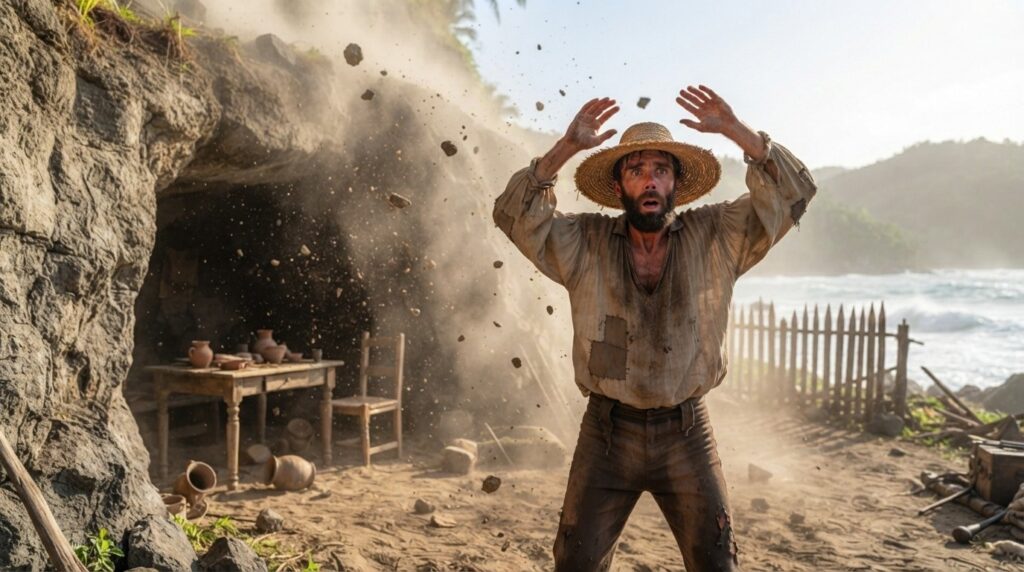
I did not move for a long time. Everything was silent; even the birds had stopped singing. Then the earth shook again, and I heard stones tumbling down the hillside like thunder. I looked at the mouth of my cave and thought, “If I had been inside, I would be dead now.” My hands were cold. When I looked at the posts that held up the roof, I saw that one of them had already cracked.
Soon a heavy storm arrived, with howling wind and lashing rain, and it seemed that the whole island was in a rage. Huddled in my tent, I made myself think calmly. If another quake struck, I reasoned, my beautiful cave could easily become my grave. I could not live beneath that cliff any longer.
By morning, my decision was made. I would build a new and safer home, well away from the hill. I was reluctant to abandon the cave on which I had spent so many weeks, but I had no wish to be buried in it.
In the end I did not abandon the cave entirely. I used it as a storeroom for the things I did not need every day: boxes, barrels and tools. But I never slept in it again. My new home stood in the open, near the sea, where nothing could fall on my head. I was a little sad, because I had worked so hard on the cave. But a man who stays alive can always build again.
Words from this chapter
- pick – noun a tool with a pointed metal head, used for digging
- chamber – noun a large room
- proportion – noun the relationship between two amounts
- felled – verb cut down
- planks – noun long flat pieces of wood
- herd – noun a group of animals of the same type
- rumbling – verb making a long, deep sound
- heave – verb to move up and down with great force
- determined – adjective having decided firmly to do something
- improve – verb to make better
- stored – verb kept for later
- satisfaction – noun the pleasant feeling of having what you want
- trimmed – verb cut a little to make tidy
- craftsman – noun a person who is skilled at making things by hand
- decent – adjective good and acceptable
- palace – noun a very big house of a king or queen
- timber – noun wood used for building
- blade – noun the flat, sharp part of a knife or sword
- extremely – adverb very, very
- longed – verb wanted very much
- enormous – adjective extremely big
- sway – verb to move slowly from side to side
- slope – noun ground that goes up or down
- churned – verb moved violently, like water in a storm
- foamed – verb made white bubbles
- physically – adverb in the body
- trembling – verb shaking because of fear or cold
- tumbling – verb falling and rolling
- howling – verb making a long, loud crying sound
- lashing – verb hitting hard, like rain or waves
Check your understanding
Why was Robinson's satisfaction with the cave so great?
How did Robinson feel at the end of the earthquake?
What did Robinson decide?
Reading is great. Speaking is better.
Talk about the story with a real teacher. Your first 25-minute lesson is free.
Book a free trial lessonFind your English level