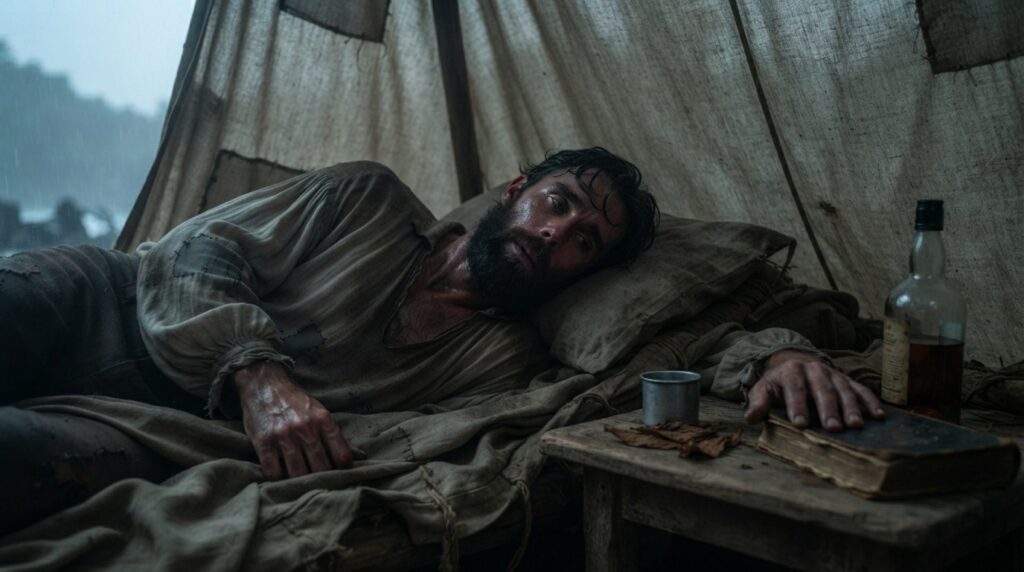
The weeks went by, and I worked on my new home at a measured pace, since the rains were coming and there was no hurry. By June 1660 I had spent about nine months on the island. One morning I woke up with a heaviness in my head and a deep chill in my bones, and when I tried to stand, my legs gave way beneath me. By evening a violent fever had taken hold of me. I shivered with cold, then burned with heat, then shivered again, in a cycle that seemed to have no end. I was terrified. I had no doctor, no medicine and no one to bring me a cup of water, and I was quite convinced that I was going to die.
On the second day I tried to reach the stream for water. I stood up and managed ten steps before I fell to the ground. I lay in the sun for a long time with my head full of strange noises, and at last I crawled back to my tent on hands and knees, where I found a bottle with a little stale water in it. It was the worst water I have ever drunk, and I have never been so grateful for anything.
For several days I lay on my bed, unable to eat or work. “It will end here,” I thought, “and nobody will ever know what became of me.” It was an unbearable thought, and yet I could do nothing about it.
My dog stayed close to me every day, lying beside my bed and sometimes pushing his nose into my hand, while the cats sat on my feet. They did not understand why I was ill, but they did not leave me. In those lonely days the three of them were my doctors, and I owe them more than I can say. When a man is sick and alone, even a dog's warm head is a medicine.
On one of those nights I had a dream that I shall never forget. I saw a man descend from a black cloud, standing in a ring of fire so bright that I could barely look at him. He stepped on to the ground, and the earth shook beneath him, as it had shaken during the earthquake. “All these things have not made you change your life,” he said, in a voice that froze my blood. “Now you shall die.” I woke up screaming, drenched in sweat, and in the dark, for the first time in many years, I examined my conscience. I thought about my father’s advice, about the lonely way I had left home, and about the hard, selfish choices that I had made since. I felt very small, and very guilty.
I lay in the dark and examined my life. I thought of the day I had left my parents' house without a word, and of my father's tears; I thought of the storm, of the pirates, and of the promise to heaven that I had never kept. “How many chances did God give me?” I asked myself. “And how many times did I refuse?” I was ashamed. For the first time, I did not try to find an excuse.
As soon as I could walk, I searched my boxes for something that might help me. In a sailor’s chest, I found some tobacco, and I remembered a man in Brazil who had praised it as a medicine. I steeped some of the leaves in a cup of rum and drank it. It made me drowsy, and I slept for hours, and when I woke, I was a little better.
At the bottom of the chest I came across a Bible that I had never looked at. I opened it at random, and my eyes fell on these words: “Call on me in the day of trouble, and I will help you.” I read them over and over, and tears poured down my face. I fell to my knees and prayed, for the first time in years, with real feeling. “Thank you for my life,” I whispered. “Please do not leave me now.”
I read slowly, one line at a time. I did not understand everything, but some of the words were like a lamp lit in a dark room. I remembered my father in church with his head bowed, and I wished that he could see me now. I read until evening, and then I closed the book and held it against my chest like a child. It was not a magic book, but it spoke to me, and no one else on the island could do that.
Gradually, the fever left me, and within a few weeks I was strong again. But I was no longer the same man. I began to read a few pages from the Bible every morning, and I found that it brought me a kind of peace that I had never known. I started to ask myself a new question. Perhaps the sea had not tried to destroy me after all. Perhaps it had spared me for a reason, and my task was to discover what that reason was.
I began to look at the island in a new way. Before the fever it had been a prison, and I had thought only of leaving it. Now it was also a place where I could begin again. I had time, I had work, and I had been given a second chance. Every morning I thanked God for the new day, and I started to look at the tall hills and the green valleys in the distance, and to wonder what lay on the other side.
Words from this chapter
- measured – adjective slow and careful
- convinced – adjective completely sure
- descend – verb to come down
- drenched – adjective completely wet
- selfish – adjective caring only about yourself
- steeped – adjective left in a liquid so that the taste or effect goes into it
- drowsy – adjective feeling sleepy
- random – adjective without a plan
- pace – noun the speed of walking or moving
- chill – noun a cold feeling
- beneath – preposition under
- violent – adjective using force to hurt; very strong
- fever – noun a high temperature when you are ill
- shivered – verb shook because of cold or fear
- seemed – verb looked like; appeared to be
- terrified – adjective extremely afraid
- medicine – noun something you take to get better
- quite – adverb fairly; very
- managed – verb succeeded in doing something difficult
- crawled – verb moved on hands and knees
- stale – adjective not fresh
- grateful – adjective wanting to say thank you
- unbearable – adjective too bad to accept
- barely – adverb only just; almost not
- froze – verb stopped moving because of fear
- examined – verb looked at very carefully
- conscience – noun the voice inside you that tells you what is right or wrong
- praised – verb said good things about
- gradually – adverb slowly, little by little
- destroy – verb to damage something so badly that it no longer exists
Check your understanding
How did Robinson's dream affect him?
Where did Robinson find the Bible?
What new question did Robinson ask himself?
Reading is great. Speaking is better.
Talk about the story with a real teacher. Your first 25-minute lesson is free.
Book a free trial lessonFind your English level