I had a heap of treasures, but I had no home, and I understood that a man cannot live indefinitely on a beach with his boxes around him. By day the sun beat down with merciless force, and at night every sound in the dark made my heart race. Worse still, I did not know whether the island was inhabited. Until I did, I would have to behave as if I had enemies.
I drew up, in my mind, a list of requirements. My home had to be close to fresh water and offer some shelter from the heat. It had to be secure against wild beasts and any human visitors. And it ought to command a view of the sea, since I still allowed myself to hope that one day a sail would appear on the horizon.
For two days I walked along the coast and over the hills, judging every site against my list. One place lay beside a stream, but the sea flooded it at high tide. Another offered good shade but no water. A third was so choked with thorn bushes that I could not force my way through. I returned to the beach in the evening with sore feet and an empty stomach. “A home is not easily found,” I told my dog, and he looked at me as though he agreed.
After a long search I found a place that met all four conditions. On the side of a hill lay a small level meadow, and behind it rose a sheer wall of rock, as steep and smooth as the front of a house. A little stream ran not far away. Nobody could approach me from behind or from above, and from the meadow I could watch the whole of the sea. “This is it,” I said aloud to the dog, and he wagged his tail as if he approved.
In the evening I sat on the soft grass with my back against the warm rock and watched the sun go down over the sea. The sky turned red, then purple, then a deep dark blue. For the first time on the island I did not feel like a hunted animal; I felt like a man who was at home. It was only a small piece of grass, but it was mine.
First, I put up a tent made from the old sails. Then I began to build a defence. I cut a large number of strong stakes, each as tall as myself, and drove them deep into the ground in a half circle, so close together that not even a hand could pass between them. Inside the line, I piled thick lengths of ship’s cable, which made the fence far stronger than it looked. I made no door at all. I climbed in and out by a short ladder, and I pulled it after me, so that behind the stakes I felt as safe as a king in his castle.
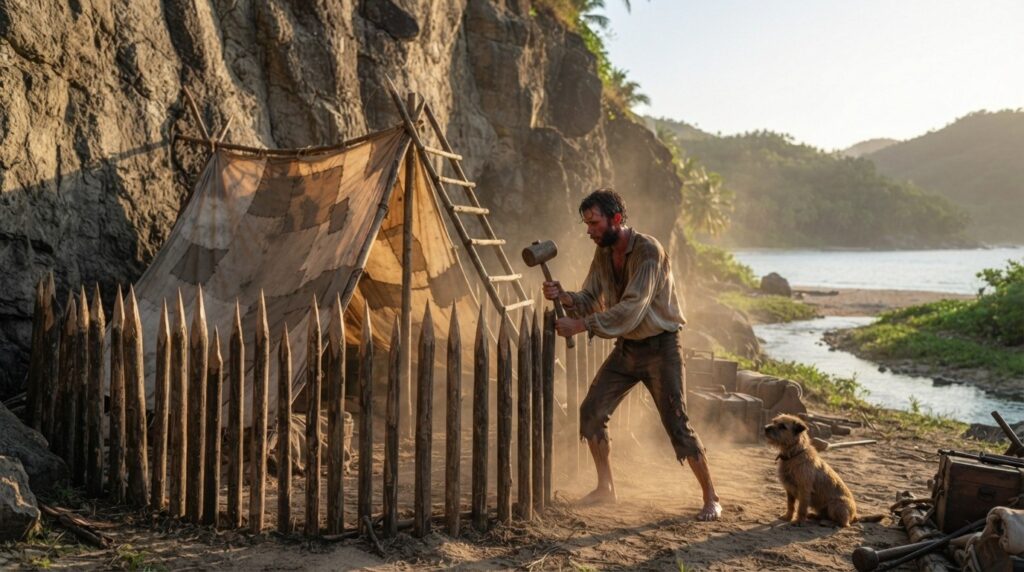
That night I climbed the ladder, drew it up behind me and lay down in the tent. I heard the wind in the trees and the small waves on the beach, but I was not afraid. My guns lay beside me, and my dog slept at my feet. “Nothing can come in,” I thought, “and nothing can see in.” Within minutes I was asleep, and I slept better than I had for many weeks.
It was exhausting labour, and my back was burnt and my hands were raw by the time I finished. Yet the work was a medicine in itself. As long as I had something to build, I had no time to despair.
I arranged my belongings with the care of a shopkeeper. The food went into the boxes, and the boxes into the coolest corner. The guns hung on two pegs near my bed, and the tools lay on a shelf that I had made from a board of the ship. Everything had its place, and when I put out my hand in the dark, I always found what I wanted. Good order, I discovered, is a kind of companionship.
When the fence was complete, I carried all my possessions inside and began to dig a cave into the rock behind the tent, to give myself a cool and secure storeroom. And then, one afternoon, a violent thunderstorm rolled in over the island. A single flash of lightning would have been enough to turn my powder into a bomb, and the thought paralysed me. When the weather cleared, I spent two weeks dividing my powder into about a hundred small packages, which I hid in separate places among the rocks. It was tedious, but I slept better afterwards, and in my situation a good night’s sleep was worth almost any price.
That night I lay awake thinking about my new life. In England I had never given a moment's thought to lightning. Here a single flash could end everything. I understood that on the island I was responsible for every small detail: the water, the food, the fire, the fence, even the weather inside my own head. It was a heavy thought, but it was also a strengthening one. “If I must think of everything,” I said, “then I shall think of everything.”
Words from this chapter
- indefinitely – adverb for a very long time with no end
- merciless – adjective showing no pity
- inhabited – adjective having people living there
- sheer – adjective very steep, almost vertical
- stakes – noun strong sticks with a point at one end
- cable – noun a very thick rope
- paralysed – adjective made unable to move
- tedious – adjective boring and taking a long time
- heap – noun a big, untidy pile
- shelter – noun a place that protects from weather or danger
- heat – noun the quality of being hot
- secure – adjective safe; firmly fixed
- beasts – noun large or wild animals
- command – noun an order; control over people
- view – noun what you can see from a place
- horizon – noun the line where the sky and the sea meet
- flooded – verb filled with water
- tide – noun the rise and fall of the sea
- offered – verb said you would give or do something
- choked – verb could not breathe because something blocked the throat
- meadow – noun a field of grass and flowers
- rose – verb went up (past of rise)
- defence – noun protection from attack
- labour – noun hard physical work
- despair – noun the feeling of having no hope
- belongings – noun the things that you own
- companionship – noun having friends or company
- possessions – noun things that you own
- violent – adjective using force to hurt; very strong
- thunderstorm – noun a storm with thunder and lightning
Check your understanding
What did Robinson not know about the island at first?
What made the rock wall a good place to build?
Why did Robinson divide his powder?
Reading is great. Speaking is better.
Talk about the story with a real teacher. Your first 25-minute lesson is free.
Book a free trial lessonFind your English level