The ship carried several spare masts and a good number of planks, and I lowered them one by one into the water, lashed them together with rope and trusted them to bear my weight. They did. But a raft the size of a dining table would never carry the weight of my ambitions, so I cut some longer boards and built it wider and steadier, until I judged it capable of crossing the water with a full load.
It took me nearly the whole day to build it. My hands were raw, my back was burned by the sun, and twice the raft came apart in the water and I had to begin again. I was not a clever builder, but I was a stubborn one, and stubbornness was exactly what the situation demanded.
Then I went shopping, in the strangest market in the world. From the sailors’ chests I filled three boxes with bread, rice, dried meat and cheese. I found clothes in good condition and chose the best of them. And then I came upon the thing I valued above all others: the carpenter’s chest, packed with hammers, saws, axes, nails and a dozen tools that I did not yet know how to use. I would not have exchanged it for a cargo of gold. I added two good guns, a quantity of powder and several swords, and, when the raft was loaded to the edge, I prepared to cross.
I stood in the middle of the ship's treasure like a child in a toy shop. I wanted everything, but a raft is not a ship, and every heavy object was a danger. I took a box of nails out, put it back, and took it out again. “What does a man need first?” I asked myself. “Food. Water. A knife. A gun. Tools.” That was my order of importance, and the pretty things stayed behind.
I had no sail and no oar, but the water was smooth and a gentle breeze blew towards the shore. With a long pole I pushed and steered, and for the first half hour I felt rather pleased with myself. Then the raft tilted, my boxes slid towards the edge, and I flung myself on the other side to hold them. The next hours were a sequence of small disasters, each one narrowly avoided. At last, in the late afternoon, I found a quiet inlet and drove the raft up on to the sand.
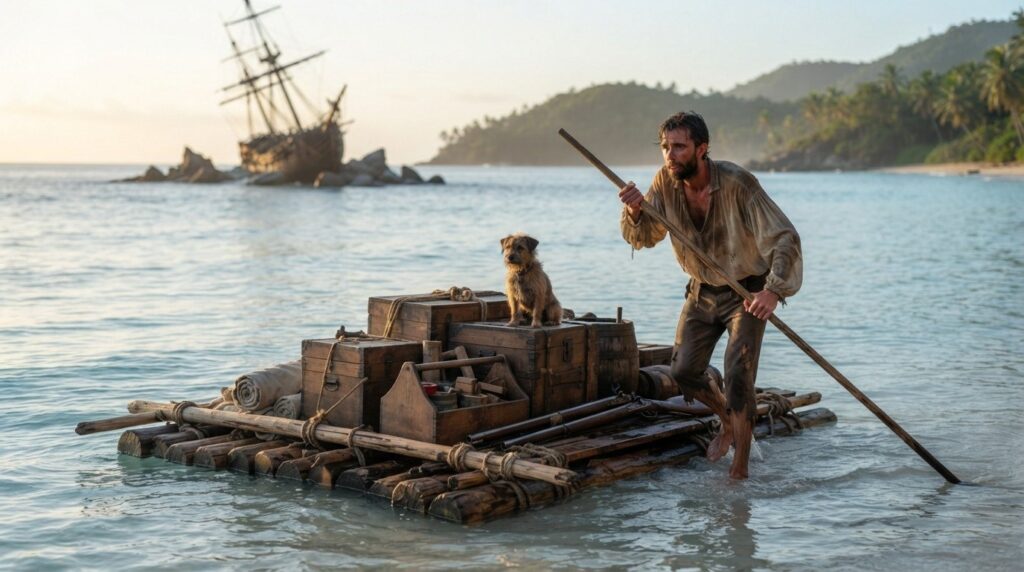
The sand was warm under my feet, and for a moment I did not want to move. I put my hand down and felt the small stones. Land! The dog sprang off the raft and ran in circles, and the two cats stepped on to the sand slowly, like elderly ladies. I laughed out loud. It was the first time I had laughed on that island.
I unloaded everything and climbed a hill to look about me. The view was beautiful and terrifying in the same moment: I was standing on an island. Water lay on every side. There were no roads, no roofs and no smoke, only birds, some animals I could not name, and an enormous silence. For the first time, I understood the full meaning of the word alone.
I sat on the hill for a long time while the sun went down on the water. Then I made a list in my head. I had a knife, two guns, powder, tools, food for many weeks and a dog. I had no house, no friends and no plan. “Robinson,” I said aloud, “you can sit here and weep, or you can work.” I stood up. The list was not long, but it was a beginning.
I spent that night on the beach with my boxes arranged around me like the walls of a tiny fort. The next day I swam out to the wreck again, and I kept doing so as long as the sea allowed. Over the following days I made twelve voyages, and each one brought some new prize: sails, ropes, nails, a hammock, more guns and more powder. On the last trip I found a handful of coins in a drawer and laughed out loud. “What use are you to me now?” I asked them. But I took them anyway; they were small, and they were light.
The trips were dangerous. One afternoon the tide turned while I was far from the beach, and the raft crawled, far too slowly. A cold wind rose and the water grew rough. My arms were burning, and I thought of everything I carried: the tools, the powder, the food. “Not now,” I said to the sea. “Not after all this.” At last the beach came closer, and I fell on the sand with my heart beating like a drum. After that, I always watched the tide.
That night the wind rose and a violent storm swept the coast. When I looked out in the morning, the ship was gone, broken up and scattered by the waves. I had stripped her just in time, and I knew that luck, if it was luck, had been on my side.
Words from this chapter
- lashed – verb tied tightly
- steadier – adjective less likely to move or fall
- tilted – verb leaned to one side
- inlet – noun a narrow piece of water that goes into the land
- enormous – adjective very big
- quantity – noun an amount of something
- prize – noun something valuable that you win or find
- scattered – verb thrown in many directions
- planks – noun long, flat pieces of wood
- ambitions – noun strong wishes to be successful
- capable – adjective able to do something well
- demanded – verb asked for something very strongly
- valued – verb thought something was important
- dozen – noun twelve
- exchanged – verb gave one thing and received another
- cargo – noun the things that a ship carries
- breeze – noun a light, gentle wind
- steered – verb made a boat go in a direction
- flung – verb threw with force
- narrowly – adverb only just
- avoided – verb kept away from
- sprang – verb jumped suddenly
- elderly – adjective old
- unloaded – verb took things off a ship or vehicle
- terrifying – adjective extremely frightening
- weep – verb to cry
- fort – noun a strong building for defence
- voyages – noun long journeys by sea
- violent – adjective using force to hurt; very strong
- swept – verb moved quickly and powerfully
Check your understanding
What did Robinson value more than anything else?
How did Robinson feel when he saw the island from the hill?
Why was Robinson lucky?
Reading is great. Speaking is better.
Talk about the story with a real teacher. Your first 25-minute lesson is free.
Book a free trial lessonFind your English level