On the ship there were some extra pieces of wood for the masts. I pushed them into the water, and I tied them together with rope. In this way I made my first raft. Then I put a few boards on top. I tried it, and it was strong enough for me. But I wanted to carry many things, so I needed a better raft.
It took me nearly the whole day to build the better raft. My hands were red, and my back was burned by the sun. Twice the raft came apart in the water, and I had to start again. I was not a clever builder. But I was a stubborn one, and stubbornness was exactly what I needed.
I opened the sailors’ boxes and took out everything that I needed. I filled three boxes with bread, rice, dry meat and cheese. Then I found a lot of clothes. Some of them were wet, but most of them were fine. I put them on the raft. I also found the carpenter’s box, and it was the most important thing of all. It had hammers, saws, nails and many other tools. Next, I took two good guns and some powder for them. I took a few swords, too.
I stood in the middle of the ship's treasure like a child in a toy shop. I wanted everything. But a raft is not a ship, and every heavy thing was a danger. I took a box of nails out, and I put it back, and I took it out again. “What does a man need first?” I asked myself. “Food. Water. A knife. A gun. Tools.” That was my order. The pretty things stayed in the ship.
At last the raft was full, and I was ready to go. There was no sail and no oar, and I was afraid. But the sea was calm, and the wind was blowing towards the land. I used a long piece of wood to push the raft, and slowly I moved towards the island. It was not easy. Once the raft nearly turned over, and some of my things nearly fell into the water. But in the end I found a small, quiet bay, and I pushed the raft onto the sand.
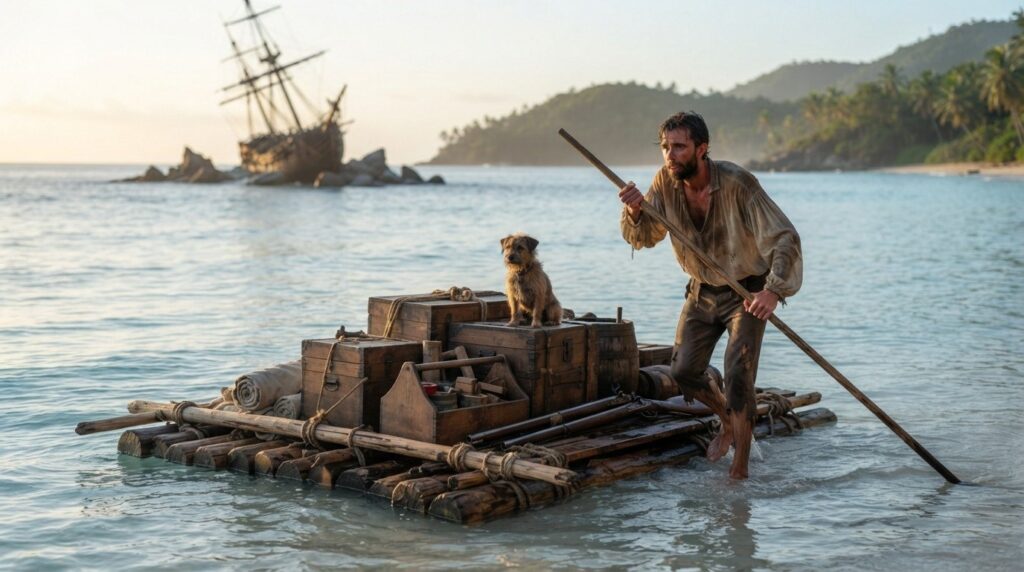
The sand was warm under my feet, and for a moment I did not want to move. I put my hand down and felt the small stones. Land! The dog jumped off the raft and ran in circles, and the two cats walked on the sand slowly, like old ladies. I laughed. It was the first time that I laughed on that island.
I carried everything onto the beach. I was very happy. But I was also tired, and I knew I must be careful. I did not know this place, and I did not know who lived here. So I climbed a small hill to look around. From the top, I saw the truth: I was on an island! The sea was on every side. There were no houses, no roads and no people. There were only some birds and a few animals. It was a lonely, wild place.
I sat on the hill for a long time, and the sun went down on the water. Then I made a list in my head. I had a knife, two guns, powder, tools, food for many weeks and a dog. I had no house, no friends and no plan. “Robinson,” I said aloud, “you can sit here and cry, or you can work.” I stood up. The list was not long, but it was a beginning.
That night I slept on the beach, with my boxes around me like a little wall.
That night I could not sleep. The island was full of sounds: the wind in the trees, the small waves and the cries of strange birds. Every sound made me jump. I held my gun, and my dog lay next to me with its ears moving at every noise. I looked up. There were more stars than I ever saw in England. “Somebody made all this,” I thought, “and he made me, too.”
The next day I went back to the ship. I made many trips, one after the other. Each time I brought something new: sails, ropes, nails, a hammock, more food and more powder. I made twelve trips in all. On the last trip, I found some money in a drawer, and I laughed. “What can I buy here?” I said to the money. “Nothing!” But I took it, because it was small and light.
The trips were dangerous. One afternoon the tide turned when I was far from the beach, and the raft moved slowly, too slowly. A cold wind came, and the water became rough. My arms were burning. I thought of everything that I carried: the tools, the powder, the food. “Not now,” I said to the sea. “Not after all this.” At last the beach came nearer, and I fell on the sand with my heart beating like a drum. After that, I always watched the tide.
That night, a big storm came again. When I looked out in the morning, the ship was gone. The sea had broken her into pieces. I was very lucky. I had taken the best things just in time.
Words from this chapter
- masts – noun the tall poles that hold the sails of a ship
- tied – verb fastened with a rope
- carpenter – noun a person who makes things from wood
- powder – noun a dry material for a gun
- bay – noun a part of the sea that goes into the land
- hammock – noun a bed made of cloth that hangs between two posts
- sails – noun big pieces of cloth that catch the wind
- trips – noun journeys
- rope – noun a thick, strong string
- raft – noun a flat boat made of pieces of wood
- boards – noun long, flat pieces of wood
- enough – determiner as much as you need
- carry – verb to hold something and take it with you
- nearly – adverb almost
- build – verb to make a house, boat, wall etc.
- burned – verb was on fire; destroyed with fire
- apart – adverb away from each other
- stubborn – adjective not wanting to change your mind
- filled – verb made full
- saws – noun tools for cutting wood
- nails – noun small metal pins you hit with a hammer
- swords – noun long, sharp metal weapons
- treasure – noun gold, silver and precious things
- oar – noun a long stick for moving a boat
- blowing – verb (wind) moving
- push – verb to move something away from you
- island – noun land with sea all around it
- stones – noun small pieces of rock
- careful – adjective thinking about danger and trying to be safe
- truth – noun what is true
- lonely – adjective sad because you are alone
- wild – adjective living in nature, not with people
- aloud – adverb in a voice that people can hear
- cry – verb to have tears in your eyes
- beginning – noun the start
- brought – verb past of bring
- dangerous – adjective not safe
- tide – noun the rise and fall of the sea
Check your understanding
What was the most important thing that Robinson found?
What did Robinson see from the top of the hill?
What happened to the ship after the twelfth trip?
Reading is great. Speaking is better.
Talk about the story with a real teacher. Your first 25-minute lesson is free.
Book a free trial lessonFind your English level