I woke at first light to a morning so peaceful that for several seconds I simply lay in the branches and forgot. The storm had gone as if it had never been, the sky was washed clean, and the sea lay as flat as a polished plate. Then memory returned, all at once, and with it a feeling of loneliness so complete that I can still recall its exact weight. I looked at the empty beach and at the green hills that rose behind it, and I understood that I had no food, no water, no weapon and no friend in the world.
I stayed in the tree for a few minutes, listening. Birds I did not know were calling from the hills, and the leaves moved softly in the breeze. Somewhere far off I heard a deep sound, which turned out to be only the sea in the rocks. Every noise was a question. Was there a man here? A lion? A snake? I searched my pockets and found a knife, a pipe and a little tobacco. It was not much to begin a new life with.I told myself firmly that a man with a knife and a little courage is never completely without hope.
I climbed down and walked along the shore, stiff and aching. My thirst was so fierce that my tongue seemed to be made of wood, and I was grateful beyond words when I found a thin stream trickling down to the sea. I drank until I could drink no more. But there was nothing to eat, and in the end I sat down on a rock and wept like a child, asking why I alone had been spared when better men had been taken.
Grief, however, is a luxury for those with full stomachs, and eventually practical thoughts began to push their way through. When I looked up, I noticed a shape far out on the water. It was our ship. The tide and the wind had carried her up against a reef of rocks, where she stood almost upright, no more than a mile from the beach. My heart gave a leap. If the sea stayed calm, she might still hold everything that I needed to stay alive.
I studied the sea for a long time. The waves were small and the wind was gentle, but I could see where the water turned dark and deep around the rocks, and I hesitated at the edge. Perhaps there were large fish out there; perhaps the cold would stop my heart halfway. Yet the argument against staying was simpler and stronger: a man who does nothing on an empty beach will starve. So I made up my mind to try.
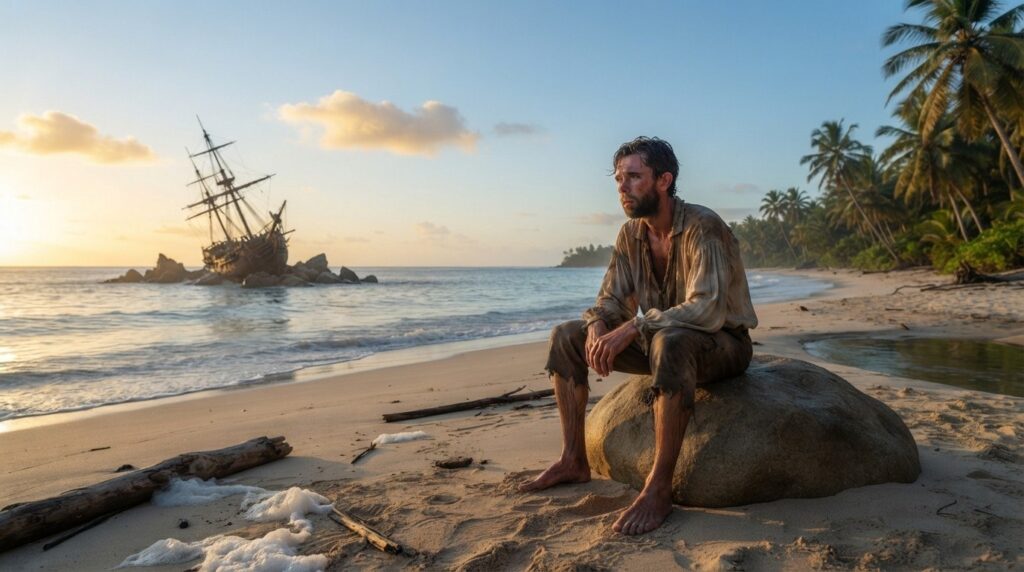
I waited until the tide had gone out, stripped to my shirt and swam. It was a long, cold effort, and when I finally arrived I discovered that the ship’s sides were too high and too smooth to climb. Twice I circled her, close to despair, before I spotted a length of rope trailing in the water near the bow. I grabbed it, and with arms that trembled from exhaustion I hauled myself over the side.
The deck sloped like a hillside, and I held on to the walls as I walked. Everything was wet and quiet. A door stood open, and beyond it I saw a table still laid with plates and a half-eaten piece of bread. The sailors' coats hung along the wall. For a moment I felt sure that someone was standing behind me, and I spun round. There was nobody. Only the water moved somewhere in the depths of the ship, with a slow sound like the breathing of an enormous animal.
The ship was a sorry sight. Her middle was flooded and everything in it ruined, but the stern was dry, and there I found bread, rice, cheese and dried meat in enough quantity to keep a man alive for weeks. I ate hungrily, and I drank a little rum, which spread through my body like a gentle fire and restored my nerve.
I made my way to the captain's cabin. His bed was still made, and his coat hung on a hook behind the door. On the wall there was a small picture of a woman and two children, and I stood in front of it for a long time. These men had families, and no one had yet told them the news. I closed the door quietly and whispered, “Rest in peace, my friends,” and I felt that the words were not enough.It was strange to stand among the things of dead men and to feel, at the same time, so hungry and so alive.
A faint sound made me spin round. Cowering in a corner was a small dog, trembling, and beside it sat two cats. They were the only survivors. I fed them and spoke to them softly, and I realised, with some surprise, how much their company meant to me. Then, looking at the heap of useful things around me, I recognised the next problem. I had a wreck full of treasure and no way to carry it. I needed a raft, and I needed it before the weather changed its mind.
Words from this chapter
- trickling – verb flowing slowly in a thin line
- spared – verb not killed or hurt when others were
- reef – noun a line of rocks near the surface of the sea
- despair – noun the feeling that there is no hope
- bow – noun the front part of a ship
- hauled – verb pulled with great effort
- cowering – verb making yourself small because you are afraid
- survivors – noun people or animals that stay alive after a disaster
- nerve – noun courage
- polished – verb rubbed to make shiny
- breeze – noun a light, gentle wind
- stiff – adjective hard to move or bend
- thirst – noun the need to drink
- beyond – preposition on the other side of; further than
- wept – verb cried
- grief – noun deep sadness, usually after a death
- luxury – noun something expensive and pleasant you do not need
- eventually – adverb in the end, after a long time
- upright – adverb standing straight up
- leap – verb to jump high or far
- halfway – adverb in the middle between two points
- starve – verb to die from not having food
- stripped – verb took off clothes or covering
- effort – noun hard work to do something
- circled – verb moved in a circle
- spotted – verb saw; noticed
- grabbed – verb took hold of suddenly
- trembled – verb shook because of fear or cold
- exhaustion – noun extreme tiredness
- hillside – noun the side of a hill
- depths – noun the deepest parts
Check your understanding
How did Robinson feel when he found the stream?
Why was the ship still standing?
What did Robinson realise at the end of the chapter?
Reading is great. Speaking is better.
Talk about the story with a real teacher. Your first 25-minute lesson is free.
Book a free trial lessonFind your English level