The captain took me to Brazil, a big country in South America. It was a long trip, and the captain and I became good friends. On the ship he asked me about my life, and I told him everything. When we arrived, he was very kind to me. He gave me some money for my boat, and he found me a place to stay with a man who had a sugar farm.
Brazil was full of colour. The harbour was busy, the houses were white, and the air smelled of sweet sugar. The farmer showed me his mill. Two big oxen turned a heavy wheel, and the wheel pressed the juice out of the sugar cane. Then the juice went into big hot pots, and men boiled it for many hours until it became thick and brown. I tasted a little, and it was the sweetest thing that I ever ate. On the last evening the captain shook my hand. “You are a brave and clever young man,” he said. “Work hard, and God will help you.” The next morning his ship sailed away, and I watched it until it was only a small white point. Then I turned and walked to my new life.
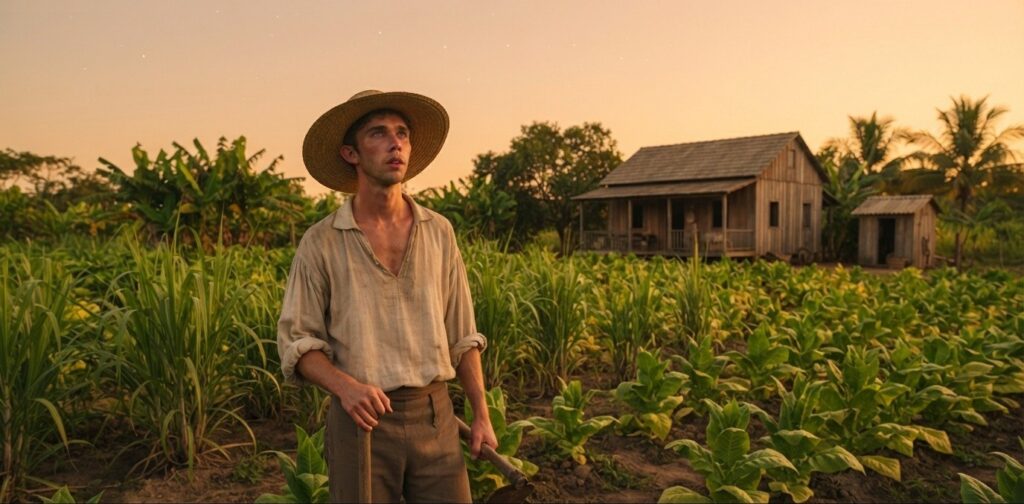
I watched the farmer at work, and I learned a lot about sugar. It was hard work, but it was also a good business. I thought, “This is a good way to make money.” I did not have much money, but I wrote a letter to a friend in England, and she sent me some. The captain helped me with the letter. I bought some land and started my own farm. I grew sugar and tobacco, and I worked very hard. I worked from the morning until the night.
My first harvest was a hard test. In the first year the rain came late, and the young plants were small and yellow. I stood in my field every morning and looked at the sky. “Please,” I said, “just a little rain.” At last the clouds came, and for three days it rained and rained. The plants stood up and became green again. When I sold my first tobacco, I held the money in my hand for a long time. It was not much, but I earned it with my own hands, and I was proud. That night I bought some meat and good bread, and I ate like a king.
The first years were not easy. I had no workers, and I had to do everything with my own hands. Sometimes I was very tired. I often thought, “Why did I leave my father’s house?” But slowly my farm got bigger. I had friendly neighbours, and they helped me when I needed it. On Sundays we ate together, and they told me stories about Brazil. I learned a few words of their language, and I made a small garden behind my house. I built a nice house, and I had good food on my table.
In the evenings I often thought of Xury. Was he well? Was he a free boy now? I hoped that he was learning to be a sailor, as he wanted. Sometimes I took a piece of paper, and I began a letter to my father: “Dear Father, I am alive and I am well.” But each time I stopped. I was afraid of his answer, and I was afraid of no answer. So the paper stayed on my table, and the words stayed in my head.
Life was good. For four years I lived and worked in Brazil. But I was not completely happy. In the evening I sat outside my house and I looked at the stars. I was often alone, and I thought about my family in England. Sometimes I remembered my father’s words about the middle way of life. Maybe he was right. Now I had everything I needed, but something was missing.
Then one evening my neighbours came to see me. There were three of them. “Robinson,” they said, “we need more workers on our farms, but workers are very expensive here. You know Africa, and you know the coast. Please sail there with us and bring some people back to work for us.” They meant slaves.
I asked many questions. Who will be the captain? How big is the ship? When do we go? Each answer made the plan sound easier. “It is only a few months,” one neighbour said, “and when you come back, you will have no more worries about money.” Another man laughed and said, “You are the only one who knows the coast. Without you, there is no trip.” I felt proud, and I felt afraid, and the two feelings sat together in my heart.
Many people at that time thought this was normal. Today we know it was very wrong. I had been a slave myself, so I knew it was wrong. I knew how it felt. I should say no, I thought. But my old wish to travel came back, and I wanted a new adventure. The neighbours promised me a part of the money. I thought about it all night. In the morning, I said yes. I did not know that this trip would change my life for ever.
Words from this chapter
- farm – noun land where people grow food
- sugar – noun a sweet white food that comes from plants
- tobacco – noun a plant that people smoke
- neighbours – noun people who live near you
- workers – noun people who do a job
- expensive – adjective costing a lot of money
- wrong – adjective not right or good
- adventure – noun an exciting and unusual experience
- captain – noun the person in charge of a ship
- south – noun the direction opposite north
- became – verb past of become
- arrived – verb came to a place
- smelled – verb had a smell; used the nose
- mill – noun a machine or building that makes flour
- pressed – verb pushed hard
- pots – noun round containers for cooking or keeping food
- boiled – verb cooked in very hot water
- thick – adjective wide; with things close together
- tasted – verb had a taste; tried food
- ate – verb past of eat
- shook – verb past of shake
- brave – adjective not afraid of danger
- clever – adjective quick to learn and understand
- sent – verb past of send
- grew – verb past of grow
- harvest – noun the time when you collect crops
- field – noun an open area of land for animals or plants
- clouds – noun white or grey things in the sky
- earned – verb got money for work
- meat – noun food from animals
- together – adverb with each other
- language – noun the words people speak, like English
- built – verb past of build
- hoped – verb wanted something to happen
- alive – adjective living, not dead
- completely – adverb totally
- missing – adjective not there; lost
- slaves – noun people who are owned by another person
Check your understanding
Where did the captain take Robinson?
What did Robinson grow on his farm?
What did the neighbours ask Robinson to do?
Reading is great. Speaking is better.
Talk about the story with a real teacher. Your first 25-minute lesson is free.
Book a free trial lessonFind your English level