The Portuguese captain proved as good as his word. Once we reached Brazil he introduced me to the owner of a sugar plantation, and I stayed with the man long enough to watch how the work was done. It took me little time to see that a planter who was patient, hard-working and a little lucky could grow rich. I wrote to a friend in England who looked after my small savings, and with the captain’s help she sent me goods and money. With them I bought a piece of uncultivated land and began to farm it myself.
Brazil was a country full of colour. The harbour teemed with life, the houses were white, and the air smelled of sweet sugar. My new friend showed me his mill, where two great oxen turned a heavy wheel that pressed the juice from the cane. The juice ran into large copper pots, and men boiled it for many hours until it turned thick and brown. I tasted a little, and it was the sweetest thing I had ever eaten. On our last evening the captain shook my hand. “You are a brave and clever young man,” he said. “Work hard, and God will help you.”
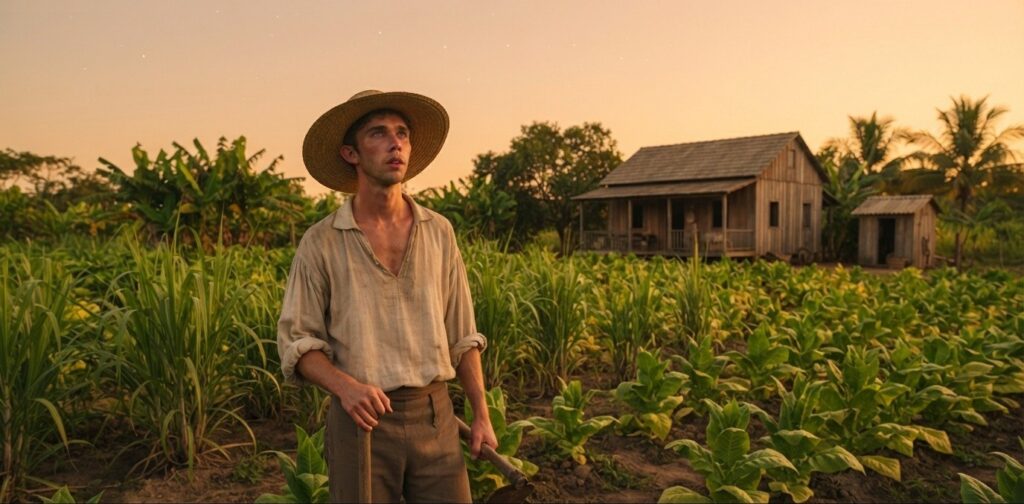
The early years were a struggle. I worked from dawn until dark, with no help except my own hands, and more than once I regretted the choices that had led me to the other side of the world. I cleared the ground, planted my first crops and learned, through many failures, what the soil would and would not bear. But the land responded to my efforts, and so did my neighbours, whose friendship eased my loneliness. They shared their advice, their tools and, on Sundays, their tables, and for the first time since leaving York I felt that I belonged somewhere. I even learned to speak their language, badly at first and then with growing confidence.
My first harvest was a severe test. That year the rains came late, and the young plants stood small and yellow in the field. Every morning I looked at the sky and muttered, “Just a little rain, please.” At last the clouds arrived, and for three days it poured without ceasing; the plants lifted their heads and turned green again. When I sold my first tobacco, I held the money in my hand for a long time. It was not a great sum, but I had earned it with my own hands, and the pride I felt was more real than anything the gold of Guinea had given me.
By the end of the fourth year I owned a comfortable house, a growing crop of sugar and tobacco, and a respectable name. In theory, I had achieved exactly the quiet prosperity my father had once described to me, the middle way of life. Yet as I sat on my porch in the evening, listening to the insects and watching the first stars appear, I felt strangely empty. I wondered whether my parents were still alive, and whether they ever spoke my name.
In the evenings I often thought of Xury. Was he well? Was he a free boy by now? I hoped he was learning to be a sailor, as he had wished. Sometimes I took a sheet of paper and began a letter to my father: “Dear Father, I am alive and well.” But each time I stopped. I was afraid of his answer, and almost as afraid of no answer at all. So the paper stayed on my table, and the words stayed in my head.
One night three of the neighbouring planters came to see me. They told me there was a desperate shortage of labour in Brazil, and that workers were expensive. Since I had visited the coast of Guinea, they said, I would know how to find more. Would I sail there with them and bring back a cargo of slaves, to be shared among the plantations? They even promised me a share without any payment.
I asked a great many questions. Who would command the ship? How large was she? When would we sail? Each answer made the plan sound simpler. “It is only a matter of a few months,” one neighbour said, “and when you return, you will never have to worry about money again.” Another laughed and said, “You are the only man here who knows that coast. Without you, there is no voyage.” I felt flattered, and I felt afraid, and the two feelings sat side by side in my heart.
I wish I could say that I refused at once. People in those days accepted slavery as a normal part of business, and the fact that I had been enslaved myself should have made me hate it more than anyone. It did not, and I am not proud of that. My restlessness had been waiting for an excuse, and the promise of profit and adventure was more than enough. I told myself that it would be a short journey, that I was an experienced traveller and that fate could not possibly be so cruel twice. After a short silence, I heard myself say yes. My neighbours shook my hand and went home delighted. I stayed on the porch for a long time, listening to the night and trying not to hear the small, stubborn voice inside me that said I was making a terrible mistake.
Words from this chapter
- plantation – noun a very large farm for growing sugar, tobacco or cotton
- uncultivated – adjective not used for growing crops
- struggle – noun something very difficult that needs a lot of effort
- prosperity – noun success and wealth
- shortage – noun when there is not enough of something
- labour – noun work, or the people who do it
- enslaved – adjective made into a slave
- restlessness – noun the feeling that you cannot stay still or be satisfied
- excuse – noun a reason that you give for what you do
- fate – noun the force that some people think controls what happens
- proved – verb showed that something is true
- planter – noun a person who owns a plantation
- savings – noun money you keep for later
- copper – noun a red-brown metal
- dawn – noun the time when the sun rises
- regretted – verb felt sorry about something you did
- crops – noun plants that farmers grow for food
- soil – noun the earth in which plants grow
- friendship – noun being friends
- eased – verb became less painful or difficult
- confidence – noun a feeling that you can do something well
- severe – adjective very bad or serious
- muttered – verb spoke quietly, often angrily
- respectable – adjective thought to be good and proper by other people
- achieved – verb succeeded in doing something after effort
- desperate – adjective so worried that you will try anything
- cargo – noun the things that a ship carries
- command – noun an order; control over people
- voyage – noun a long journey by sea
- flattered – adjective pleased by praise
- slavery – noun the system of owning people
- delighted – adjective very pleased
Check your understanding
Why did Robinson feel empty, even with a comfortable life?
What did the planters want Robinson to do?
How does Robinson judge his decision today?
Reading is great. Speaking is better.
Talk about the story with a real teacher. Your first 25-minute lesson is free.
Book a free trial lessonFind your English level