The ship left Hull on a bright September morning, and for the first day everything went well. I stood on the deck, watched the coast move slowly past, and felt like the happiest young man in England. I was free, and the whole world was waiting for me. I did not think of my parents even once.
The captain, who was my friend's father, was a patient man, and he allowed me to stand next to him at the wheel. He showed me how to read the compass and how to watch the sky for signs of weather. The sailors were friendly and laughed kindly when I asked too many questions. In the evening the sun sank into the sea in a blaze of red and gold, and the coast of England became a thin grey line behind us. I stood at the rail for a long time. Everything I had dreamed about seemed to be coming true.
But early the next morning the wind began to rise, and by the afternoon the sea was wild. I had never seen waves like these. They rose as high as houses and crashed over the deck, and the ship rolled and shook as if it would break into pieces. The sailors shouted orders to each other and ran from one side of the ship to the other. I was terribly seasick, and I was more frightened than I had ever been in my life.
Darkness fell early, and the noise became worse. The wind screamed in the ropes like a hundred voices, boxes broke open below deck and slid across the floor, and each time the ship fell from the top of a wave I felt as though my stomach had been left in the air. An old sailor passed me with a white face. “I have been at sea for twenty years,” he said, “and I have never seen weather like this.” His words frightened me more than the wind itself.
I remembered my father’s words, and I remembered how I had left home without a word. “This is my punishment,” I thought. On my knees, in the dark, I made a promise: “Dear God, if you save me from this storm, I will go straight home. I will listen to my father, and I will never go to sea again.”
The storm lasted all night. By morning water was pouring into the ship faster than the sailors could pump it out. “We are sinking!” the captain shouted. He fired the ship’s guns to ask for help. Luckily, another ship was close by, and her captain sent a small boat to us. The sailors in it risked their lives to take us off. We climbed down into the boat, one by one, and as we pulled away I looked back and saw our ship go under the waves. In a few seconds there was nothing left of her but some pieces of wood on the water.
The small boat jumped on the waves like a toy. The men rowed with all their strength, and nobody spoke. Water came over the sides, and I helped to throw it out with my hat. When at last I looked up, I saw the shore ahead, a dark line with small figures on it, running along the beach with ropes and shouting to us.
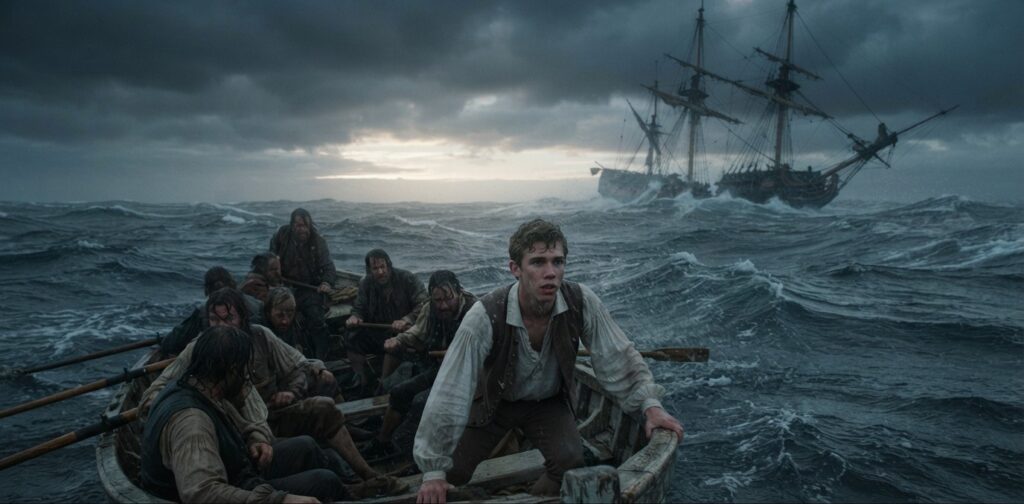
We came ashore tired, cold and hungry, but alive. Kind people gave us food, dry clothes and a place to sleep, and I fell asleep as soon as I lay down.
In the middle of the night I woke and could not sleep again, so I walked down to the beach alone. The storm was gone, but the sea was still loud in the dark. Pieces of wood and a broken box lay in the wet sand: the last things that came from our ship. I picked up one of them and held it for a moment. It was heavy and cold. Then, for a second, I felt something like a hand on my shoulder, and a quiet voice inside me said, “Go home.” But when the sun came up, the voice grew quiet.
The next morning the sun was shining and the sea was calm again. It looked so peaceful that it was hard to believe it had tried to kill us the day before. My friend laughed and said, “Well, Robinson, were you frightened?” I felt ashamed of my fear, and I laughed too. I said nothing about my promise. In fact, I almost forgot it.
That afternoon I walked down to the harbour on my own. At the edge of the water lay a broken board with a few letters of our ship's name still painted on it. I stood looking at it for a long time, and for a moment I did not feel like laughing. Then my friends called me, and I went back to them.
Only the captain, my friend’s father, looked at me seriously. “Young man,” he said, “you should never go to sea again. This storm was a warning to you. Go home to your father.”
I was silent. Somewhere inside me I knew he was right. But I was too proud to go home and admit my mistake, so I took the road to London instead.
Words from this chapter
- rise – verb to go up
- crashed – verb hit something with great force and noise
- seasick – adjective feeling ill because of the movement of a ship
- punishment – noun something bad that happens because you did something wrong
- pump – verb to move water out using a machine
- risked – verb did something dangerous
- warning – noun something that tells you about a danger
- proud – adjective thinking that you are too important to admit a mistake
- hull – noun the main body of a ship
- deck – noun the floor on top of a ship
- compass – noun a tool with a needle that shows north
- kindly – adverb in a kind way
- sank – verb went down under the water
- blaze – noun a big, strong fire
- rail – noun the wooden bar along the edge of a ship's deck
- seemed – verb looked like; appeared to be
- rose – verb went up (past of rise)
- rolled – verb turned over and over
- terribly – adverb very; very badly
- darkness – noun the state of being dark
- pouring – verb (rain) falling very heavily
- sinking – verb going down under the water
- luckily – adverb by good luck
- strength – noun being strong
- ahead – adverb in front; forward
- ashore – adverb onto the land from the sea
- ashamed – adjective feeling bad about something you did
- harbour – noun a safe place where ships stay
- seriously – adverb in a serious way
- admit – verb to agree that something is true
Check your understanding
What did Robinson promise during the storm?
Who saved the sailors from the sinking ship?
Why did Robinson not go home?
Reading is great. Speaking is better.
Talk about the story with a real teacher. Your first 25-minute lesson is free.
Book a free trial lessonFind your English level