My name is Robinson Crusoe, and I was born in 1632 in the city of York, in the north of England. My father was a successful merchant who had come to England from another country, and he had worked hard to build his business. He hoped that his children would have a calm and comfortable life, and he did everything he could to make that possible.
Our house in York was large and comfortable, with a garden that ran down towards the river. My mother was a gentle woman who cooked wonderful meals, and on Sundays the whole family sat down together at the long oak table. During the week, merchants from other cities often came to talk business with my father. I was not allowed to join them, so I sat on the stairs and listened quietly. I did not understand the figures and the prices, but I loved the names of the distant ports they mentioned, and I repeated them to myself at night like a prayer.
I had two older brothers. One of them was killed fighting in a war, and the other one disappeared and was never heard of again. That left me as the only son at home, and my father made careful plans for my future. He wanted me to study law and to settle down in a respectable job, in a nice office, in a quiet street.
I, however, had other ideas. From the time I was a small boy, I had dreamed about ships, foreign countries and the endless sea. I could not concentrate on my books, and I could not imagine spending my life behind a desk. In the evenings I used to walk down to the river and listen to sailors who told stories about storms, strange animals and golden cities. Every story made my wish stronger.
My teachers soon gave up on me. One of them gave me a thick book on law and told me to read a page aloud. I managed one line before my eyes drifted to the window, where a ship with white sails was moving slowly along the river. I forgot the book, the teacher and the whole room. When the lesson ended, he told my father, “Your son has a good mind, but it is never in this room.” My father was angry, but I could see that he was mostly worried. He did not know what to do with a boy like me.
One morning my father called me to his room. He was old and ill, and he spoke slowly but seriously. “Robinson, why do you want to leave your home?” he asked. “A sailor’s life is full of danger and hard work. Only people who are very rich or very poor need to look for adventure. The best life is the one in the middle, because it brings the fewest problems. Stay with us, and you will be happy.”
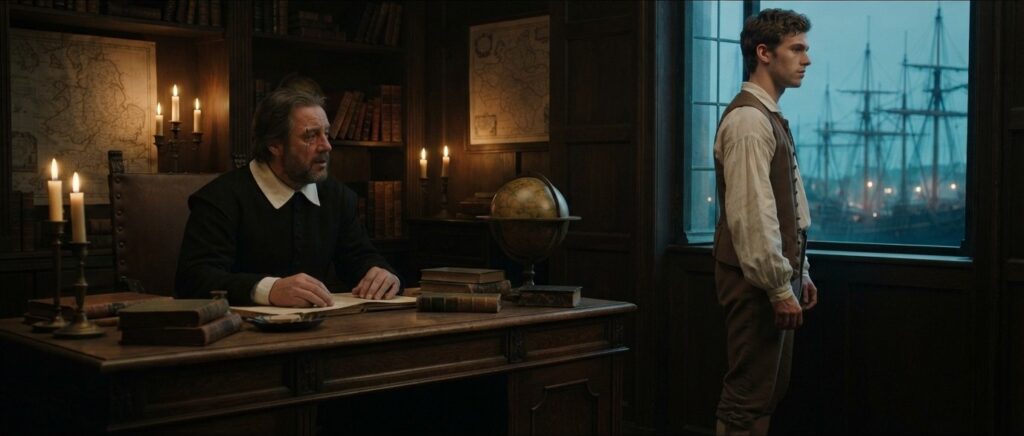
He talked to me for a long time, and when he finished, there were tears running down his face. I was deeply moved, and for a few weeks I tried to forget my dream. I even went to my mother and begged her to speak to my father for me, but she refused. “Your father loves you and wants the best for you,” she said. “If you leave, you will break his heart.”
The following year was long and quiet. I worked in my father's office, writing letters and counting coins, and every evening I walked down to the river to watch the boats. Sometimes I spoke to the sailors there. They had brown faces and strong hands, and they told me about hot countries, strange animals and storms that lasted for days. I listened to every word. At night I lay awake and told myself that one day I would go, but then I remembered my father's tears and felt ashamed. I loved my family, and I loved the sea, and I could not find a way to keep both.
Still, the dream did not go away. It stayed with me like a quiet voice that I could not silence. One day in September 1651, when I was nineteen, I happened to be in the port of Hull. There I met an old friend, whose father owned a ship that was about to sail to London. “Come with us,” my friend said. “It won’t cost you anything.”
That night I lay in a small room above an inn near the harbour, and I did not sleep. I thought of our house in York, the lamp that my father always left burning in his study, and the sound of my mother's voice calling us to dinner. I told myself that I would write to them from London, that I would explain everything, and that they would forgive me when I came home with stories and gifts. It was a comfortable lie, and I wanted very much to believe it. In the morning the ship was waiting, and my courage was stronger than my conscience.
I should have asked my parents for permission, but I was afraid that they would say no again. Instead, I said nothing to them at all. I did not even say goodbye. I simply packed a few things, climbed on board, and began a journey that would change my life for ever. It was the first of many mistakes, and I would pay for all of them.
Words from this chapter
- merchant – noun a person who buys and sells things for money
- respectable – adjective thought to be good and proper by other people
- concentrate – verb to think hard about one thing
- endless – adjective with no end
- adventure – noun an exciting and unusual experience
- permission – noun when someone says that you are allowed to do something
- disappeared – verb went away and could not be found
- seriously – adverb in a way that is not funny
- successful – adjective doing what you wanted to do
- comfortable – adjective pleasant to sit, lie or live in
- prices – noun how much things cost
- distant – adjective far away
- mentioned – verb talked about briefly
- settle – verb to go and live in a place
- however – adverb but; even so
- foreign – adjective from another country
- imagine – verb to make a picture in your mind
- managed – verb succeeded in doing something difficult
- drifted – verb was moved slowly by water or wind
- deeply – adverb very much; strongly
- begged – verb asked for something in a very strong way
- refused – verb said no
- ashamed – adjective feeling bad about something you did
- hull – noun the main body of a ship
- owned – verb had something as your property
- inn – noun a small hotel where you can eat and drink
- harbour – noun a safe place where ships stay
- explain – verb to make something clear
- gifts – noun presents
- courage – noun being brave
Check your understanding
Why did Robinson's father want him to stay at home?
What happened to Robinson's two older brothers?
How did Robinson leave home?
Reading is great. Speaking is better.
Talk about the story with a real teacher. Your first 25-minute lesson is free.
Book a free trial lessonFind your English level