I was born in 1632 in the city of York, in the north of England, into a family that was comfortable without being grand. My father, a merchant born in another country, had made a respectable fortune through hard work and good judgement, and he wanted nothing more than to see his children settled in safe and sensible lives. Our original family name was Kreutznaer, but over the years English tongues had turned it into Crusoe, and so that is what everyone called us.
Our house in York stood on a quiet street, with a garden that ran down towards the river and a long oak table around which the whole family gathered on Sundays. My mother, a gentle and patient woman, presided over those meals with great dignity. During the week, merchants from other cities came to discuss business with my father, and I was not permitted to join them. I would sit on the staircase instead, listening to talk of wool, wine and freight charges that meant nothing to me. What caught my attention were the names of distant ports, which I repeated to myself at night as other children repeat their prayers.
My two older brothers had already disappointed my father’s hopes. The elder had been killed fighting the Spaniards near Dunkirk, and the second had vanished so completely that nobody in the family ever learned what became of him. I was therefore the last son left at home, and all my father’s plans came to rest on me. He had decided that I should study law and, in time, take up some steady, respectable profession.
Unfortunately, my mind was elsewhere. For as long as I could remember, I had been fascinated by ships, harbours and the tales of sailors from distant lands. Books bored me, an office frightened me, and the very thought of spending forty years in the same quiet street made me restless in a way I could not explain, even to myself. In the evenings I wandered down to the river to watch the boats, and I would stand there until it was dark, imagining the places they were going to.
My teachers soon despaired of me. One of them put a heavy volume on the law in front of me and instructed me to read a page aloud. I managed a single line before my eyes drifted to the window, where a ship under full sail was gliding along the river, and the book, the teacher and the whole room simply ceased to exist. When the lesson was over he informed my father that I had a good mind but never brought it with me. My father was angry, naturally, but beneath the anger I could see real anxiety. He had no idea what to do with a son like me.
One morning my father called me into his room. He was elderly and in poor health, and he spoke with a seriousness I had never heard before. “Why would you want to leave a comfortable home for a life of danger and hardship?” he asked. “Only the desperate, who have nothing to lose, or the ambitious, who want to rise too high, go looking for adventure abroad. I have always believed that the middle way of life is the best one: it is protected from the worst troubles, and it leaves a man free to be happy. Stay with us, Robinson, and you will see that I am right.”
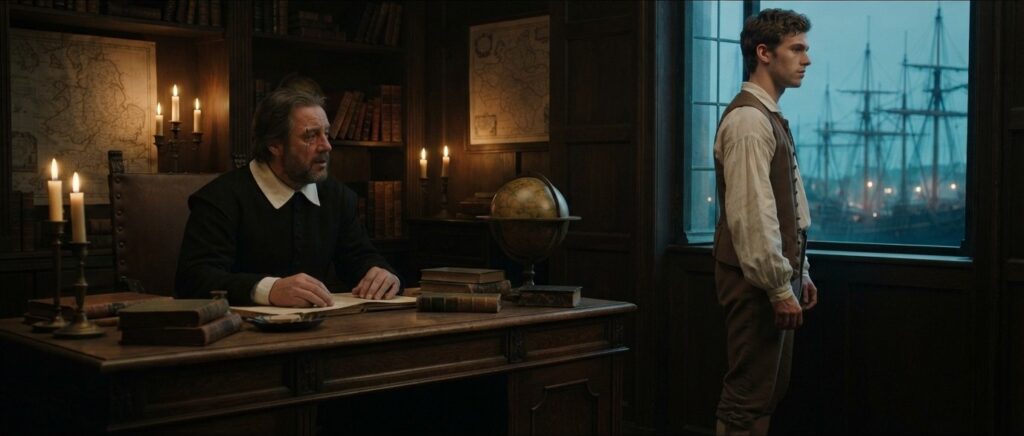
When he had finished, tears were running down his cheeks, and I felt a wave of guilt wash over me. His words moved me deeply, and for several weeks I honestly tried to put the sea out of my mind. I even went to my mother, hoping she would plead my case, but she was firmly on my father’s side. “He loves you,” she said, “and it would break his heart if you left. Think about what you would be giving up.”
The following year was a long and uncomfortable one. I worked in my father's office, copying letters and counting coins, and in the evenings I walked down to the river and watched the boats come and go. Sometimes I spoke to the sailors, men with weathered faces and enormous hands, who told me about burning deserts, strange animals and storms that lasted a week. I drank in every word. At night I lay awake, resolving to go and resolving to stay in turn, torn between my love for my family and a longing that no argument could cure.
Yet some desires cannot be argued away. They wait quietly, like a seed in the ground, until the weather changes. In September 1651, when I was nineteen, I happened to be in the port of Hull, where I bumped into an old school friend. His father was the captain of a ship preparing to sail for London, and my friend invited me to join them, free of charge.
That night I lay in a small room above an inn near the harbour, unable to sleep. I thought of our house in York, of the lamp my father always left burning in his study, and of my mother's voice calling us to dinner. I promised myself that I would write to them from London, that I would explain everything, and that they would forgive me when I returned with stories and presents. It was a comfortable lie, and I wanted badly to believe it. By morning my courage had grown stronger than my conscience, which is how most foolish journeys begin.
I knew perfectly well what I owed my parents. I should have asked for their blessing, or at the very least their forgiveness. Instead I said nothing to anyone, packed a bag in a hurry, and stepped on board. It was, as I was to learn at great cost, the most foolish decision of my life, and also the one that made my story possible.
Words from this chapter
- fortune – noun a large amount of money
- judgement – noun the ability to make good decisions
- vanished – verb disappeared suddenly
- fascinated – adjective very interested in something
- restless – adjective unable to stay calm or satisfied
- desperate – adjective so unhappy that you will try anything
- ambitious – adjective wanting very much to be successful
- blessing – noun approval and good wishes
- respectable – adjective thought to be good and proper by other people
- sensible – adjective reasonable and practical
- gathered – verb collected; came together
- dignity – noun the quality of being calm and respected
- permitted – verb allowed
- disappointed – adjective sad because something was not as good as you hoped
- profession – noun a job that needs training
- unfortunately – adverb sadly
- wandered – verb walked slowly with no special aim
- instructed – verb told someone what to do
- ceased – verb stopped
- beneath – preposition under
- anxiety – noun a strong feeling of worry
- elderly – adjective old
- hardship – noun a difficult life with little money or comfort
- abroad – adverb in or to another country
- cheeks – noun the soft sides of your face
- guilt – noun the bad feeling after doing something wrong
- plead – verb to ask in a desperate way
- firmly – adverb strongly; in a fixed way
- uncomfortable – adjective not comfortable
- weathered – adjective changed in colour or shape by sun and rain
Check your understanding
What did Robinson's father believe about the middle way of life?
Why did Robinson's mother refuse to help him?
How does Robinson judge his decision to leave?
Reading is great. Speaking is better.
Talk about the story with a real teacher. Your first 25-minute lesson is free.
Book a free trial lessonFind your English level