My name is Robinson Crusoe. I was born in 1632 in the city of York, in the north of England. My father was a rich merchant. He came from another country, but he made a good life in England. He had a nice house and a good business, and he wanted a quiet and safe life for his children.
Our house was big and warm. It had a garden with apple trees, and from the garden we could see the river. My mother cooked very good food, and on Sundays the whole family sat at the long table. My father worked many hours every day. Merchants from other cities came to our house, and they talked about money, wool and ships. I often sat on the stairs and listened to them. I did not understand the numbers, but I loved the names of faraway ports, and I said them quietly to myself at night.
I had two older brothers. One of them died in a war. The other one went away, and nobody ever saw him again. So I was the only son at home, and my father had big plans for me. He wanted me to go to school, study law and find a good job in an office.
But I did not want to sit in an office. I was a bad student, and I often looked out of the window and thought about the sea. I dreamed about ships, big waves and faraway countries. I listened to the stories of sailors in the street, and I wanted to see the world with my own eyes.
At school my teacher was not happy with me. He gave me a heavy book about law, and he said, “Robinson, read the first page.” I read one line, and then I looked out of the window again. A ship was passing on the river, with white sails in the sun. I forgot the book, the teacher and the room. After the lesson the teacher said to my father, “Your son has a good head, but it is never in this room.” My father was angry, but he was also worried. He did not know what to do with me.
One morning my father called me to his room. He was old and tired, and he spoke slowly. “Robinson, why do you want to go to sea?” he asked. “A sailor’s life is hard and dangerous. Only very rich people or very poor people go looking for adventure. The best life is the middle life. It is not too rich and it is not too poor. It has the fewest problems. Stay at home, my son, and you will be happy.”
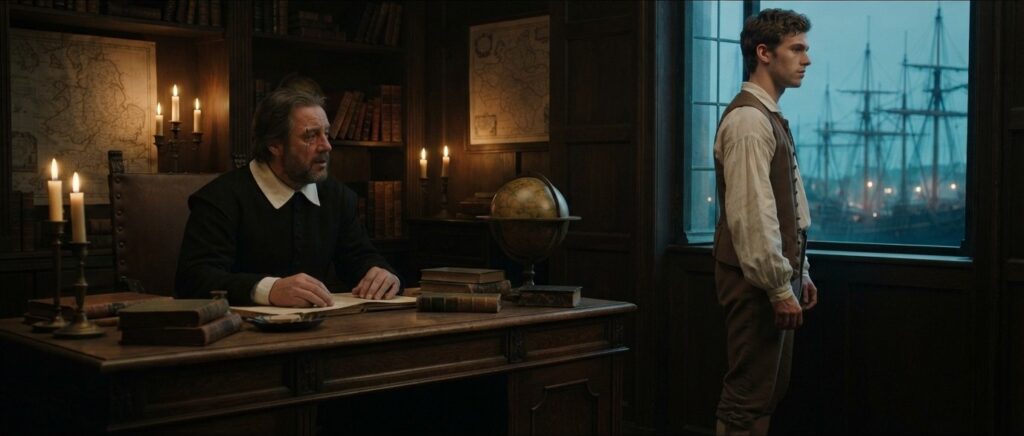
When he finished, there were tears in his eyes. I felt very sad, and I promised to stay. For some weeks I tried to forget my dream. I told my mother about it, and I asked her to talk to my father. But she also said no. “Your father loves you,” she said. “Please do not break his heart.”
The next year was long and quiet. I worked in my father's office, and I wrote letters and counted coins. Every evening I walked to the river and watched the boats. Sometimes I spoke to the sailors. They had brown faces and strong hands, and they told me about hot countries, strange animals and big storms. I listened to every word. Sometimes I sat by the river until it was dark, and the boats became black shapes on the water. At night I could not sleep. I looked at the ceiling and I said to myself, “One day I will go. But how can I leave my family?” I loved them, but I loved the sea, too.
But the dream did not go away. It was always there, like a small fire in my head. After about a year, in September 1651, I was nineteen years old. One day I was in the port of Hull, and I met an old school friend there. His father had a ship, and it was going to London the next day. “Come with us,” my friend said. “The trip is free!”
I knew that I must ask my parents. But I was afraid that they would say no again, and I did not want to hear it. So I did not ask my father. I did not ask my mother. I did not even say goodbye. I took a small bag with some clothes, and I got on the ship.
The ship left the port early in the morning. I stood at the back and looked at the land. I could see the roofs of the town and the grey smoke from the chimneys. Somewhere behind those roofs, my mother was making breakfast, and my father was reading his letters. For a moment I felt a cold pain in my chest. “Perhaps I should go back,” I thought. But then the wind filled the sails, the ship began to move, and my fear became excitement. I was young, and the whole world was in front of me.
That was the first big mistake of my life. My long and strange story began on that day.
Words from this chapter
- merchant – noun a person who buys and sells things for money
- business – noun work that makes money
- quiet – adjective calm, without much excitement
- dangerous – adjective not safe
- adventure – noun an exciting and unusual experience
- dream – noun something you want very much
- faraway – adjective very far from here
- port – noun a town where ships stop
- born – verb came into the world as a baby
- safe – adjective not in danger
- whole – adjective all of something
- merchants – noun people who buy and sell things
- wool – noun the hair of sheep
- ships – noun large boats
- stairs – noun steps inside a building
- quietly – adverb with very little noise
- died – verb stopped living
- nobody – pronoun no person
- waves – noun lines of water that move on the sea
- sailors – noun people who work on a ship
- heavy – adjective weighing a lot
- ship – noun a large boat
- sails – noun big cloths on a boat that catch the wind
- forgot – verb past of forget
- worried – adjective thinking about problems; afraid
- spoke – verb past of speak
- slowly – adverb not fast
- sailor – noun a person who works on a ship
- hard – adjective difficult; or not soft
- middle – noun the centre
- tears – noun water from your eyes when you cry
- felt – verb past of feel
- promised – verb said you will surely do something
- tried – verb past of try
- forget – verb to not remember
- heart – noun the part of your body that moves blood
- wrote – verb past of write
- counted – verb said numbers in order
Check your understanding
Where was Robinson born?
What did Robinson's father want for him?
How did Robinson leave home?
Reading is great. Speaking is better.
Talk about the story with a real teacher. Your first 25-minute lesson is free.
Book a free trial lessonFind your English level