In London I was lucky to meet a ship’s captain who knew the coast of Guinea in West Africa well. He had made good money there by selling English goods and buying gold dust. “Come with me,” he said. “You can bring some small things to sell, and you will pay nothing for the journey.” I remembered my father’s warning for a moment, but the thought of gold was stronger.
This time I made a better choice. I spent forty pounds on cheap things such as toys, scissors and knives, and I took them with me. The captain was an honest man, and he taught me a lot about navigation and trade. During the long days at sea he showed me how to use the stars to find our way, and how to talk to the people in the markets of Africa. When we came back to London, I sold everything for a large sum of money. I felt like a real merchant at last.
The trip to Guinea was hard, but I loved it. The sun was fierce, and I was often ill with a fever, yet everything was new to me: the red rivers, the bright birds and the noisy markets. The local people were friendly, and they were happy to buy my toys and knives. In the evenings I sat in the shade and counted my gold again and again. I was twenty years old, and I felt like a real man at last. Sometimes, late at night, I thought of my father's house, and I felt a little ashamed.
Sadly, the captain died soon after, but I was now more eager than ever to go back. So I borrowed money and prepared a second voyage. I did not write to my parents. I told myself that I would write to them when I was rich and successful, and that they would be proud of me.
I knew that my father was worried about me. A letter takes only a few minutes to write. But every time I picked up the paper, I thought, “Not yet. When I am rich, I will go home, and my father will be proud of me.” So I put the paper away again. Pride is a strange thing, because it never lets a man say sorry.
It was a terrible mistake. Early one morning, as we sailed along the coast, a fast ship with a lot of oars came out of the mist, and we saw her flag. “Pirates!” the captain screamed. “Pirates from Salé!”
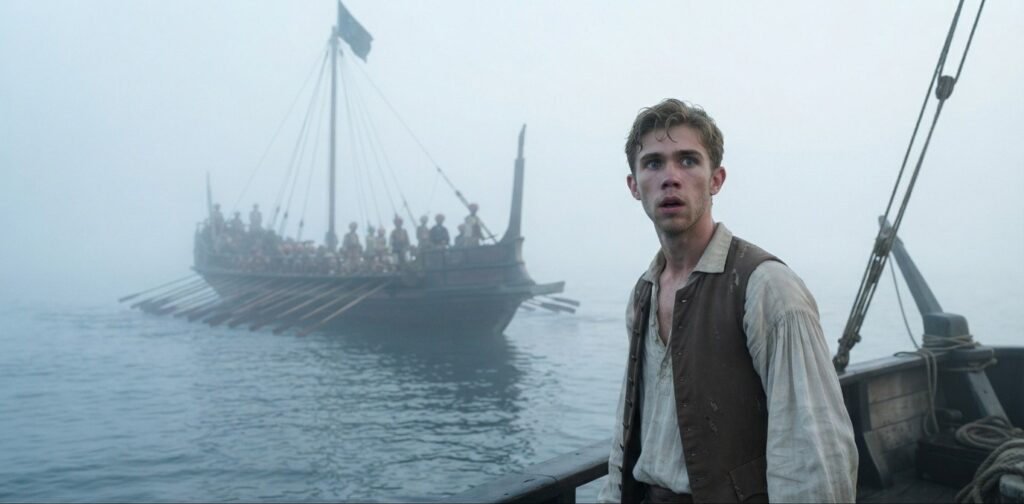
Everybody ran onto the deck. The captain looked through his glass, and his face turned grey. We changed direction and put up every sail we had. For hours the pirate ship came closer and closer, and I could see men with long knives standing at the front. My heart was beating like a drum. I looked at the empty sea around us and thought, “There is nowhere to run.”
We tried to escape, and then we tried to fight, but the pirates had more men and bigger guns. After a long and bloody battle we had to give up. The pirates took us all as prisoners to their port, Salé, on the coast of Morocco. The captain of the pirates chose me as his personal slave. I had to work in his house and garden, and a guard followed me everywhere. I was never allowed to leave.
Salé was a white town on the hot coast, with high walls, a busy harbour and a big market. They marched us through the narrow streets, and people stopped to stare at us. I was tired and thirsty, and I did not understand a word of what was said around me. I was only a young man in dirty clothes, and now another man could look at me and say, “This one is mine.”
At first I could not believe what had happened to me. Only a few weeks before, I had been a free man with money in his pocket and big dreams in his head. Now I was a servant, and I slept on the floor. At night I thought about my father’s words about the “middle way”, and I understood too late how right he had been. I cried quietly, so that nobody could hear me.
The garden behind my master's house was the only place I came to know well. There were orange trees, a small fountain and a high white wall. I worked there from morning until evening, and I thought, “It is a beautiful place, but it is a prison.” Between two houses I could see a small piece of the sea, and I looked at it every day. I had never thought about what it means to own another human being. Now I knew, and I decided that no person should ever belong to another. Sometimes the guard noticed me looking at the water, and he shouted, and I went back to my work.
For two long years I lived as a slave, and every day I stared at the sea that I had once loved so much. I did not know how, and I did not know when, but I made myself a promise: one day, I would find a way to escape.
Words from this chapter
- navigation – noun finding the way for a ship
- trade – noun the business of buying and selling
- sum – noun an amount of money
- eager – adjective wanting to do something very much
- voyage – noun a long journey by sea
- battle – noun a fight between two groups
- prisoners – noun people who are kept and cannot leave
- guard – noun a person who watches someone to stop them leaving
- lucky – adjective having good luck
- captain – noun the person in charge of a ship
- goods – noun things that are made to be sold
- warning – noun something that tells you about danger
- choice – noun the act of choosing; something you choose
- honest – adjective always telling the truth
- merchant – noun a person who buys and sells goods
- fierce – adjective wild, strong and frightening
- fever – noun a high temperature when you are ill
- ashamed – adjective feeling bad about something you did
- borrowed – verb took something that you must give back
- prepared – verb made ready
- successful – adjective doing what you wanted to do
- oars – noun long sticks for moving a boat
- mist – noun a thin cloud near the ground
- pirates – noun people who rob ships at sea
- deck – noun the floor on top of a ship
- slave – noun a person who is owned by another person
- harbour – noun a safe place where ships stay
- marched – verb walked with firm, regular steps
- servant – noun a person who works for another person
- stared – verb looked for a long time
Check your understanding
What did the first captain teach Robinson?
Why did Robinson not write to his parents?
What did Robinson promise himself?
Reading is great. Speaking is better.
Talk about the story with a real teacher. Your first 25-minute lesson is free.
Book a free trial lessonFind your English level