One evening I sat in front of my tent and thought about time. I had no clock, no calendar and nobody to ask. If I stopped counting, the days would all begin to look alike, and soon I would not know the day of the week or even the month. I was afraid that I might slowly lose my mind.
“I must make a calendar,” I said to myself. I cut a big piece of wood into a tall post and put it into the ground by the sea, at the place where I had first come ashore. Then I cut some words into it with my knife: “I came to this place on 30 September 1659.” Every day I cut one more line into the post. Every seventh line was longer than the others, because it marked a Sunday, and the first line of each month was longer still. In this way, I always knew exactly what day it was.
Every morning the first thing I did was to walk to the post, cut one new line and say the date aloud: “It is Tuesday, the second of October.” My voice was the only voice on the island, and at first it sounded strange to me. But I liked this small ceremony. It was like a good morning from a friend. The post stood on the beach, grey and tall, and I thought that any passing ship would see it from far away.
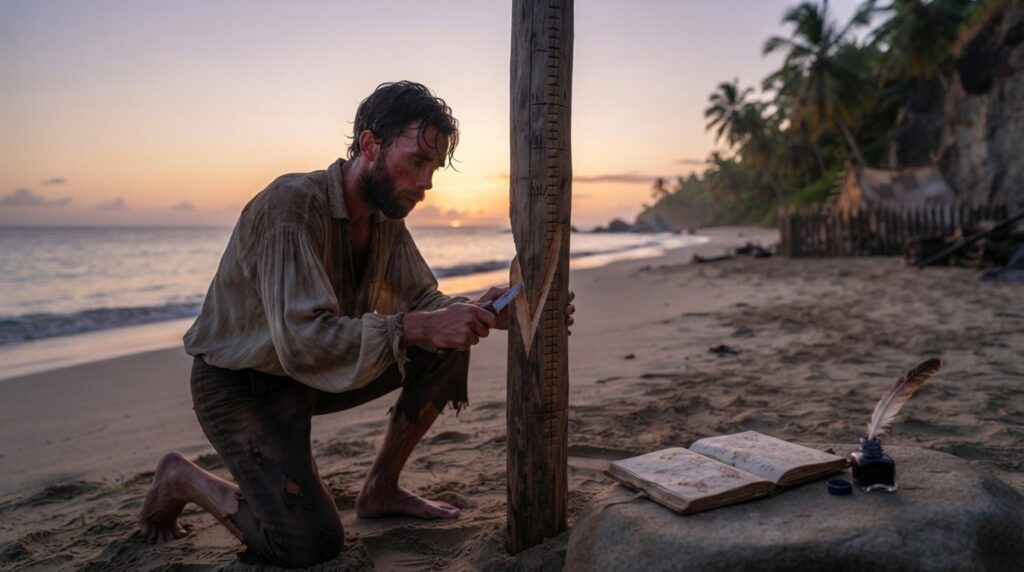
Among the things I had brought from the ship, I found some pens, a bottle of ink, a few books and a pile of paper. “Now I can keep a journal,” I thought. Every night I wrote down what I had done that day, what the weather had been like, and what I had been thinking. When I wrote, I felt less alone, as if someone was listening to me. It was a small thing, but it kept me human. When I read my first pages many years later, I almost cried.
Some days I wrote only a few words. “1 October. Rain. I carried the last box.” “8 October. I saw a goat on the hill, but it ran away.” “15 October. I made a shelf. It is not straight, but it works.” On other days I wrote for an hour. I wrote about my father, my mother, the sea and the strange sounds of the night. The pages became a small book of my new life, and each page said: “Robinson was here.”
In the first weeks I was very unhappy. I often sat on the beach and cried. One night I could not sleep at all because I was thinking about my terrible luck. At last I lit a small lamp, took my pen and made a list. On one side of the paper I wrote the evil things, and on the other, the good things.
Sometimes in the evening I talked to the dog. “What do you think?” I asked him. “Will a ship come tomorrow?” He put his head on one side and said nothing, but he listened, and that was enough. One night I tried to sing an old English song. My voice was rough and the words were half forgotten, and after two lines I stopped. The silence after the song was bigger than before. I cried a little, and then I laughed at myself.
Evil: I am alone on a terrible island. I have no one to talk to. I have few clothes. I have no way of escape.
Good: But I am alive, while all my friends drowned. I have food and fresh water. I have guns and tools. I have not seen any dangerous animals.
I read the list several times. Slowly, I began to feel a little better. I understood that nothing is so bad that we cannot find something good in it, if we look hard enough. From that day, I tried to begin each morning by remembering the good side of the list.
I made a plan for every day. I woke with the first light and washed in the stream. I worked until noon, and then I rested in the shade, because the sun was too hot. In the afternoon I worked again, and in the evening I wrote in my journal. A man who works has no time to be too sad. When I was tired at the end of the day, my thoughts became quiet, and I slept well.
When the rainy season came, I had to stay inside my tent for days at a time. But I was no longer so afraid of the empty hours. The rain on the roof of my tent made a soft, steady sound, and in the evenings I fed the cats and told them about my day. I had my calendar, my journal, my dog and my two cats, and I had work to do.
In those rainy days I thought a great deal about England. I imagined my mother in the kitchen and my father at his desk with his letters. Sometimes I spoke to them in my head. “Father, you were right about the middle life,” I said. “I was a fool.” I was not angry with myself any more. I was sad, and I was a little grateful, too. Perhaps I had to lose everything before I could understand it.
Words from this chapter
- lose my mind – phrase become mad
- alike – adjective the same, similar
- marked – verb showed
- unhappy – adjective sad
- lit – verb started a flame in something
- evil – adjective very bad
- escape – verb to get away from a place
- rainy season – noun the part of the year when it rains a lot
- front – noun the part that faces forward
- tent – noun a home made of cloth
- calendar – noun a list of the days of the year
- lose – verb to not have something any more
- ashore – adverb onto the land from the sea
- sounded – verb made a sound
- strange – adjective unusual, not normal
- ceremony – noun a formal event for an important occasion
- among – preposition in the middle of a group of things
- ink – noun coloured liquid for writing
- pile – noun many things one on top of another
- journal – noun a book where you write about your days
- human – noun a person
- shelf – noun a flat board on a wall for things
- straight – adjective not bent or curved
- luck – noun good things that happen by chance
- enough – determiner as much as you need
- forgotten – verb not remembered
- drowned – verb died under water
- several – determiner more than two but not many
- steady – adjective firm; not shaking
- grateful – adjective wanting to say thank you
Check your understanding
Why did Robinson make a calendar?
What kind of list did Robinson write?
What did the list teach Robinson?
Reading is great. Speaking is better.
Talk about the story with a real teacher. Your first 25-minute lesson is free.
Book a free trial lessonFind your English level