My first crop of grain solved one problem and created several others. I had no mill to grind the grain into flour and no oven in which to bake it. I also needed pots, jars and dishes for storing food and carrying water, and the few vessels that I had saved from the ship were quite inadequate. I decided that I would have to learn every craft myself, and I began with pottery.
I thought about all the labour that stands behind a single loaf of bread. Someone must plough the field and sow the seed, wait for the rain and cut the plants; someone must take the grain from the ears, grind the flour, mix the dough and bake it. In England I had never given any of this a thought. A baker did it all, and I paid a few coins. Now I understood that a piece of bread is a small miracle of many hands, and on the island I had only two.
I knew that pots were made from clay, and after a few days of searching I discovered a bed of good red clay in the hills. I carried it home in a basket and shaped my first vessel, with my fingers, into something resembling a pot. I stood it in the sun to dry. By the next day it was so weak that it crumbled when I touched it. I made another, and another, and they all failed. Sometimes the sun baked the clay too fast and it cracked; sometimes the walls were too thick and they collapsed. For weeks I wasted clay and hope in equal quantities, and I came close to abandoning the whole project.
My first pots were remarkably ugly. One was shaped like a bag, one like an old hat, and one looked like a sleeping animal. I set them in a row and laughed. Poll regarded them in silence, which I believe was the kindest comment he could have made. But I did not give up. Each new pot was a little better than the last one, and every morning I examined them with hope.
Then chance gave me what skill had not. One evening I lit a large fire and set several pots near it, simply to keep them warm. In the morning I found them in the ashes, whole and hard, and as red as the tiles on a roof. “That is the secret,” I said aloud. “Clay needs fire.” From then on I built a roaring fire around my pots and kept it burning for hours, until they rang when I tapped them. I made jars and plates and one great pot big enough to hold a month’s grain. They were not beautiful, but they were mine, and I handled them as tenderly as if they were porcelain.
When I opened the fire the next morning, I took the first pot in my hands. It was still warm. I tapped it softly with a knuckle, and it rang with a clear note, like a small bell. I filled it with water and waited. Not one drop came out! I jumped up and danced around the fire like a boy, while the dog barked and Poll shouted, and for one wonderful moment the island was full of music.
Flour was the next problem. I selected a trunk of hard wood, hollowed out the top with my axe and fire to make a rough mortar, and pounded the grain in it with a heavy stick. It was slow and tiring, but it produced a reasonable flour. For a sieve, I used a piece of cloth cut from the sailors’ neckcloths, which removed the worst of the husks.
In the evening my arms ached so badly that I could hardly lift my cup. My back was sore, and there was white dust in my hair and beard. But in my jar there was a small heap of fine flour, and it grew a little every day. I looked at it with pride. A rich man in England counts his money; I counted my flour, and I was convinced that I was the richer of the two.
Finally, I had to find a way to bake without an oven. I made a fire on a flat stone, waited until the stone was glowing, and swept the embers aside. I laid my dough on the hot surface, covered it with a clay pot and piled fresh embers around the outside.
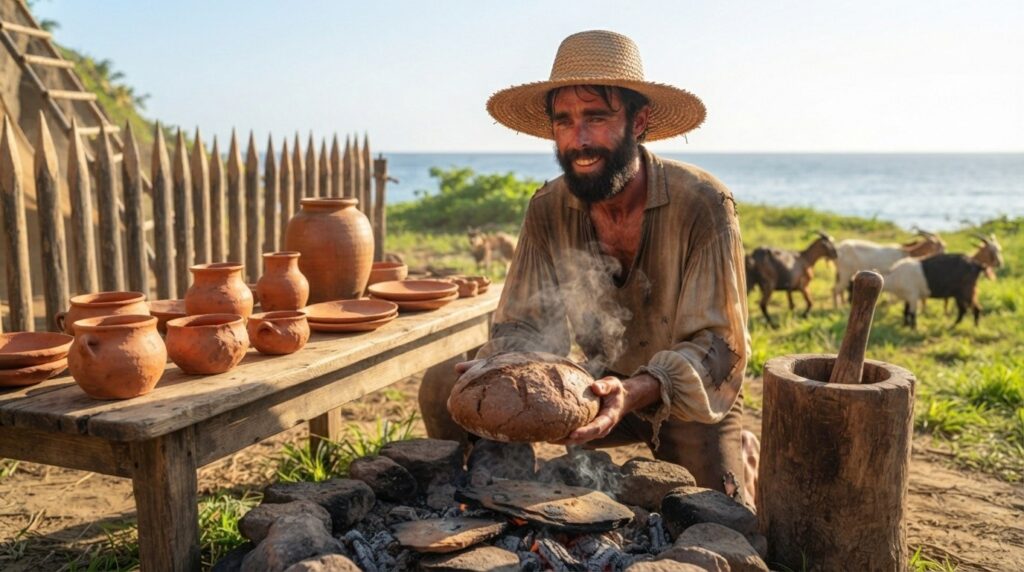
My first loaves were dreadful. The first was black as coal on the outside and raw within. The second was as hard as a stone, and when I offered a piece to the dog, he sniffed it and walked away. I was furious, but I learned. The fire must not be too fierce, and I must watch the stone with care. On the fifth day I produced a loaf that was brown and soft, and I said aloud, “That is better. That is much better.”
When I lifted the pot, a small golden loaf lay underneath. The smell alone nearly made me weep. I ate it slowly, with a little cheese, and I declare that no meal in any palace has ever tasted better. There was nobody to congratulate me, and nobody to thank, except myself, but on that day I felt that I had earned the right to be proud.
Words from this chapter
- inadequate – adjective not good enough
- resembling – verb looking like something
- crumbled – verb broke into small pieces
- tenderly – adverb in a gentle and careful way
- porcelain – noun very fine, delicate china
- mortar – noun a hard bowl for crushing grain with a stick
- embers – noun hot pieces of wood from a fire
- congratulate – verb to tell someone that they did something well
- solved – verb found an answer to
- vessels – noun ships or large boats
- craft – noun a boat; a skill of making things by hand
- pottery – noun pots and dishes made from clay
- labour – noun hard physical work
- vessel – noun a ship or large boat
- collapsed – verb fell down suddenly
- quantities – noun amounts
- abandoning – verb leaving forever
- remarkably – adverb surprisingly
- examined – verb looked at very carefully
- skill – noun the ability to do something well
- roaring – verb making a very loud, deep noise
- hollowed – verb made empty inside
- pounded – verb hit again and again
- reasonable – adjective fair and sensible
- husks – noun the dry outer covers of seeds
- ached – verb felt a dull, continuous pain
- convinced – adjective completely sure
- glowing – verb giving a soft, warm light
- dreadful – adjective very bad; terrible
- furious – adjective extremely angry
Check your understanding
What problem did Robinson face with his first crop?
How did Robinson discover how to make strong pots?
How did Robinson feel about the bread?
Reading is great. Speaking is better.
Talk about the story with a real teacher. Your first 25-minute lesson is free.
Book a free trial lessonFind your English level