On a clear morning I climbed to the top of the high hill on the far side of the island. I looked across the sea, and I saw something that made my heart beat fast. Far away, there was land! It was like a blue line on the water. “It is the coast of America,” I said. “There are people there. Maybe there are Spanish towns, too.” For the first time in years, I had a real hope. That night I could not sleep. I lay in my tent and listened to the wind, and I made a hundred plans.
For many days I went back to the top of the hill, and I looked at the blue line. Sometimes I was afraid that it was only a cloud. But in the evening, when the sun went down, it was still there. Clouds change and go away. Land stays. I sat on a rock and I thought, “It is real. It is there. And somebody lives on it.” My heart was so full that I could not eat my supper that night.
From that day, I could think of nothing but a boat. “I will build a boat,” I said, “and I will sail to that land.” I had no boat, and I could not swim so far. So I decided to make a canoe.
I made a careful plan. How far was the land? Maybe forty or fifty miles. A good canoe could do that in one or two days if the sea was calm. I needed food, water and my gun. I needed a mast and a sail. I wrote the list in my journal, and I looked at it every evening. Each line made the dream a little more real. In my head, I was already on the other side.
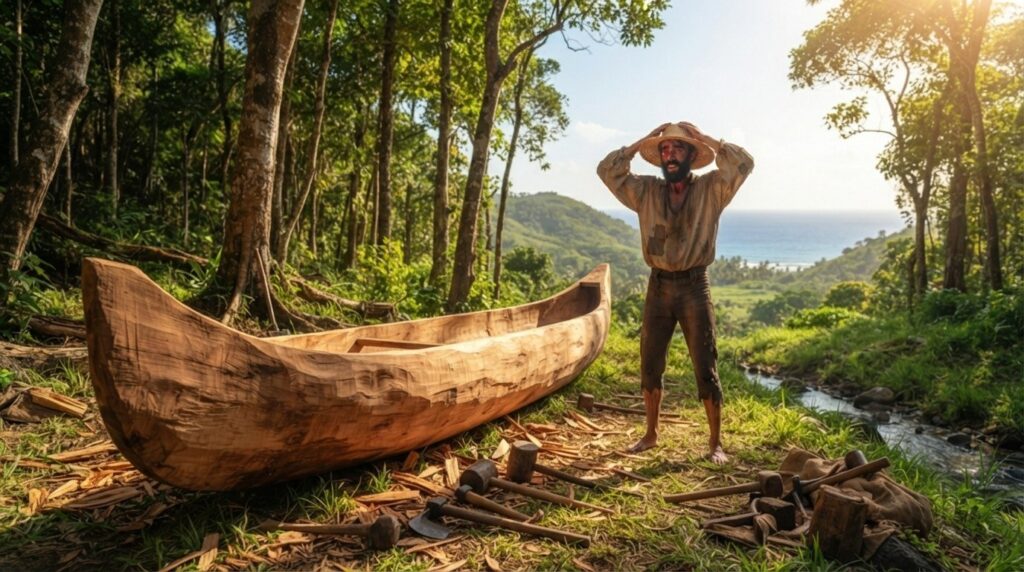
I looked for the biggest tree in the forest. I found a tall cedar tree, as thick as a house. I cut it down with my axe, and it took me twenty days. Then I cut the branches and made the trunk smooth. It was hard work, and my hands were sore, but I was happy. For weeks I worked with my axe and with fire. I dug the inside of the trunk, and I shaped the outside. After about five months, the canoe was ready. It was long and beautiful, and it was big enough for twenty men. “I am a genius,” I said, and I walked around it many times.
I worked in the hot sun every day. I burned the inside of the trunk with fire, and then I cut away the black wood with my axe. Sometimes I burned my fingers, and I jumped around and shouted. In the evenings I lay in my tent, and I imagined the day when I arrived. I saw people on the beach, and they ran to me, and I said, “Good morning!” in a loud voice. I practised the words in my head, because I did not know if they would understand English.
Then I had a terrible thought. Where was the sea? I looked, and I understood. I made the canoe in the forest, far from the water. It was about one hundred metres from the sea, and it was on top of a small hill! The canoe was too heavy to move. I could not push it. I could not pull it. “How stupid I was!” I cried. “I did not think about the end of the job!”
I sat down on the grass and looked at the canoe for a long time. It was like a dead whale on the hill. The dog came and sat next to me, and he looked at the canoe, too. I think he was also surprised. I imagined the whole island laughing at me: the birds, the goats, the trees. “Look at the clever man,” they said, “who built a ship on a mountain.” And the worst of it was that they were right.
I tried everything. I used big sticks as levers, and I used round pieces of wood to roll it. Nothing worked. Then I thought, “I can dig a canal from the sea to the canoe.” I made a plan, and then I counted. It would take ten or twelve years. I laughed and cried at the same time.
For many weeks I worked every day, and my hands became rough and sore. At last the rain came and washed away my small canals, and I stopped. I sat under a tree and watched the water run down the hill, and I understood that I could not win this fight. Slowly, my anger went away. I looked at the canoe, and I saw that it was really beautiful. “Maybe,” I said to myself, “it is enough to know that I made it.”
In the end, I left the beautiful canoe on the hill, and I never used it. But I learned an important lesson. Before you begin a big job, you must think about the whole plan, from the beginning to the end. Sometimes the work is not a waste, because the work itself makes you stronger. I was strong, and I was a better carpenter than before. When I went back to my home, Poll was waiting for me. “Robin Crusoe!” he said. I laughed, and my sadness went away.
Words from this chapter
- coast – noun the land next to the sea
- canoe – noun a long narrow boat that you move with a paddle
- cedar – noun a tall tree with sweet-smelling wood
- genius – noun a very clever person
- levers – noun long sticks that help you to move heavy things
- canal – noun a long narrow channel of water made by people
- lesson – noun something you learn from an experience
- waste – noun something done without any useful result
- clear – adjective easy to see through; easy to understand
- climbed – verb went up using hands and feet
- hill – noun a small mountain
- island – noun land with sea all around it
- across – preposition from one side to the other
- heart – noun the part of your body that moves blood
- beat – verb to hit again and again; (a heart) to move
- land – noun the ground; not the sea
- spanish – adjective from Spain
- hope – verb to want something to happen
- tent – noun a home made of cloth
- wind – noun air that moves
- cloud – noun a white or grey thing in the sky
- clouds – noun white or grey things in the sky
- supper – noun an evening meal
- nothing – pronoun not anything
- build – verb to make a house, boat, wall etc.
- sail – noun a big cloth on a boat that catches the wind
- miles – noun a measure of distance (1.6 km)
- mast – noun the tall pole on a ship that holds the sails
- forest – noun a large area with many trees
- branches – noun arms of a tree
- smooth – adjective flat, with no rough parts
- pull – verb to move something towards you
- stupid – adjective not clever
- whale – noun a very big sea animal
- round – adjective like a circle
- fight – verb to try to hurt someone with your body or weapons
- anger – noun a strong feeling when you are not happy with someone
- sadness – noun the feeling of being sad
Check your understanding
What did Robinson see from the top of the hill?
How big was the canoe?
What was the problem with the canoe?
Reading is great. Speaking is better.
Talk about the story with a real teacher. Your first 25-minute lesson is free.
Book a free trial lessonFind your English level