On a clear morning, I climbed to the top of the highest hill on the far side of the island. I looked out over the sea, and I saw something that made my heart beat faster. Far away, there was land. It was like a thin blue line on the water. “It must be the coast of America,” I said. “There are people there. Perhaps there are even Spanish towns.” For the first time in years, I had real hope. That night I could not sleep. I lay in my tent, listened to the wind and made a hundred plans in my head.
For many days I went back to the top of the hill and looked at the blue line. Sometimes I was afraid that it was only a cloud. But in the evening, when the sun went down, it was still there. Clouds change and go away. Land stays. I sat on a rock and thought, “It is real. It is there. And somebody lives on it.” My heart was so full that I could not eat my supper that night.
From that day, I could think of nothing but a boat. I had no boat, and I could not swim so far, so I decided to make a canoe. I searched the forest for the biggest tree I could find, and I found a huge cedar, almost as thick as a house. It took me twenty days to cut it down with my axe, and many more to remove the branches and to shape the trunk. For weeks I worked with my axe and with fire, hollowing out the inside and making the outside smooth. After about five months the canoe was ready. It was long and beautiful, and it was big enough for twenty men. “I am a genius,” I said, and I walked around it a dozen times with pride.
I made a careful plan. How far was the land? Perhaps forty or fifty miles. A good canoe could cross that in a day or two if the sea was calm. I would need food, water and my gun, and I would need a mast and a sail. I wrote the list in my journal and looked at it every evening. Each line made the dream a little more real. In my head, I was already on the other side.
Then I had a terrible thought. Where was the sea? I looked, and I understood. I had built my canoe in the forest, far from the water, about a hundred metres from the shore and on the side of a hill. It was much too heavy to move. I could not push it. I could not pull it. “How stupid I was!” I cried. “I never thought about the end of the job!”
I worked in the hot sun every day. I burned the inside of the trunk with fire and then cut away the black wood with my axe. Sometimes I burned my fingers, and I jumped around and shouted. In the evenings I lay in my tent and imagined the day when I arrived. I saw people on the beach running towards me, and I said, “Good morning!” in a loud voice. I practised the words in my head, because I did not know whether they would understand English.
I tried everything. I used long sticks as levers. I put round pieces of wood under the canoe to make it roll. Nothing worked. Then I thought of digging a canal from the sea to the canoe, and I made a plan and counted. It would take ten or twelve years. I did not know whether to laugh or cry.
I sat down on the grass and looked at the canoe for a long time. It was like a dead whale lying on the hill. The dog came and sat next to me, and he looked at the canoe, too. I think he was also surprised. I imagined the whole island laughing at me: the birds, the goats, the trees. “Look at the clever man,” they said, “who built a ship on a mountain.” And the worst of it was that they were right.
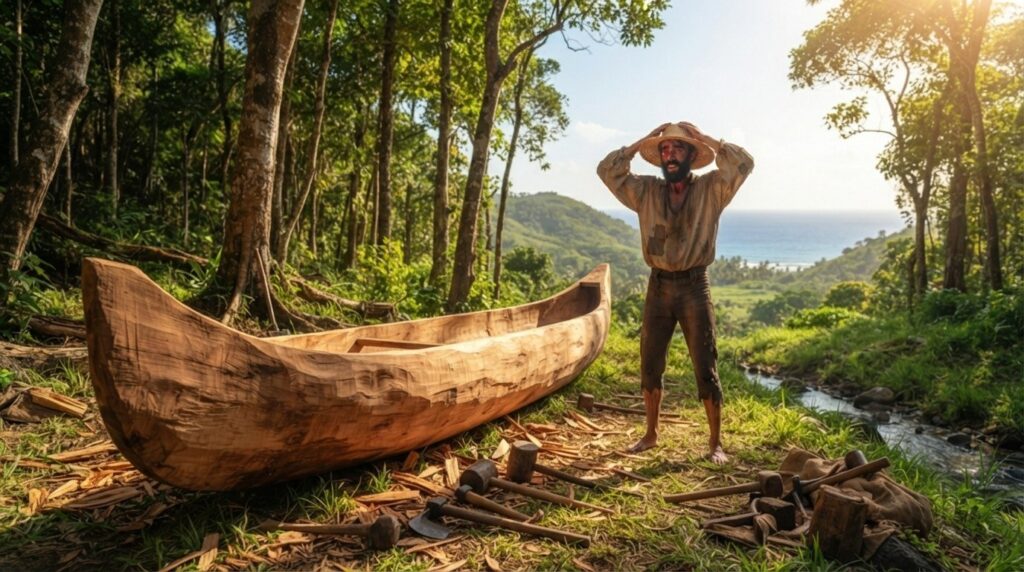
Then the anger came. I kicked the canoe, which hurt my foot and did nothing to the canoe. I shouted at the sky, at the sea and at myself. Then, because I was tired, I sat down on the trunk and began to laugh. A grown man shouting at a tree is a very funny sight, and even Poll, who was sitting on my shoulder, was silent with surprise.
In the end I left the beautiful canoe where it was, and I never used it. But I learned an important lesson: before you begin a big task, you must think about the whole plan, from the beginning to the end. And I learned something else. The work had not been a complete waste. I had become a much better carpenter, and I was stronger than ever. A man who can build a canoe alone can learn to do many other things, too. When I came home that evening, Poll was waiting for me on his pole. “Robin Crusoe!” he said, and I laughed, and my disappointment went away.
Words from this chapter
- thin – adjective not thick or wide
- cedar – noun a tall tree with sweet-smelling wood
- hollowing – verb making a space inside something
- dozen – noun twelve
- levers – noun long sticks that help you to move heavy things
- canal – noun a long narrow channel of water made by people
- shape – verb to make something into a form
- carpenter – noun a person who makes things from wood
- beat – verb to hit again and again; (a heart) to move
- spanish – adjective from Spain
- tent – noun a home made of cloth
- supper – noun an evening meal
- canoe – noun a long, narrow boat moved with paddles
- searched – verb looked carefully for something
- forest – noun a large area with many trees
- thick – adjective wide; with things close together
- axe – noun a tool for cutting wood
- remove – verb to take away
- branches – noun arms of a tree
- smooth – adjective flat, with no rough parts
- genius – noun a very clever person
- pride – noun the feeling of being proud
- mast – noun the tall pole on a ship that holds the sails
- journal – noun a book where you write about your days
- goats – noun farm animals with horns
- kicked – verb hit with the foot
- sight – noun something you see
- task – noun a piece of work
- waste – noun a bad use of something
- disappointment – noun the sad feeling when something is not as good as you hoped
Check your understanding
Where did Robinson think the land was?
What was Robinson's big mistake?
What lesson did Robinson learn?
Reading is great. Speaking is better.
Talk about the story with a real teacher. Your first 25-minute lesson is free.
Book a free trial lessonFind your English level