After my terrible journey in the boat, I decided to stay close to home. I left my small canoe in a quiet bay, and I never sailed far again. But I was not sad. I had plenty to do, and every year I became a better farmer.
My biggest worry was food. My powder was getting less and less every year, and I could not shoot goats for ever. “What will I do when it is all gone?” I asked myself. The answer was clear: I had to keep goats of my own.
I counted my powder. There was enough for perhaps twenty shots, no more. I looked at my guns and put them down gently, like old friends. “Soon you will be quiet for ever,” I said to them. It was a sad thought. For many years the guns had given me meat, safety and courage, and I knew that one day I must learn to live without them.
First I tried to catch some wild ones. I dug holes in the ground and covered them with branches and leaves. After a while I found a goat in one of the holes, and, in another, two kids. They were frightened and refused to eat, so I tied them with a rope and carried them home. Slowly, they began to trust me, and soon they followed me everywhere like little dogs. After some months, I had a small group of goats.
I took one of the small young goats in my arms. It was warm, and its heart was beating fast. I gave it a little milk from a cup, and slowly it stopped shaking. After a while it licked my fingers with its rough little tongue. I laughed. It was the first friend I had made on the island, after Poll and the dog. When I carried it home, it looked at me with big yellow eyes, and I thought, “Perhaps we will be a family.”
Then I built a large fence around a green field, so that the animals would be safe and have plenty of grass. It was hard work, but it gave me a lot of pleasure. When I had ten goats, I started to take their milk. It was warm and sweet. I learned to make butter and cheese. After a few years I had more than forty goats, and I could eat meat and drink milk every single day. I was a farmer, a baker and a cheese maker, all at the same time!
The first time I made butter, I shook the milk in a bag for an hour, and my arms were tired. Then I saw small yellow pieces in the bag, and I shouted for joy. I also made cheese and pressed it between two flat stones. That evening I had a feast: fresh bread, butter, cheese, raisins and roast goat. I sat at my table and thought, “The best kings in Europe do not eat better than I do.”
My clothes were now in a terrible state. I was still wearing the old clothes from the ship, and they were so torn that they hardly covered me. So I made new clothes from goat skins. I made a hat, a coat and trousers, with the fur on the outside. They were ugly, and my friends in England would have laughed at me, but they were warm and useful. My hat was big and ugly, but in the rainy season the water ran down it, and I stayed dry.
I did not know how to sew, and my first coat was a disaster. It was like a big bag with two holes for my arms. My trousers were too short, and my hat looked like a small black animal. When I put on my new clothes for the first time, the dog did not know me. He barked at me and ran away, and I laughed so much that I fell on the grass. After a few days he understood, and he came back and licked my hand.
Finally, I decided to make an umbrella. In Brazil I had seen many people use them against the sun, so I remembered how they were made. It took me many attempts, but at last I made a good one. I covered it with skins, and I could open and close it. In the hot sun, I held it over my head, and in the rain, it kept me dry. “A king must have an umbrella,” I said, laughing.
My first umbrella was not good. The wind took it away, and it fell to pieces on the ground. The second one had a good shape, but when the rain came, it would not close. I tried again and again. At last I had an umbrella that worked. I walked around in the rain feeling proud and dry and a little silly. Poll sat on my shoulder, under the umbrella, and said, “Poor Robin Crusoe,” in a very sad voice.
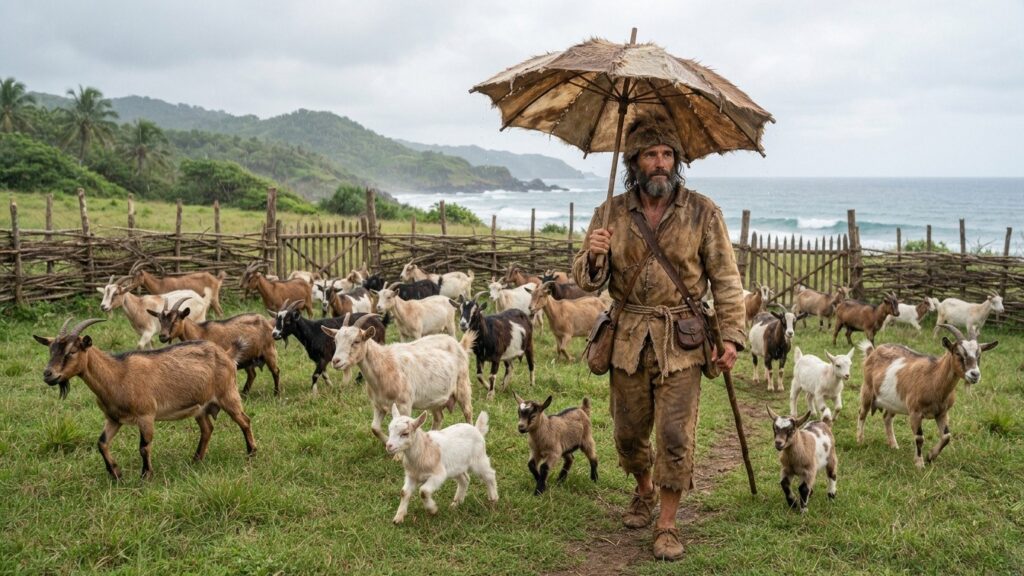
In the evening I sat outside with my goats around me and watched the sun go down over the sea. I was not unhappy. I was Robinson Crusoe, king of this island.
Words from this chapter
- worry – noun a problem that makes you afraid
- kids – noun young goats
- trust – verb to believe that someone is good and honest
- pleasure – noun the feeling of being happy
- butter – noun a soft yellow food made from milk
- torn – adjective with holes or cuts
- attempts – noun tries
- sun go down – phrase disappear below the sea in the evening
- journey – noun a long trip
- canoe – noun a long, narrow boat moved with paddles
- plenty – pronoun a lot; more than enough
- powder – noun gunpowder, which makes a gun fire
- shoot – verb to fire a gun
- goats – noun farm animals with horns
- counted – verb said numbers in order
- gently – adverb in a kind, soft way
- safety – noun being safe
- courage – noun being brave
- covered – verb put something over another thing
- refused – verb said no
- beating – verb (a heart) moving fast
- shaking – verb moving quickly from side to side
- rough – adjective not smooth; (sea) with big waves
- fence – noun a wall made of wood or sticks
- single – adjective only one
- roast – verb to cook in an oven or over a fire
- skins – noun the outsides of animals, used to make clothes
- fur – noun the soft, thick hair of an animal
- finally – adverb at last, after a long time
- umbrella – noun a thing you hold over your head against rain or sun
Check your understanding
What was Robinson's biggest worry?
How did Robinson catch the goats?
What did Robinson do with the umbrella?
Reading is great. Speaking is better.
Talk about the story with a real teacher. Your first 25-minute lesson is free.
Book a free trial lessonFind your English level