That night I led the captain and the two other men to my home. They were exhausted and hungry, and they stared in astonishment at my fence and my cave. I gave them bread, cheese and a cup of rum. “You are safe here,” I told them. “Now we must think about the ship.”
The captain looked at everything: the ladder, the high fence, the dense green forest and my cool cave. “I cannot believe it,” he said. “One man built all this, alone.” I laughed and showed him my pots, my goats and my fields. He touched the bread with his fingers and said, “This is a real home.” That night the three men slept on dry grass in my cave, and I listened to them breathing. I listened for a long time, and I was very happy.
I explained my plan to the captain. There were eleven mutineers. Three guarded the boat, while the others roamed through the woods. “If we are careful, we can take them one by one,” I said. “We have guns, and they do not know we are here.” The captain was delighted. “You are a remarkable man,” he said. “I shall do whatever you say.”
That night I could not sleep. I checked my guns again and again, and Friday cleaned his and put it by the door. I remembered the many nights when I had lain awake in fear, alone. Tonight I was not alone. I had a friend and three more men, and I had a plan. I looked at the stars through the hole in the roof and thought, “Tomorrow everything will change.” It was a good feeling, and it was also a little frightening.
The next morning we waited near the boat. The boatswain and some of the men returned from the woods to look for the prisoners, and found nothing. The prisoners were not under the tree! The men looked at one another in fear. The captain stepped out from the trees, gun in hand. “Lay down your weapons,” he commanded. Some of the men ran away, but the others obeyed. We took their guns and bound their hands.
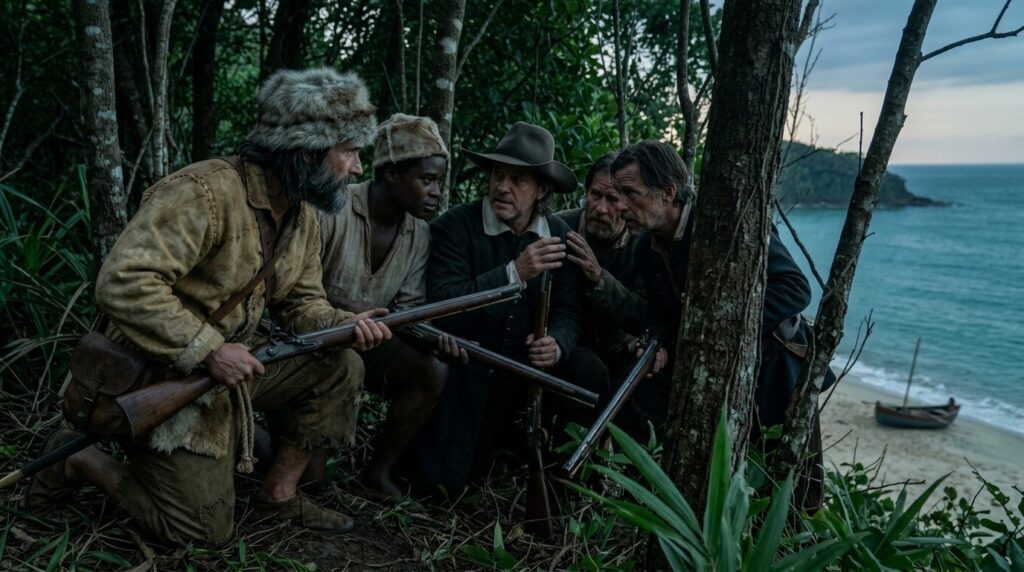
I turned to Friday. “We must be clever,” I said. He shouted loudly in the woods, in a variety of voices, so that the men who were hiding believed that a whole army was against them. I laughed until my sides hurt. In the end all of them were our prisoners, and the captain’s loyal sailors came forward and promised to serve him again.
Now we needed the ship. She was waiting in the bay, with about ten men on board. At dusk we took the small boat and rowed out. We called in the voices of the mutineers: “Come, come, we have the prisoners!” The men on the ship, who suspected nothing, came down one by one, and the captain’s sailors seized them as they arrived. The fight was short, and when the sun rose, the ship was ours once again.
At sunrise the captain stood on the deck of his ship and put his hand on the wheel. Then he bent down and kissed the wood. His sailors cheered, and some of them wiped their eyes. I walked slowly along the deck, like a ghost. The ship was enormous. I touched the ropes, the sails and the wooden walls, and I smelled the tar and the salt. After twenty-eight years I was on a real ship again, and I could not believe it.
The captain shook my hand. With tears in his eyes, he said, “Sir, you have given me back my ship, and my life.” He ordered his men to give me some clothes, and for the first time in twenty-eight years I took off my goat skins. I felt strange, like a boy in his first suit.
Before we left the island, I took a long walk alone. I touched my fence and my post with its notches. I stood in the middle of my field and looked at my goats. I said goodbye to the little stream, the cave and the valley with the grapes. I thought about the man who had come here, wet and afraid, with a knife and a pipe. That man had been young, and this man was old. But I was not sorry. I loved the place that had been my prison, my school and my home.
On board, the captain handed me a mirror, and I looked at myself for the first time in twenty-eight years. I did not know the man in it. His beard was grey, his skin was dark, and his eyes were full of lines. The ship's barber cut my hair and my beard and made me look like an Englishman again. When he had finished, I looked younger, but I still did not feel like the Robinson who had left York.
The captain wished to punish the mutineers, but I asked him to be merciful. “Let them stay here,” I suggested. “They can learn to farm the island, as I did.” Five of them chose to remain. I gave them my tools and my seeds, and I told them everything I knew about survival. Then I said farewell to my small kingdom. I took my goat-skin hat, my umbrella and my parrot, Poll, and on the last day, we went on board, and the ship sailed away from the island that had been my home.
Words from this chapter
- exhausted – adjective very tired
- roamed – verb walked without a fixed direction
- remarkable – adjective unusual and deserving attention
- commanded – verb gave an order
- army – noun a large group of soldiers
- dusk – noun the time when the day ends and it begins to be dark
- merciful – adjective kind and not wanting to punish
- farewell – noun goodbye
- stared – verb looked for a long time
- astonishment – noun great surprise
- fence – noun a wall made of wood or sticks
- cave – noun a big hole in a rock or a hill
- ladder – noun steps you can move, for climbing
- dense – adjective thick; with things close together
- goats – noun farm animals with horns
- mutineers – noun sailors who take a ship from its captain
- guarded – verb watched to keep safe
- delighted – adjective very pleased
- boatswain – noun an officer on a ship who looks after the crew and equipment
- prisoners – noun people who are not free
- weapons – noun things used to fight, like guns and swords
- obeyed – verb did what someone told you to do
- suspected – verb thought that something was probably true
- seized – verb took hold of quickly and firmly
- rose – verb went up (past of rise)
- deck – noun the floor on top of a ship
- wiped – verb cleaned with a cloth
- enormous – adjective extremely big
- notches – noun small cuts in wood
- umbrella – noun a thing you hold over your head against rain or sun
Check your understanding
What was Robinson's plan for the mutineers?
How did Friday help?
What did Robinson ask the captain to do?
Reading is great. Speaking is better.
Talk about the story with a real teacher. Your first 25-minute lesson is free.
Book a free trial lessonFind your English level