The ship left Hull and sailed south along the coast. At first the weather was good, and I was happy. I stood on the deck and looked at the sea. “This is the life for me,” I thought. “Why did my father not understand?”
The captain was the father of my friend, and he was a kind man. He showed me the ropes and the big wooden wheel of the ship. The sailors were friendly, and they laughed when I asked a lot of questions. In the evening the sun went down into the sea, red and gold, and the land became a thin grey line behind us. I stood on the deck for a long time. “This is the real world,” I thought. “And I am part of it.” I was very happy, and I did not know what was waiting for me.
But on the second day the wind began to blow hard, and the sea became very rough. The waves were as high as houses, and the ship went up and down, up and down. I was very sick, and I was very afraid. I had never seen the sea like this. The sailors ran here and there and shouted to each other. Nobody had time to help me. I thought about my mother and my warm bed at home. Was it too late to go back? I did not know.
Night came early, and the noise was terrible. The wind cried in the ropes like a hundred voices. Boxes broke open and slid across the floor. Every time the ship fell from the top of a wave, my stomach stayed in the air. An old sailor passed me, and his face was white. “I have worked at sea for twenty years,” he said, “and I have never seen a storm like this.” His words made me more afraid than the wind.
“This is the end,” I thought. “God is angry with me because I did not listen to my father.” I went down into the ship and held on to a post. I said a prayer. “Please save me,” I said. “If I live, I will go home. I will listen to my father, and I will never go to sea again.”
The storm lasted all night. Water came into the ship, and the sailors worked hard to take it out. In the morning it was worse. “We are sinking!” the captain shouted. “We need help!” He fired a gun, and another ship saw us. Its sailors put a small boat into the water and came for us. It was very dangerous, but they were brave men. We climbed down into the small boat one by one, and the sailors rowed us away. I looked back and I saw our ship go down under the water. It was gone.
The small boat jumped on the waves like a toy. The sailors pulled the oars with all their strength, and nobody spoke. Water came over the sides, and I helped to throw it out with my hat. When I looked up at last, I could see the land. It was a dark line, and on it I saw small figures. They were running along the beach with ropes and shouting to us.
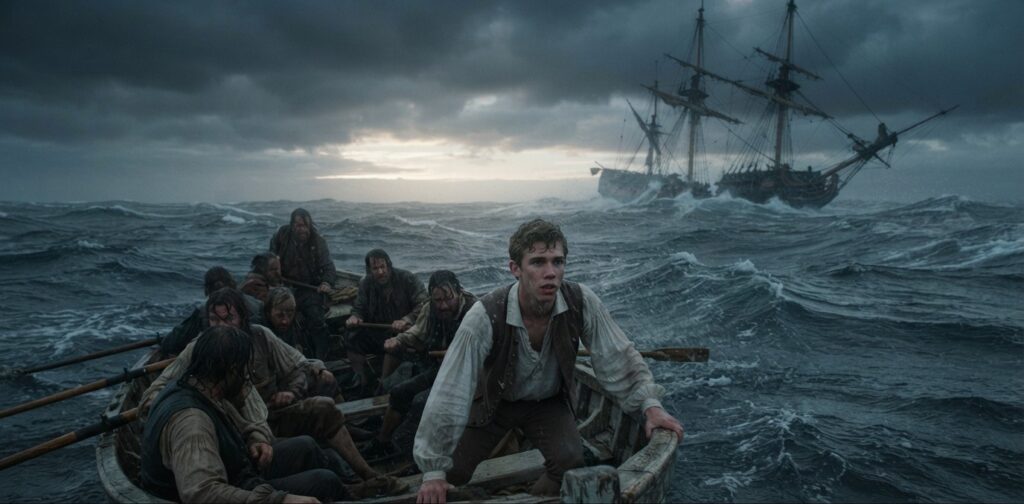
At last we reached the land. We were wet, cold, tired and hungry. The people in the town were kind to us. They gave us food and a warm bed, and I slept for many hours. In my dreams, I was at home again.
In the night I woke up, and I could not sleep again. I walked down to the beach alone. The storm was gone, but the sea was still loud in the dark. In the wet sand there were pieces of wood and a broken box, the last things from our ship. I picked up one piece and held it. It was heavy and cold. Then, for a second, I felt something like a hand on my shoulder, and a quiet voice inside me said, “Go home.” But when the sun came up, the voice became quiet.
The next day the storm was over, and the sun was shining. Suddenly the sea did not look so terrible. It was blue and quiet, like a big sleeping animal. Some of the sailors laughed about the storm. “Well, Robinson,” my friend said, “were you afraid?” I felt ashamed. I did not want my friends to think I was a coward. I laughed with them. And my promise to go home? I forgot it.
That afternoon I walked to the harbour alone. At the edge of the water there was a broken board with some letters of our ship's name on it. I looked at it for a long time. For a moment I did not want to laugh. Then my friends called me, and I went back to them.
Only the captain looked at me seriously. He was an old man, and his eyes were kind. “Young man,” he said, “you must go home. The sea is not for you. This storm was a sign. Go back to your father.”
I did not answer. I did not go home. I walked to London instead.
Words from this chapter
- rough – adjective with big waves and strong wind
- sailors – noun people who work on a ship
- prayer – noun words that you say to God
- sinking – verb going down under the water
- brave – adjective not afraid of danger
- ashamed – adjective feeling bad because you did something wrong
- coward – noun a person who is afraid too easily
- sign – noun something that tells you what will happen
- sailed – verb travelled on a ship
- south – noun the direction opposite north
- coast – noun the land next to the sea
- deck – noun the floor on top of a ship
- captain – noun the person in charge of a ship
- ropes – noun thick, strong strings
- wooden – adjective made of wood
- wheel – noun a round thing that turns; the ship's wheel steers it
- laughed – verb made a happy sound
- land – noun the ground; not the sea
- became – verb past of become
- thin – adjective not thick; not fat
- grey – adjective the colour between black and white
- behind – preposition at the back of
- wind – noun air that moves
- began – verb past of begin
- blow – verb (wind) to move the air
- shouted – verb spoke very loudly
- noise – noun a sound, often loud
- terrible – adjective very bad
- cried – verb had tears in the eyes; or shouted
- voices – noun the sounds people make when they speak
- slid – verb moved smoothly over a surface
- across – preposition from one side to the other
- fell – verb past of fall
- wave – noun a line of water that moves on the sea
- stomach – noun the part of the body where food goes
- stayed – verb did not leave
- storm – noun very bad weather with wind and rain
- held – verb past of hold
Check your understanding
What promise did Robinson make during the storm?
How did the sailors leave the sinking ship?
What did Robinson do the next day?
Reading is great. Speaking is better.
Talk about the story with a real teacher. Your first 25-minute lesson is free.
Book a free trial lessonFind your English level