The ship left Hull on a bright September morning, and for the first day I thought myself the happiest young man in England. The captain, my friend's father, was a patient man, and he allowed me to stand beside him at the wheel while he explained the compass and the signs of the sky. The sailors laughed kindly at my endless questions. In the evening the sun sank into the sea in a blaze of red and gold, and the coast of England dwindled to a thin grey line astern. I stood at the rail for a long time, certain that everything I had ever dreamed was coming true, and without a single thought for the two people I had left behind.
We had hardly lost sight of land when the wind began to rise, and by the following afternoon the sea had turned into something I had never imagined. The waves climbed higher than the ship’s masts, crashed over the deck and flung the vessel from side to side as though it weighed nothing. I, who had dreamed for years of the freedom of the open water, was violently seasick and so terrified that I could hardly stand. The sailors, who had seen such weather many times, went about their work with grim, silent faces, and that frightened me even more than the storm itself.
In those hours my conscience woke up with a vengeance. I thought of my father’s calm advice, of my mother’s tears, and of the cowardly way I had slipped out of their lives without a word. It seemed obvious to me that I was being punished. Clinging to a post below deck, I swore a solemn oath: if I survived, I would go straight home, fall at my father’s feet and never set foot on a ship again.
Night fell early, and the din grew worse. The wind shrieked through the rigging like a hundred voices, cargo broke loose below deck and went sliding across the boards, and every time the ship dropped from the crest of a wave I felt as if my stomach had been left behind in the air. An old sailor stumbled past me with a face the colour of chalk. “Twenty years I have been at sea,” he muttered, “and I have never seen anything like this.” His words frightened me more than the storm had done.
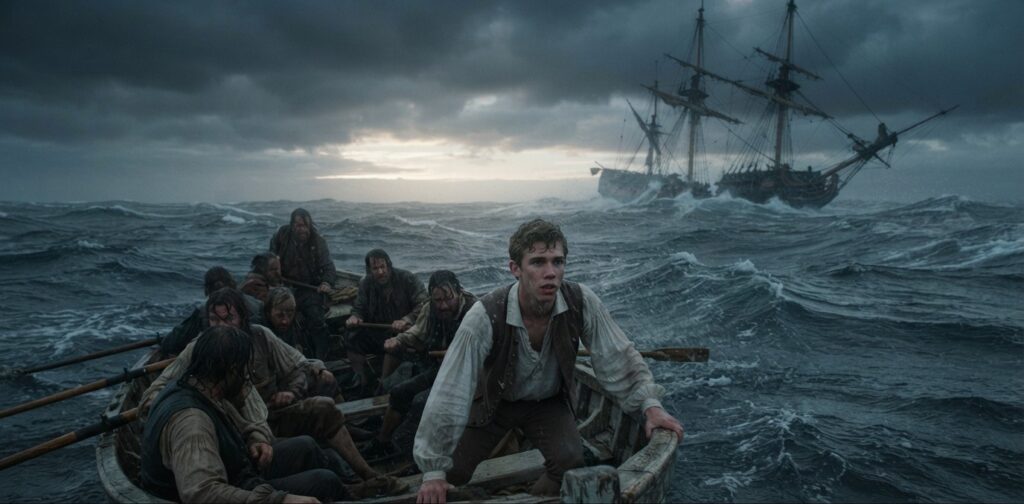
The storm raged through the night. By dawn the ship had sprung a leak, and the water rose in the hold faster than the exhausted crew could pump it out. Eventually the captain admitted that we were lost and began to fire distress signals. Another vessel, bravely holding her course through the weather, lowered a boat to us. Rowing a small boat through such seas was an act of extraordinary courage, and I have never forgotten the men who did it for strangers. We scrambled down into it one by one, and had barely pulled away when I saw our ship sink beneath the waves with a sound I can still hear.
The little boat leapt and plunged like a cork. The men rowed with every ounce of their strength, and nobody spoke a word. Water poured over the sides, and I helped to bail it out with my hat. When I finally dared to look up, I saw the shore ahead, a dark line with small figures upon it, running along the sand with ropes and shouting to us over the wind.
We struggled ashore, soaked and shaking, and the people of the nearby town treated us with great kindness. By the following morning the sky was a clear and innocent blue, and the sea lay flat and glittering, as if it had never done anything wrong. The sailors made jokes about the night before. My friend slapped my shoulder and asked whether I had enjoyed my first storm. And, this is the part I am least proud of, I laughed along with them. The terror, the prayers and the solemn promise melted away in the sunshine, and a stubborn sense of shame took their place. I could not bear the thought of crawling home to be mocked as a coward.
I remember walking down to the harbour alone that afternoon. At the edge of the water lay a broken plank with a few letters of our ship's name still painted on it, and I stood looking at it for a long time. It was all that remained of a vessel that had carried twenty men, and for a moment the laughter of the morning sounded hollow even to me. Then I heard the others calling, and I turned and went back to them.
Only my friend’s father, the captain, refused to treat the matter lightly. “Young man,” he said gravely, “if you have any sense, you will never go to sea again. What you have seen is a clear sign from heaven that this is not your path.” I gave him no answer. I knew he was right, and I knew that I would not follow his advice. Pride, I have since come to understand, is a stronger force than fear, and it carried me to London that same week.
Words from this chapter
- masts – noun the tall poles that hold the sails of a ship
- conscience – noun the inner voice that tells you what is right and wrong
- solemn – adjective very serious
- leak – noun a hole through which water comes in
- distress signals – noun calls for help from a ship in danger
- scrambled – verb climbed quickly and not very carefully
- stubborn – adjective not willing to change your mind
- mocked – verb laughed at in an unkind way
- hull – noun the main body of a ship
- compass – noun a tool with a needle that shows north
- endless – adjective never ending
- dwindled – verb became smaller and smaller
- astern – adverb at or towards the back of a ship
- crashed – verb hit something hard and noisily
- flung – verb threw with force
- vessel – noun a ship or large boat
- freedom – noun being free
- violently – adverb with great force
- seasick – adjective ill because of the movement of a ship
- terrified – adjective extremely afraid
- grim – adjective serious and unpleasant
- vengeance – noun punishment you give to someone who hurt you
- cowardly – adjective not brave
- obvious – adjective easy to see or understand
- swore – verb promised seriously
- oath – noun a serious promise
- survived – verb stayed alive after danger
- shrieked – verb gave a loud, high cry
- rigging – noun the ropes that hold a ship's sails
- cargo – noun the things that a ship carries
Check your understanding
What made Robinson's conscience wake up?
How did the sailors from the other ship behave?
What does Robinson learn about pride?
Reading is great. Speaking is better.
Talk about the story with a real teacher. Your first 25-minute lesson is free.
Book a free trial lessonFind your English level