We left Brazil on the first of September 1659, eight years to the day since I had run away from my father’s house, in a ship that carried fourteen men and a cargo for the African trade. For twelve days the weather was fair, and I should have been relieved; instead, a quiet uneasiness stayed with me, as though I could already hear the sea thinking about us. On the thirteenth day my fears proved right. A violent tempest rose out of the south, and for several days the wind drove us helplessly across the ocean. The captain no longer knew our position, and food and hope were both running short.
Before we sailed, I made my arrangements carefully. I asked a trustworthy partner to look after my plantation while I was away, and I wrote to my old friend, the Portuguese captain in Lisbon, telling him what to do if I did not return. On our last evening I walked around my fields in the red light of the setting sun. The tobacco stood tall and green, and the house looked small and warm among the trees. I felt no fear. “It is only a short voyage,” I told myself. “In a few months I shall be back.” It was the last time I would see my farm for twenty-eight years, but of course I did not know that.
Early one morning a sailor cried “Land!” and, before any of us could react, the ship struck a sandbank and stuck fast. The waves, now unobstructed, began to break over her stern, and it was obvious that she would not hold together for long. We lowered the small boat, eleven of us tumbled in, and we rowed desperately towards a coast that none of us could see clearly. The sea had no pity on us. A mountain of water rose behind the boat, and in one instant it was upside down.
On the fifth night of the storm the ship began to leak. Water seeped up through the boards, and the sailors worked the pumps without rest, their hands raw and their faces grey. I tried to help, but I was weak and often ill, and in the end I lay in the dark, listening to the timbers cry out like a living thing. “Why am I here again?” I asked myself. “I made a promise in my first storm, and I did not keep it. This is what I deserve.” I did not sleep. I only waited.
I have always been a strong swimmer, but nothing prepared me for the force of that wave. It dragged me under, rolled me over and over, and held me beneath the surface until my lungs burned. Then, just as I was losing hope, it hurled me towards the land. I scrambled to my feet and ran. Another wave overtook me; this time I clung to a rock and refused to let go until the water drained away, and then I ran again, up the beach, until I was safe from the sea.
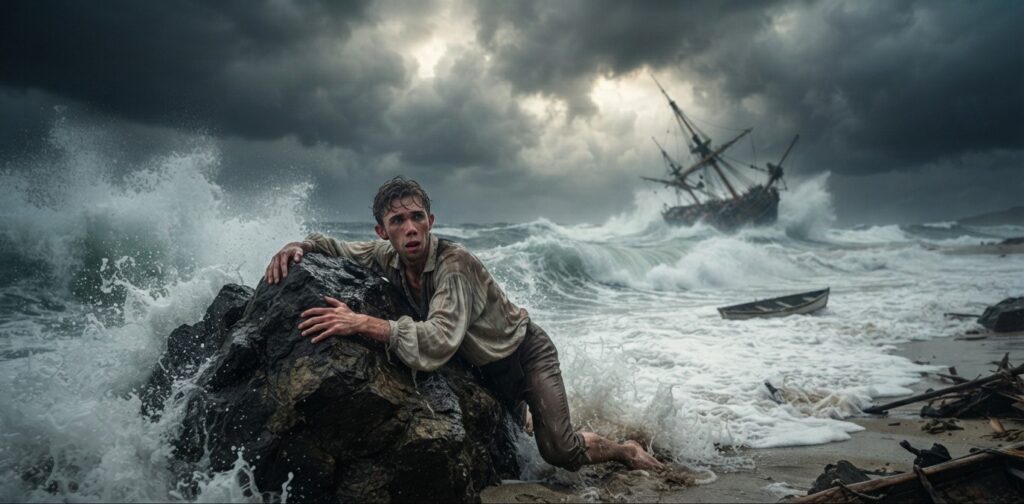
I fell to my knees, thanking heaven for my life. Then I searched the shore for my companions. There was no one. The sea had taken them all, and it had left only a hat, a cap and two odd shoes as evidence that they had ever existed. I stood there, soaked, exhausted and starving, with nothing but a knife, a pipe and a little tobacco in my pocket. No food, no water, no change of clothes, and no idea where I was. The silence after the storm was almost worse than the noise. I sat on the sand for a long time, staring at the sea that had killed my friends and spared me, and I felt a strange mixture of joy and guilt that I could not name.
I ran up and down the beach like a madman, shouting, waving my arms and jumping, laughing and weeping at the same moment. Again and again I thanked God for my life. “I am alive!” I cried to the empty sky. A bird rose from the rocks, the sea went on with its noise, and nobody heard me. At last I sat down on the sand, my legs shaking so badly that I could not stand.
As night fell, the fear of wild animals drove me into the branches of a thick tree. I wedged myself between two branches and, to my own surprise, slept deeply. I did not yet know that I was on an island, or that I would not leave it for twenty-eight years.
I walked along the beach until the light began to fade, calling the names of my friends one after another. “Tom! Will! Captain!” Only the wind and the waves answered me. I was thirsty, and my mouth was as dry as paper. I had no water and no food, and I did not know whether this land held any. I chewed a little of my tobacco, because I had heard that it helps a hungry man; it was bitter, and it did not help much. Then the darkness came down over the beach, and I understood how large the night is when you are alone in it.
Words from this chapter
- uneasiness – noun a feeling of worry
- tempest – noun a violent storm
- stern – noun the back part of a ship
- tumbled – verb fell in an uncontrolled way
- hurled – verb threw with great force
- clung – verb held on very tightly
- drained – verb flowed away
- evidence – noun something that shows that something happened
- wedged – verb pushed into a small space so that it cannot move
- starving – verb suffering because you have no food
- cargo – noun the things that a ship carries
- trade – noun buying and selling
- relieved – adjective happy that a worry has gone
- violent – adjective using force to hurt; very strong
- helplessly – adverb without being able to do anything
- ocean – noun a very large sea
- arrangements – noun plans for how something will happen
- trustworthy – adjective can be trusted
- plantation – noun a large farm for crops like sugar or tobacco
- sandbank – noun a hill of sand under the sea
- desperately – adverb in a desperate way
- instant – noun a very short moment
- timbers – noun large pieces of wood in a ship
- dragged – verb pulled along the ground with difficulty
- lungs – noun the parts of the body you breathe with
- scrambled – verb climbed or moved quickly and awkwardly
- overtook – verb went past someone going the same way
- odd – adjective strange
- soaked – adjective completely wet
- exhausted – adjective extremely tired
- mixture – noun different things mixed together
- weeping – verb crying
Check your understanding
What happened to the ship?
How did Robinson survive the big wave?
What did Robinson have when he reached the shore?
Reading is great. Speaking is better.
Talk about the story with a real teacher. Your first 25-minute lesson is free.
Book a free trial lessonFind your English level