One evening I sat in front of my tent and I thought about time. I did not know what day it was. I did not know the month. In England, we have clocks and calendars, but on this island I had nothing. If I did not count the days, they would all become the same. Soon I would not know the day or the month. Perhaps I would forget who I was.
“I must make a calendar,” I said. I found a big piece of wood and I cut it into a tall post. I put it into the ground near the beach, where I first came to the island. Then I cut some letters into the wood with my knife. “I came to this place on the 30th of September, 1659,” I wrote. Every day I cut one line into the post. Every seventh day I cut a longer line, and that was Sunday. On the first day of every month, I made the line even longer. In this way, I always knew the date.
Every morning, the first thing I did was to walk to the post. I cut one new line and I said the date aloud: “It is Tuesday, the second of October.” My voice was the only voice on the island, and at first it sounded strange to me. But I liked this small ceremony. It was like a good morning from a friend. The post stood on the beach, grey and tall, and when ships passed, I thought, they would see it from far away.
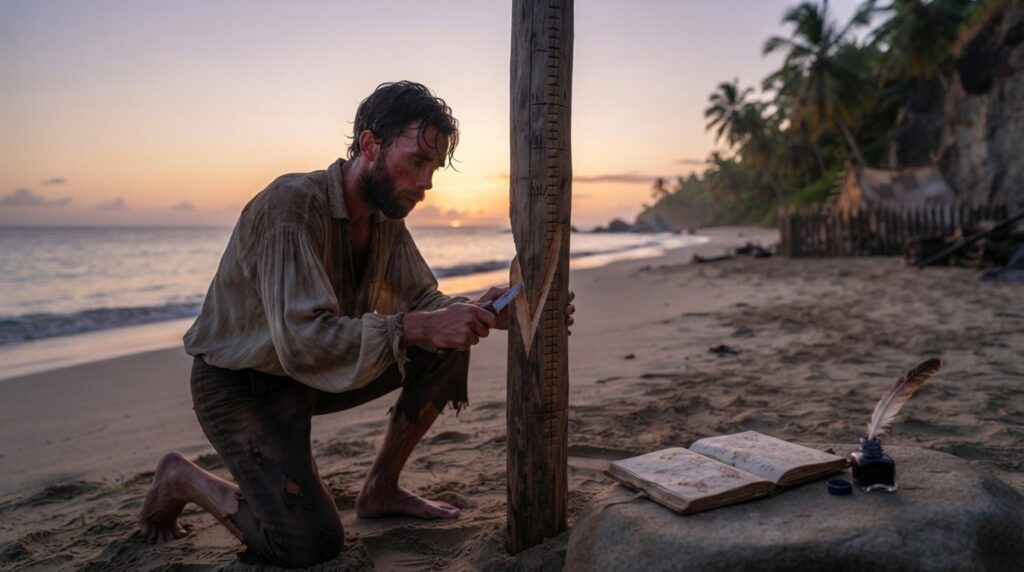
Then I looked in the boxes that I got from the ship, and I found something wonderful. There were some pens, some ink and a few books, with some paper for writing. “Now I can keep a journal,” I said. Every night I wrote about my day. I wrote about the weather, my work and my thoughts. When I wrote, I did not feel so alone. I felt that I was talking to a friend.
Some days I wrote only a few words. “1 October. Rain. I carried the last box.” “8 October. I saw a goat on the hill, but it ran away.” “15 October. I made a shelf. It is not straight, but it works.” On other days I wrote for an hour. I wrote about my father, my mother, the sea and the strange sounds of the night. The pages became a small book of my new life, and each page said: “Robinson was here.”
In the first weeks I was very sad. I cried a lot. One night I did not sleep at all, and I thought about my terrible luck. Then I took my pen, and I made a list. On one side of the paper I wrote the bad things. On the other side I wrote the good things.
Sometimes I talked to the dog in the evening. “What do you think?” I asked him. “Will a ship come tomorrow?” He put his head on one side and said nothing, but he listened, and that was enough. One night I tried to sing an old English song. My voice was rough, and the words were half lost, and after two lines I stopped. The silence after the song was bigger than before. I cried a little, and then I laughed at myself.
Bad: I am on a lonely island. I have no friends here. I have few clothes. I cannot talk to anybody.
Good: But I am alive. All my friends died in the sea, and I did not. I have food and water. I have guns and tools. There are no wild animals here that can eat me.
I looked at the list for a long time. Then I felt a little better. “There is always something good,” I said, “if you look for it.” After that night, I did not cry so often. I started each day with the same words: “I am alive, and I have work to do.” It was a simple sentence, but it was strong.
I made a plan for every day. I woke with the first light and washed in the stream. I worked until noon, and then I rested in the shade, because the sun was too hot. In the afternoon I worked again, and in the evening I wrote in my journal. A man who works has no time to be too sad. When I was tired at the end of the day, my thoughts were quiet, and I slept well.
The rains came in the autumn, and I had to stay in my cave for many days. But I was not bored. I had my calendar, my journal, my dog and my two cats.
In those rainy days I thought a lot about England. I imagined my mother in the kitchen, and my father at his desk with his letters. Sometimes I spoke to them in my head. “Father, you were right about the middle life,” I said. “I was a fool.” I was not angry with myself any more. I was sad, and I was a little grateful, too. Perhaps I needed to lose everything before I could understand it.
Words from this chapter
- calendar – noun a list of the days, weeks and months of the year
- post – noun a tall piece of wood standing in the ground
- journal – noun a book where you write about your days
- ink – noun the coloured liquid that you use to write
- lonely – adjective sad because you are alone
- list – noun a number of things written one under the other
- luck – noun good or bad things that happen to you by chance
- bored – adjective tired because you have nothing interesting to do
- front – noun the part that faces forward
- tent – noun a home made of cloth
- island – noun land with sea all around it
- nothing – pronoun not anything
- count – verb to say numbers in order
- perhaps – adverb maybe
- forget – verb to not remember
- wood – noun the material from trees
- cut – verb to make into pieces with a knife; past of cut
- tall – adjective high
- ground – noun the earth under your feet
- beach – noun the land with sand next to the sea
- knife – noun a tool for cutting
- wrote – verb past of write
- voice – noun the sound you make when you speak
- sounded – verb made a sound
- wonderful – adjective very good
- thoughts – noun ideas in your mind
- goat – noun a farm animal with horns
- rough – adjective not smooth; (sea) with big waves
- lost – verb could not find; not able to find the way
- silence – noun no sound at all
- simple – adjective easy; not complicated
- noon – noun twelve o'clock in the day
- rainy – adjective with a lot of rain
- imagined – verb made a picture in your mind
- desk – noun a table for writing
- fool – noun a stupid person
- grateful – adjective wanting to say thank you
- lose – verb to not have something any more
Check your understanding
Why did Robinson make a calendar?
What did he put on one side of his list?
How did the list help Robinson?
Reading is great. Speaking is better.
Talk about the story with a real teacher. Your first 25-minute lesson is free.
Book a free trial lessonFind your English level