After some months I recovered from my disappointment over the great canoe, and I made a new plan. This time I built a smaller boat, and I built it within reach of the water. I thought carefully about every stage of the work, from the felling of the tree to the day it would float, and the labour took about two years. When at last I pushed the canoe into the sea and watched it ride lightly on the waves, I felt a pleasure so sharp that it almost hurt. I made a mast and a small sail from the old sails of the ship. It was not much of a vessel, but it was mine.
The little canoe floated at once. I sat in it in the quiet bay and moved my oar slowly through the clear water, where I could see small fish passing beneath me. I laughed like a child. On the beach Poll watched me from a tree and shouted, “Robin Crusoe!” I made a few short trips around the bay, and each day I felt more confident. A man who is proud of his boat sometimes forgets to be afraid of the sea.
I wanted to see the whole of my island, and I was tired of walking. “I shall sail round it,” I announced to the dog. It was a sensible idea, but I knew that the coast held at least one danger. On the east side a ridge of rocks ran far out into the sea, and I had often looked at it with unease. Curiosity, however, was stronger than caution.
Before I left, I told the dog to stay at home. He looked at me with sad eyes and lay down on the sand with his head between his paws. I packed my bag again and again, and I checked the sail, the oar and the rope. Then I looked at the sky. It was blue, with a few white clouds. “A good day for a short trip,” I said. I felt no fear, and that was my mistake.
One morning I stored some bread, a jar of water and my gun in the boat and pushed off. The sea was calm and the sun was warm, and for a few hours I felt like a free man. I followed the coast and watched the hills and beaches slide by, and when I reached the east end, I saw the line of rocks ahead of me, long and black, with the waves breaking over them in sheets of white foam.
As I approached the rocks, I noticed something strange. On one side the water was quiet and green; on the other it ran fast, like a river, and white spray leapt into the air like trees. The noise was tremendous. I did not understand what it meant. I was only a farmer in a little boat, and I knew far too little about how strong the sea could be.
“I shall steer well clear of them,” I said. But as I approached, my boat began to accelerate, as though a hand had seized it. A strong current had taken hold of me and was sweeping me out to sea. I pulled with all my strength on the oar, but the water was far stronger. Every minute the island grew smaller.
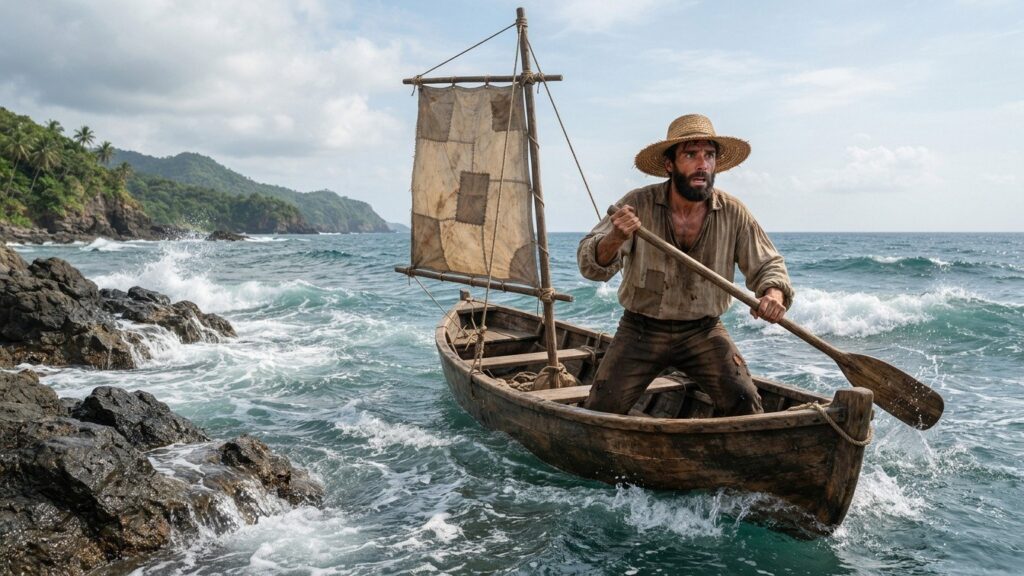
I was cold with fear. I stood up in the boat and shouted, but only the wind answered me. I looked back at the island. I could still see my hill, the green valley and the small white beach, but they looked like a painting, and every minute they grew smaller. I sat down again and pulled at the oar until my arms burned. But the sea was stronger than I was, and it did not even notice me.
“This is the end,” I thought. “I shall die at sea, and nobody will ever know.” I thought of my fence, my fields, my dog, my parrot and my cats. In my old life I had called this island a prison. Now it seemed to me the most desirable place on earth, and I could not reach it.
I made a promise to God and to myself. “If I can only return,” I said, “I shall never complain about this island again.” It was strange. For years I had called it my prison. Now I saw that it was also my home, and the thought of losing it was worse than the thought of staying in it for ever.
For hours I struggled. Then, when my arms had almost given up, the wind swung round to the north and began to push the boat back towards the shore. I clung to the sail and prayed. The current weakened, I recovered control of the steering, and at last I ran the boat onto a small beach and collapsed on the sand.
When the boat touched the sand, I fell out of it on to my knees and pressed my face to the ground. The sand was wet and cold, and it tasted of salt. I was shaking so badly that I could not stop. “Thank you,” I said again and again. “Thank you, thank you.” I looked up at the hills and the trees, and I loved every one of them, even the thorn bushes.
I slept where I fell. Later I walked to my country house and slept again. In the morning, a small, comical voice woke me: “Robin Crusoe! Robin Crusoe! Where have you been?” It was Poll. I laughed until the tears ran down my face. I was home, and I was alive, and I swore that I would never again sail beyond sight of my own beach.
Words from this chapter
- recovered – verb became well or normal again
- unease – noun a feeling of worry
- accelerate – verb to go faster
- desirable – adjective wanted by many people
- control – noun the power to make something do what you want
- collapsed – verb fell down because of tiredness
- sheets – noun large flat pieces of something
- caution – noun great care to avoid danger
- disappointment – noun the sad feeling when something is not as good as you hoped
- labour – noun hard physical work
- vessel – noun a ship or large boat
- beneath – preposition under
- confident – adjective sure about yourself
- announced – verb said something officially or loudly
- sensible – adjective reasonable and practical
- ridge – noun a long, narrow top of a hill
- curiosity – noun the wish to know about something
- stored – verb kept for later
- foam – noun white bubbles on top of waves
- approached – verb came nearer
- leapt – verb jumped high or far
- tremendous – adjective very great
- seized – verb took hold of quickly and firmly
- struggled – verb tried very hard with difficulty
- swung – verb moved in a curve
- clung – verb held on tightly
- weakened – verb became weaker
- comical – adjective funny
- swore – verb promised seriously
- beyond – preposition on the other side of; further than
Check your understanding
What did Robinson feel when the canoe first floated?
What happened near the line of rocks?
What did Robinson promise himself at the end?
Reading is great. Speaking is better.
Talk about the story with a real teacher. Your first 25-minute lesson is free.
Book a free trial lessonFind your English level